The Subdivided Boundary and the High Cost of Domestic Sanctuary
CHAPTER 1: THE TARIFF OF APPEARANCES
“The color is non-compliant, Mark. Section Four, paragraph three. No active earth tones below the beige spectrum.”
Brenda did not look up from her aluminum clipboard. Her pen, a cheap blue plastic stick with a chewed cap, made a sharp clicking sound against the metal rim. She stood exactly one inch outside the driveway’s concrete apron, her gray pantsuit catching the early, flat light of a suburban Tuesday. Behind her, the master-planned grid of Whispering Pines stretched out in identical rows of charcoal roofing and manicured sod, silent except for the low, distant whine of a commercial trimmer three streets over.
Mark didn’t move from the second step of his porch. He kept his palms flat against his thighs, feeling the rough texture of his khakis. His fingers were stiff from forty-eight hours of data entry, the skin dry from the office air conditioning. He didn’t answer immediately. In his line of work, an immediate response was an unforced error; it gave the system a baseline to measure your velocity.
“The pots are unpainted terra cotta,” Mark said. His voice was low, clipped, matching the chill remaining in the morning shade. “They were here when the bank cleared the title.”
“The bank doesn’t vote on the board,” Brenda replied. She finally raised her eyes, the thick lenses of her glasses catching the glare of the rising sun until her pupils were lost in twin discs of white light. She adjusted the oversized sunglasses perched on her auburn hair, her fingers rigid. “Three days to clear them or face twenty-five dollars a morning, backdated to the initial inspection on the first of the month. The community standard isn’t an elective, Mark. We all pay for the uniformity.”
She didn’t wait for his signature. She didn’t have to. She simply slapped an orange slip against the top of his black mailbox, the adhesive strip making a wet, tearing sound against the metal before she turned, her heels clicking a rhythmic, military cadence down the sidewalk toward the cul-de-sac.
Mark walked down the steps, his sneakers crunching on the stray gravel near the flowerbed. He didn’t look after her. Instead, he reached into the mailbox, his fingers brushing past three past-due medical statements from the final month of the separation before they wrapped around a heavy, white envelope. It bore no postage stamp.
On the front, written in the same blue ballpoint ink as the violation notice, was his name. Inside, a single sheet of standard copy paper contained a photocopied diagram of his backyard lot, the red pen lines tracing the exact radius of his inground pool. A small, hand-drawn asterisk sat right at the corner where his white vinyl privacy fence met the utility easement.
Below the diagram, a single sentence was typed in a generic sans-serif font: The structural variance must be corrected before the birthday assessment.
Mark folded the sheet twice, sliding it into his back pocket. The paper was cold against his skin. He looked toward the rear of his property, where the tops of his fence panels gleamed under the expanding sunlight. The wood of the old oak tree near the property line was dark with morning dew, its thick branches hanging low, completely obscuring the small, black cylinder of the battery-operated lens he had tucked into the bark three nights ago. He hadn’t checked the log yet. He hadn’t needed to. But the air smelled faintly of turned earth and old plastic, a scent that didn’t belong to the clean morning.

CHAPTER 2: THE METRIC OF CONFINEMENT
The aluminum teeth of the telescopic pole clicked into place, a cold, metallic vibration that traveled up through Mark’s palms and settled in the joints of his shoulders. The backyard was still caught in the long, blue shadow of the eastern perimeter wall—a six-foot barrier of pre-cast concrete that the developer had marketed as an “acoustic shield” but functioned more like a vertical line on a ledger.
He lowered the nylon skim net into the deep end, the water breaking with a small, flat slap that disturbed the mirror reflection of the sky. He wasn’t looking for stray leaves. He was looking for depth.
He dragged the net along the smooth blue plaster of the pool’s basin, his eyes fixed on the black plastic disc of the main drain. The water was clear—painfully clear, the kind of transparency that cost seventy-four dollars a month in chemical stabilizers and three hours of manual labor every Saturday morning. It was a fragile clarity, maintained in a state of constant defiance against the creeping silt of the unfinished construction zone two hundred yards behind his lot.
His phone buzzed in his khaki pocket. A short, single pulse. Not a text. A system alert from the router in the hallway.
Mark didn’t stop his stroke. He drew the pole back, his movements measured, unhurried. He knew Brenda’s routine down to the minute; she wouldn’t make her secondary pass down the eastern access lane until the school buses cleared the main boulevard at 8:10 AM. He had twenty-two minutes of isolation left before the street became an active observation deck.
He set the pole down on the damp concrete coping, the aluminum clicking sharply against the aggregate. He pulled the folded photocopy from his back pocket. The paper had absorbed his body heat, turning soft and slightly damp at the edges, but the red ink of the drawn asterisk remained sharp. It sat precisely over the junction where his third fence post met the gray utility box owned by the county water district.
He walked over to the fence line. The white vinyl panels were cold to the touch, their hollow plastic frames retaining the night’s chill like blocks of engineered ice. He knelt in the damp grass, the moisture soaking through the knees of his khakis with a cold, creeping pressure.
The ground here was different. The sod had been laid three years ago by the previous owner, but right at the base of the post, the dirt was dark, loose, and lacked the fine web of roots that held the rest of the turf together. Someone had cleared the topsoil within the last forty-eight hours.
Mark reached down, his fingers tracing the edge of the vinyl post where it disappeared into the concrete footing. His nail caught on something hard buried beneath the loose topsoil. Not a root. Not a stone.
He dug down three inches, his fingers scraping against a cold, rusted surface. It was an iron survey pin—a heavy, four-sided spike driven deep into the limestone subgrade. It was painted a faded, industrial orange, the tip notched with a cold-chisel mark that pointed directly back toward his house.
He drew his fingers back, leaving the iron pinned beneath the earth. He stood up, wiping the black loam onto the grass, his mind already running the calculations. If this pin was the legal boundary mark, then his white vinyl fence didn’t sit three inches inside his property line.
It sat six feet behind it.
The realization didn’t come with a rush of adrenaline; it came with a cold, structural stillness. The entire layout of the backyard—the pool’s concrete apron, the underground intake lines, the filtration shed tucked against the rear wall—had been built based on a plot map that had been deliberately truncated. For three years, the HOA had issued fines for his tree placements and his patio extensions based on a line that didn’t exist in the county recorder’s office.
The heavy thud of a vehicle door closing in the front driveway broke the silence of the yard.
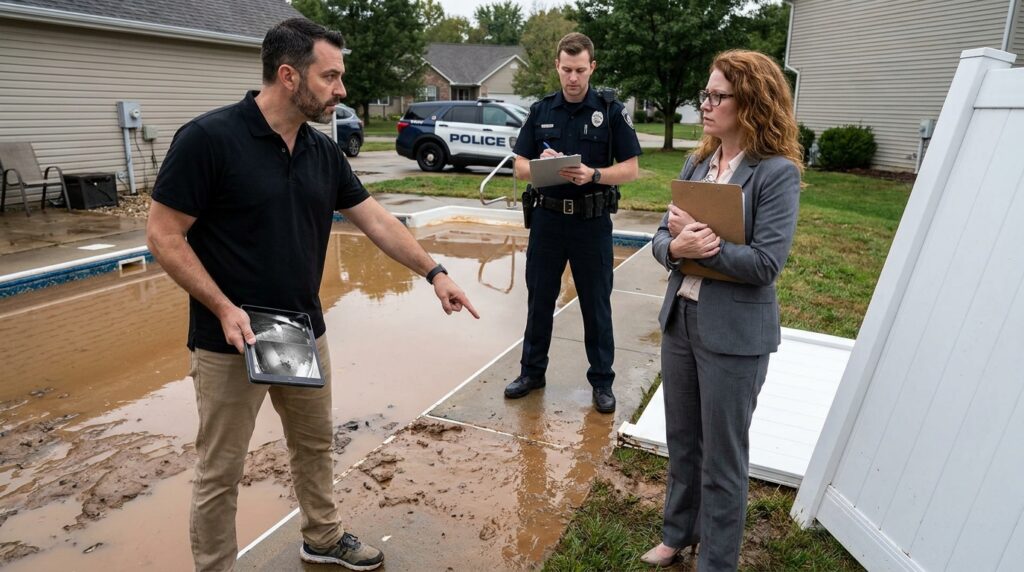
Mark turned his head toward the side gate. The latch didn’t rattle—whoever was out there knew how to handle a handle without triggering the internal spring. He stood perfectly still by the pool edge, his black polo absorbing the first direct rays of sunlight as they cleared the concrete wall.
A shadow broke across the white slats of the gate. It wasn’t Brenda’s heavy, deliberate silhouette. This shadow was wide, square-shouldered, the outline of a heavy tactical belt creating a jagged edge against the plastic vinyl.
Mark reached down and picked up his ruggedized tablet from the lawn chair, his thumb sliding across the glass to lock the interface. The screen remained dark, but the small blue LED in the corner continued its rhythmic, one-second pulse, recording the signal from the oak tree above.
“Mark?”
The voice was masculine, flat, carrying the dry timbre of someone who spent his mornings reading VIN numbers off abandoned trailers. It was Officer Reynolds. He wasn’t at the door; he was standing at the entrance to the utility lane, his hand resting on the latch of the gate, his dark uniform cutting a hard, vertical line against the white subdivision backdrop.
Mark didn’t move toward him. He kept his heels planted at the pool’s muddy edge, the tablet heavy in his left hand, his face caught in the cold transition between the shadow and the sun.
“The gate is locked from the inside, Officer,” Mark said. His voice didn’t rise. He kept it low, forcing Reynolds to step closer to the partition if he wanted to maintain the conversation. “The corporate boundary ends at the concrete apron.”
Reynolds didn’t drop his hand from the latch. His dark eyes scanned the length of the fence, stopping for a fraction of a second on the loose dirt at the base of the third post before settling on Mark’s face. “I’m not here about the apron, Mark. Your neighbor three doors down called in a report about an unsecured industrial hazard in the rear easement. She claims your pool pump is venting gray water into the common drainage line.”
Mark looked at the tablet screen. The network log was completely silent, but the hand-drawn asterisk in his pocket felt heavy, like a piece of lead pulling at his hip. “The pump doesn’t vent,” Mark said. “It filters. If there’s gray water in the easement, it didn’t come from my basin.”
“She’s got a photograph,” Reynolds said, his tone carrying no weight, just the neutral delivery of a man tracking an assigned ledger. “And she’s already filed the mitigation order with the county health inspector. They’ll be out here before noon to lock the valve.”
Mark’s grip tightened around the edge of the tablet. The plastic casing gave a tiny, internal creak. Brenda wasn’t trying to collect twenty-five-dollar fines anymore. She was moving to declare the entire property an active bio-hazard, a designation that would trigger an automatic occupancy revocation under the county health code. She was trying to empty the house.
“Tell her to bring the county surveyor when she comes,” Mark said, his voice dropping into a hard, metallic register that matched the iron pin beneath his feet. “Because the valve isn’t the only thing that’s going to get locked.”
Reynolds didn’t answer. He simply drew his hand back from the gate latch, his pen clicking once inside his shirt pocket as he turned back toward his cruiser. But as the patrol car’s engine caught, a low, wet gurgle rose from the deep end of the pool—the sound of air entering an intake line that should have been under twelve pounds of pure vacuum pressure.
Mark looked down. A thin, brown spiral of clay-silt was beginning to rise from the main drain, curling through the clear blue water like smoke in an empty room.
CHAPTER 3: THE STRATEGIC PERIMETER
“The hoop violates the street-facing threshold by eighteen inches, Mark. I have the laser measure logged to the curb seam.”
Brenda did not blink. She stood on the narrow asphalt gutter at the base of his driveway, her silhouette framed by the stark, repeating rectangles of two hundred identical two-story homes. The mid-day sun hit her gray pantsuit, turning the synthetic fabric into a flat, metallic sheet. In her left hand, the aluminum clipboard gleamed; in her right, a small plastic housing with a red diode lens pointed directly at the heavy steel base of his daughter’s basketball goal.
Mark stayed three paces back, his sneakers firmly planted on his own concrete apron. He kept his hands out of his pockets, elbows slightly bent, his weight shifted over his insteps. He was watching the way her right thumb hovered over the record button of her phone. She wasn’t just measuring; she was fishing for a reactive gesture.
“The goal is weighted with sand, Brenda,” Mark said. His tone was a level, uninflected sequence of dry syllables. “It requires two people to clear the bracket safety pin. It stays behind the utility joint.”
“The joint belongs to the municipal easement, but the air rights above the concrete are governed by the architectural covenant,” Brenda replied. She stepped forward, her heels hitting the curb with a sharp, dry click. She didn’t look at the hoop; her eyes remained locked on the gray space between Mark’s collarbones. “Section Nine. No recreational structures may project over the visible driveway margin during non-designated hours. It’s an immediate fifty-dollar assessment per day. I’ve already entered the catalog entry into the central management system.”
Mark let the silence stretch. A car passed behind her—a white delivery van with an unmarked side panel, its tires making a sticky, tearing sound against the hot asphalt. He watched the driver’s side mirror. It didn’t slow down, but the brake lights flickered twice as it cleared his property line, a tiny anomaly he logged automatically.
“The covenant specifies street-facing visibility from the primary access boulevard,” Mark said, his voice dropping into the precise, rhythmic cadence he used for system audits. “The curve of the cul-de-sac drops this lot three degrees below the sightline of the entry gate. If you’re measuring from the boulevard, you’re calculating an imaginary plane.”
Brenda’s jaw tightened, a tiny, vertical muscle twitching beneath her ear before her face reset into a mask of smooth, corporate certainty. “The board doesn’t interpret angles, Mark. We look at the ledger. Your account has three open variances. When the fourth hits the system at midnight, the automated mitigation review triggers. You won’t be arguing about eighteen inches then. You’ll be explaining to the municipal escrow holder why your primary deed has a structural lien attached to it.”
She stepped back, her clipboard cutting a quick, diagonal line through the air as she tucked it back beneath her arm. She didn’t offer a sign-off slip. She didn’t have to; the digital stamp had already sent the notification to his router.
Mark watched her walk three houses down, her steps unhurried, perfectly calculated within the center of the concrete sidewalk panels. She was moving toward her own property, but her eyes never wavered from the clean, grey line where the turf met the stone. She was assessing the grid, house by house, verifying the margins.
He turned and walked toward his garage, the soles of his sneakers picking up the heat of the driveway. The internal air of the garage smelled of dry cardboard and recycled motor oil, a heavy, dead atmosphere that compressed his chest. He didn’t look at the basketball hoop as he passed it. He was focused on the low, mechanical rattle vibrating through the drywall near the water heater closet.
The pool pump was struggling.
He walked around the side of the house, his shadow stretching thin against the white vinyl slats of the privacy fence. When he reached the filtration pad, he knelt beside the heavy plastic housing of the sand filter. The pressure gauge, usually resting comfortably at twelve pounds per square inch, was pinned at twenty-eight. The clear sight-glass at the top of the multi-port valve was no longer clear; a dark, oily sludge was swirling inside the glass dome, thick with the smell of river silt and decayed organic matter.
He touched the cold metal casing of the pump motor. It was hot—too hot to hold for more than three seconds—and the internal cooling fan was emitting a thin, high-pitched whistle that indicated a failing bearing.
Mark pulled the ruggedized tablet from the workbench ledge, his thumb sliding across the unmarred glass to pull up the system logs. The network traffic was ordinary, a steady stream of automated packet updates from his home server, but when he opened the background diagnostic for the tree-mounted camera, he noticed a drop in the frame rate between 2:00 AM and 3:30 AM.
The camera hadn’t shut off. The system had simply skipped three hundred frames every ten minutes, a clean, systematic deletion that could only be executed from inside the local network hub.
He leaned back against the concrete foundation of his house, his eyes tracking the thin, blue line of the pool’s water level. The brown cloud that had started from the main drain was expanding, turning the entire deep end into an opaque, reflective sheet that swallowed the light.
Someone didn’t just want him out of compliance. Someone had the administrative credentials to reach into his physical router and scrub the verification loop while the yard was dark. He reached into his back pocket, his fingers finding the sharp, folded edge of the unsigned photocopy. The hand-drawn asterisk over his water utility joint wasn’t an accusation from a bitter neighbor. It was a spatial anchor for a systematic extraction.
He stood up, his sneakers crunching on the dry mulch, and walked toward the master electrical box mounted near the meter. If the network was compromised from the inside, the digital logs were useless. He needed to verify the physical copper before the evening inspection.
As his hand touched the iron latch of the electrical panel, a low, rhythmic vibration started up through the soles of his shoes. It wasn’t the pump. It was the deep, heavy rumble of an engine idling at the curb outside his gate—the distinct, unhurried percussion of a commercial diesel block waiting for a gate to swing open.
CHAPTER 4: THE INTRUSION LOGIC
The galvanized iron lock on the side easement panel didn’t break; it yielded. A two-man crew in matching safety-orange vests and unbranded high-vis caps didn’t check the house for occupants before setting their stabilizer jacks into the soft turf bordering the shared utility strip.
Mark met them at the fence corner. The diesel exhaust from the idling flatbed out on the curb sat thick in the humid air between the lots, a greasy, yellow vapor that clung to the wet vinyl slats of his privacy fence. His hand remained flat against the ruggedized casing of his tablet, his index finger resting directly over the physical terminal interface toggle.
“The work order is stamped by the county district clerk, sir,” the lead worker said. He didn’t offer a clipboard. He pointed a gloved thumb toward a magnetic stencil on the truck door: Regional Hydraulic Mitigation Group. “We’re logged for an emergency isolation of the common line. Main line pressure dropped four points since the morning shift change. We have an unmetered bypass verified right behind this post.”
Mark looked past the man’s shoulder. Brenda stood thirty yards away on the asphalt curve, her gray pantsuit a rigid, geometric cross against the rounded line of the cul-de-sac. She didn’t look at Mark. She had a long-lens digital camera raised to her cheek, the motorized focus ring making a thin, insect-like click every time Mark took a step toward the fence boundary.
“The bypass is a dedicated three-inch intake for the sand pool filter,” Mark said. His syllables were flat, rhythmic, empty of tone. “It sits entirely on private plat forty-two. Check the county registry.”
“The plat was updated on the sixteenth,” the worker replied, his voice flat with the mechanical indifference of an outsourced contractor. He unclipped a heavy, steel-jawed pipe wrench from his utility harness, the iron teeth catching the grey sunlight with a cold, geometric flash. “The easement was reclassified as a shared flow corridor under the neighborhood environmental variance code. The board owns the air and fluid rights sixty inches down from the surface grade. We’re locking the intake valve.”
Mark didn’t argue the line. He turned his back on the crew, walking directly to the small fiberglass utility shed where his network hub was slung beneath the secondary electrical breaker. The structural velocity of their move was too fast for standard administrative procedure; it was an extraction sequence, designed to sever his property’s primary utilities before he could file an official injunction with the municipal magistrate.
He unbolted the aluminum faceplate of his router housing. The internal temperature gauge was operating within baseline parameters, but when he traced the physical fiber feed where it spliced into the external junction box, he found the anomaly.
A black, rectangular module—no larger than a car key fob—sat wedged between the fiber terminal and the master copper grounding block. It was drawing point-five milliamps directly from his local line, its small internal transmitter humming at a frequency that his standard system diagnostics had ignored as ambient electrical noise.
It was a local network mirror. Someone had physically tapped his hardware long before Brenda started measuring the basketball goal.
Mark attached his tablet’s auxiliary diagnostic lead directly to the tapped splice. The terminal window flickered, lines of machine-readable text scrolling upward in a white blur before stabilizing into a static file folder index located on a local IP mask.
The directory wasn’t labeled with property codes or HOA violation numbers. It was labeled: Project Horizon – Acquisition Blocks 1 through 12.
He opened the primary text file in the directory. It was an unredacted copy of the Whispering Pines master covenant, but the signature pages at the bottom were empty of community initials. Instead, they bore a corporate seal from a commercial development group based in Delaware, alongside an unsigned amendment dated six months before he bought his house.
The amendment didn’t adjust architectural guidelines. It altered the legal coordinates of the master plat map, carving out a six-foot strip from every backyard on the eastern ridge to form a contiguous corridor for an industrial freight line extension.
The decoy was the pool. The fines, the orange violation slips, the midnight dirt dumping—they were tactical chaff designed to keep him looking down at his own water filter while the legal foundation of his property was systematically uncoupled from beneath his feet. If they could force an occupancy revocation based on a health code violation before the corporate buyout became public record, the developer would acquire his lot at a forced judicial auction for pennies on the dollar.
The grinding sound of iron meeting iron cut through the backyard.
Outside the shed, the contractor had thrown his weight against the primary valve housing near the white vinyl fence, the wrench jaws biting deep into the old brass casing of the intake pipe. A thin spray of brown, pressurized water hissed out from the cracked packing nut, splashing over the loose loam where the orange survey pin lay buried.
“The stem is seized,” the worker shouted toward the truck, his boots slipping in the sudden slurry of mud and clay forming at the fence line. “Give me the pneumatic cutter from the flatbed box.”
Mark stepped out of the shed casing, his black polo catching the gray mist from the ruptured line. He didn’t yell to stop them. He pulled his phone from his khaki pocket, his thumb sliding down to a secure contact entry labeled with a four-digit extension that belonged to the municipal code enforcement division’s internal desk.
“Reynolds is already on his way back, Mark,” a voice spoke from the side gate before he could press dial.
It was Brenda. She had walked down the utility alley while the tools were running, her phone still raised at chest height, her thumb hovering over the display screen like a trigger on a dead man’s switch. Her glasses were splattered with fine droplets of the brown pool water, but her mouth was fixed in a wide, triumphant line.
“The health inspector signed the emergency order two minutes ago,” she said, her voice rising above the mechanical thrum of the flatbed’s diesel block. “An unmanaged industrial discharge into a common line triggers an immediate forty-eight-hour vacation notice. You can leave the tablet on the porch, Mark. The board will take custody of the security records during the remediation phase.”
Mark looked from her sunglasses down to the ruptured valve casing where the brown clay continued to spiral into his clean sod. He didn’t move away from his electrical master panel. He reached into his back pocket, his fingers pressing against the folded edge of the photocopy, his mind finalizing the counter-move.
“The order is based on an unsigned plat map, Brenda,” Mark said. He didn’t raise his voice to clear the roar of the machinery. He kept it precise, letting the tactical silence carry the weight of the statement. “And the Delaware corporation hasn’t cleared the municipal escrow block yet.”
Brenda’s finger froze over her phone screen, her shoulder dropping two inches as the geometric perfection of her stance fractured for the fraction of a single second.
CHAPTER 5: THE THRESHOLD FAULT
The steel latch of the side gate didn’t just rattle; it gave way under the blunt thrust of a shoulder.
Officer Reynolds stepped through the gap first, his dark uniform cutting a hard, vertical line against the bleached expanse of the neighbor’s vinyl siding. Behind him, the low, mechanical whine of the flatbed’s power take-off unit dropped an octave as the two workers in safety-orange vests dragged a heavy pneumatic cutter across the property line. The machine’s reinforced rubber hose left a deep, grey indentation in Mark’s damp lawn, squeezing out a thin track of stagnant water from the turf.
Mark didn’t step back from his electrical panel. His fingers remained braced against the cold, zinc-coated edge of the junction box, his knuckles white under the flat glare of the afternoon sun. He watched Reynolds’ eyes drop to the mud slurry spreading from the cracked valve stem.
“The county health inspector logged the emergency environmental variance ten minutes ago, Mark,” Reynolds said. He didn’t unclip his holster, but his right forearm rested flat across the heavy utility belt, his fingers hovering inches from his citation book. “The report states there’s a major backflow contamination coming from your drainage well into the common aquifer line. I’ve got an administrative order to clear the access corridor for the isolation crew.”
Brenda stepped up behind the officer’s left shoulder, her heels sinking an inch into the soft loam of the utility lane. Her aluminum clipboard was clamped against her ribs like a piece of structural bracing, the neon-orange violation slips protruding from the top like tiny, jagged markers.
“He’s intentionally obstructing the mitigation sequence, Officer,” Brenda said. Her voice carried the tight, rhythmic hiss of a high-pressure valve. She pointed a polished finger toward the mud-slicked concrete coping of the pool. “The bylaws give the board emergency enforcement rights over any residential asset that threatens the subdivision’s structural integrity. The pump needs to be severed immediately.”
Mark kept his glare fixed on the small, square lens of Brenda’s sunglasses. He could see his own reflection trapped in the dark glass—a small, dark figure standing before a grey wall, perfectly static.
“The work order number on your screen is a code-three corporate filing, Reynolds,” Mark said. His syllables were short, dry, stripped of any emotional resonance. “Check the county prefix. It doesn’t originate from the municipal health department. It’s an infrastructure acquisition block issued out of Wilmington.”
Reynolds didn’t look at Brenda. He stepped closer to the pool coping, his boot heels grinding a small pile of stray aggregate into the concrete. He reached into his vest pocket, pulled out a rugged mobile terminal, and typed a short string of characters. The screen threw a blue glare across his clean-shaven jaw as he waited for the internal database loop to resolve.
“The code clears as a common-line isolation, Mark,” Reynolds muttered, though his thumb hovered over the terminal’s refresh button for two seconds too long. “The board has structural primacy over the easement.”
“They have primacy over the six feet recorded in the 2018 deed,” Mark replied. He reached into his back pocket and drew out the tablet, his thumb sliding across the unmarred glass to activate the auxiliary diagnostic feed he had pulled from his router. “They don’t have it over the six feet they carved out last Tuesday night without a public notice hearing.”
He didn’t tilt the screen toward the officer yet. He waited. He needed Brenda to commit her positioning fully before he deployed the verification file.
Brenda took a step closer, her shoulder checking the side of the white vinyl fence panel until the hollow plastic frame groaned under the pressure. “The amendments are proprietary board documents, Mark. You don’t have access credentials to the master plat, and your recording doesn’t change the fact that this pool is currently a certified bio-hazard.”
She turned her face toward the lead worker, her chin jerking sharply toward the brass pump assembly. “Cut the line. The association will absorb the mitigation assessment under the emergency reserve fund.”
The worker didn’t wait for Reynolds to sign the log. He dropped the pneumatic cutter against the primary copper junction point where the three-inch pipe entered the filtration shed. The steel teeth of the blade caught the edge of the metal with a high-pitched, metallic shriek that echoed off the two-story houses flanking the yard. A shower of bright, orange sparks sprayed across the wet grass, sizzling as they hit the brown puddle forming at Mark’s feet.
Mark didn’t call out. He didn’t drop his hand from the junction box. He simply clicked the playback button on the tablet interface, his screen throwing a bright, high-definition matrix of lines directly across the grey fabric of Reynolds’ sleeve.
The video didn’t show the backyard pool. It showed the interior server rack located inside the Whispering Pines community clubhouse—a clean, white room where a single figure in a gray pantsuit was actively plugging an unbranded network mirror module into the neighborhood’s main data switch at 11:42 PM the previous evening. The timestamp in the lower-right corner glowed in bright, unblinking green digits, syncing perfectly with the frame deletions on Mark’s home router.
“The clubhouse network log is public record under section twelve of the state corporate code, Brenda,” Mark said, his voice dropping into a hard, low frequency that cut through the mechanical scream of the cutter. “And you didn’t scrub the backup mirror on the water district’s side of the node.”
Reynolds froze. His terminal emitted a short, three-tone system chime—the specific signal for a manual database override from the county clerk’s main desk. He looked down at his own screen, then up at the video playing on Mark’s tablet, his jaw hardening into a rigid line.
The pneumatic cutter stopped mid-stroke, its engine idling down with a low, hydraulic hiss that left the backyard suddenly, brutally quiet.
CHAPTER 6: THE MATRIX OF SUBVERSION
The sudden absence of the pneumatic whine left a hard, ringing void in the backyard. High above the fence line, a crow settled onto a transformer bracket, its dark feathers silhouetted against the stark white geometry of the subdivision’s identical rooflines.
Mark didn’t lower the tablet. He kept his grip centered on the rubberized perimeter frame, his thumb resting lightly against the volume rocker. The glare of the late-day sun caught the glass at a low, acute angle, refracting into a razor-thin beam of emerald light that sliced across the wet, brown aggregate of the pool coping.
Officer Reynolds stood frozen, his eyes shifting between the blue terminal screen in his left hand and the high-definition video feed locked on Mark’s screen. The silence stretched for four full seconds, measured only by the steady, wet drip of pool water leaking from the severed intake casing.
“The server room is common property, Officer,” Brenda said, her voice dropping into a tighter, desperate octave. She didn’t retreat from the splintered vinyl fence post, but her knuckles turned a bloodless ivory where she clamped the aluminum clipboard to her ribs. “The security log requires a double-blind board authorization to clear the archive. He’s showing you an unverified local scrape. It’s an illegal data intrusion under our charter.”
Mark tilted the screen three degrees toward the officer’s utility vest. “The database isn’t common property anymore, Brenda. Look at the lower-left corner of the stream header.”
Reynolds stepped closer, his boots squelching into the mud slick. He leaned down, his face inches from the glass. The camera feed on the tablet was running a background diagnostic overlay, a scrolling column of green machine-readable data that verified the physical source of the transmission.
The IP address didn’t point to the clubhouse basement hub. It pointed to an active cellular gateway registered to a corporate entity named Horizon Land Holdco, LLC, registered out of Wilmington, Delaware.
“The board’s administrative console has been mirrored to an outside proxy for one hundred and forty days,” Mark said, his voice flat, level, and entirely devoid of heat. “Every fine, every architectural review, and every municipal health order issued in this subdivision since February has been pre-cleared through an infrastructure acquisition server before it hit the neighborhood mailboxes. The pool isn’t a maintenance violation, Reynolds. It’s a spatial clearance marker.”
Reynolds reached down and tapped his own terminal screen, typing in the corporate registry number visible in the tablet’s frame buffer. The system took three seconds to query the state division of corporations before a small red badge popped up over the record: Pending Acquisition Block – Right of Way Phase 1B.
The officer looked up from the screen, his gaze cutting past Brenda’s shoulder to lock onto the two workers in safety-orange vests. They had stopped moving entirely, their hands resting loosely on the handles of their pneumatic tools, their eyes tracking the sudden shift in the law’s gravity.
“Clear the yard,” Reynolds said. He didn’t raise his voice, but the casual, bureaucratic indifference was gone, replaced by the hard, specific cadence of an officer identifying a perimeter breech.
The lead worker didn’t ask for a supervisor’s sign-off. He dropped the heavy cutter into the grass, uncoupled the rubber high-pressure hose from the flatbed’s compressor, and turned back toward the side lane without looking at Brenda. The secondary worker followed two paces behind, his heavy leather work gloves stuffed into his pockets as his boots left a double track of grey mud across Mark’s lawn.
“Officer, the emergency remediation order is still active on the county desk,” Brenda whispered, her defensive stance finally fracturing as she took a single, unstable step back into the gravel utility strip. Her glasses had slid half an inch down her nose, the lenses reflecting the muddy soup of the pool rather than the sky. “The health of the aquifer takes precedence over a corporate registry dispute. If that pump isn’t isolated—”
“The health order was generated by an unverified automated script from an outside server, ma’am,” Reynolds cut her off, his pen clicking twice as he pulled his official clipboard from his duty belt. He didn’t look at her rules; his eyes were fixed on the state penal codes listed on the inside cover of his manual. “And you’re currently standing six feet inside a private residential plat with a construction crew that doesn’t have an execution warrant signed by a district magistrate.”
Mark watched her face. The corporate mask didn’t slip; it collapsed. The lines around her mouth deepened into hard, jagged shadows under the late sun, her posture sagging until the aluminum clipboard looked too heavy for her arms to carry.
“The bylaws protect the collective investment, Mark,” she muttered, her glare dropping to the splintered white vinyl shards littering the sod between them. “You think you can hold an individual lot against a regional logistics grid? If the block doesn’t clear unanimously, the county will declare the entire subdivision an eminent domain variance. Nobody wins here.”
Mark didn’t answer. He turned his back on her, his sneakers crunching on the dry aggregate as he walked back toward his filtration pad to inspect the physical damage to the copper intake. He didn’t need to finish the argument; the system log had already saved the transmission data to three independent cloud mirrors outside the subdivision’s gate.
Behind him, the rhythmic scratch of Reynolds’ ballpoint pen began moving across the carbon-copy forms, a dry, deliberate sound that marked the official transition from a neighborhood variance to a criminal trespass file. But as Mark reached the filtration shed, his tablet gave a single, low-frequency pulse—not a network update, but an automated alert from the main water meter at the front curb. The total volume indicator wasn’t dropping; it was accelerating, the numbers spinning forward at four gallons per second, indicating that while they had been calculating the boundary line at the pool, another valve had been opened manually beneath the driveway concrete.
CHAPTER 7: THE SUBSURFACE LIQUIDATION
The numeric indicator on the tablet screen spun in a white blur, the digits cascading past four gallons per second with a dry, internal electronic hiss. Mark didn’t check the sky. His weight was already shifting forward, his sneakers gripping the wet concrete aggregate as he cleared the filtration shed and broke into a low, kinetic stride down the narrow side alley.
Behind him, the scraping sound of Officer Reynolds’ pen died instantly.
“Mark, stay behind the residential fence line,” Reynolds commanded, his boots hitting the mud slick with a heavy, wet slap as he gave chase. But Mark was already three paces clear of the rear gate. His focus was locked on the front curb joint where the three-quarter-inch galvanized iron water service line met the master subdivision manifold.
The late-afternoon shadows cut the street into alternating slats of black and grey, the geometric precision of the curb line vibrating under the heavy, low-frequency rumble of a second vehicle entering the cul-de-sac. It wasn’t a patrol unit. It was an unbranded, commercial vacuum rig, its heavy steel storage tanks catching the low glare of the setting sun like a row of giant, dull artillery casings.
Mark dropped to his knees at the edge of his asphalt driveway, the rough stone biting through the fabric of his khakis until he felt the cold moisture of the subgrade beneath his skin.
Right beside his primary mailbox post, the rectangular cast-iron cover of the water meter box was already crooked. A thick, dark stream of high-pressure water was surging out from beneath the rim, pooling into the concrete gutter and cutting a jagged channel through the neat, black mulch Brenda had inspected that morning.
He didn’t use a tool. He shoved his fingers into the narrow lift-hole of the iron lid, the cold metal catching his nail with a short, tearing scrape as he hauled the plate back.
The meter pit was submerged in a turbulent, muddy eddy. Six feet below the surface grade, where the private residential line met the corporate main, a secondary hydraulic bypass valve had been forced open with a long-handled curb key. A heavy copper jumper wire—the kind used to ground master electrical systems to the municipal iron grid—had been sliced clean through with an industrial shear.
“The connection was unauthorized from the beginning, Mark.”
Brenda stood at the foot of his driveway, her silhouette casting a long, thin needle of shadow that reached all the way to his knees. She hadn’t dropped her clipboard, but her phone was tucked into her jacket pocket, its small green recording light blinking through the gray weave of the synthetic fabric. Her expression was static, dead, her eyes fixed on the water flooding the asphalt.
“The automated mitigation sequence doesn’t stop because you found the proxy server,” she said. Her voice was flat, empty of the earlier bureaucratic malice, carrying only the cold, mechanical weight of an operative executing a pre-calculated contingency. “The moment your primary utility volume exceeds the regional infrastructure threshold by twenty percent, the district receiver files for an immediate judicial asset freeze. The Delaware filing was the soft option. This is the liquidation.”
Mark reached down into the freezing water of the pit, his fingers searching blindly through the clay silt for the iron tee-handle of the main curb stop. The pressure was intense, a violent, vibrating column of fluid that threatened to strip the skin from his knuckles as he fought the current.
“The registry doesn’t hold an escrow block on a flooded plat, Brenda,” Mark said. His breathing was short, deep, focused through his teeth as his palms finally wrapped around the cold iron cross of the valve. “And the county magistrate doesn’t sign asset locks when the evidence of intentional infrastructure sabotage is sitting in a municipal data switch.”
“It’s not an entry error, Mark,” she replied, her heels clicking twice as she aligned her stance with the edge of the iron pit. “The corporation already owns the debt on nine of the twelve houses on this block. Your divorce settlement left you with a thirty-year conventional note held by a secondary servicer. They assigned the voting rights to the association management company four weeks ago. You’re outvoted three to one on the municipal boundary variance, whether the officer signs the trespass citation or not.”
Mark threw his weight against the iron tee-handle, his shoulder checking the side of the concrete pit wall as he strained against the hydraulic torque. The metal gave a sharp, agonizing creak—a grinding screech of rusted threads yielding to sheer physical force—before it turned ninety degrees to the right.
The high-pressure hiss died instantly, the water in the pit settling into a flat, brown mirror that reflected the hard, red lines of the cruiser’s emergency lights as Reynolds finally cleared the side gate.
But the tablet on the grass beside Mark’s knee didn’t reset to zero.
The screen flickered twice, the white directory matrix disappearing to reveal a single, automated notification from his mortgage servicer’s online portal. The status bar didn’t show an open balance or a regular billing cycle; it was completely red, overlaid with a digital execution stamp from the state land court: Acceleration Notice – Demarcation Breach Plat 42.
The decoy wasn’t just the pool, and it wasn’t the six-foot easement. The entire confrontation had been timed to coincide with a scheduled banking system sweep at 4:30 PM. By forcing his property into an unresolvable structural variance during the exact hour the corporate escrow cleared, they had triggered an automatic default clause hidden in the fine print of his refinancing agreement—a clause that reclassified any active police intervention on the land as an immediate hazard to the primary lien holder.
Mark stood up slowly, the water dripping from his soaked polo shirt into the dry mulch. He looked past Brenda’s shoulder toward the unmarked vacuum truck that had parked directly behind Reynolds’ cruiser, its high-vis light bar casting a cold, amber pulse across the identical facades of the suburban sanctuary he had spent eighteen months trying to build.
The system had calculated his composure. They had known he wouldn’t yell, they had known he would check the security footage, and they had used his own defensive precision to drag the timeline out until the clock ran out on his title.
“The citation for the fence is a misdemeanor, Officer,” Brenda said, turning her face toward Reynolds with a razor-thin smile that didn’t reach her eyes. “But the default on the master deed is a civil foreclosure. The mitigation crew has an administrative right to secure the asset now.”
Mark didn’t look at the officer. He tapped the tablet screen one final time, his index finger resting on the internal hard drive path where the unredacted clubhouse files were stored, his eyes tracking the thin geometric line of the next parameter block.
CHAPTER 8: THE RESIDUAL SANCTUARY
The light was failing now, dropping below the six-foot concrete perimeter wall in a long, cold slate of violet and rust. Mark didn’t drop the tablet. He stayed on his knees in the wet black mulch by the curb box, the moisture of the subterranean water pit chilling his lower shins to a dead, unfeeling numbness.
He didn’t look up when the heavy vacuum truck shifted into reverse, its backup beeper cutting the quiet subdivision air with a sharp, geometric chime that repeated every 1.5 seconds. He was looking at the red acceleration notice glowing on his glass interface. The text didn’t scroll; it pulsated, a digital execution code designed to lock his accounts before he could log a counter-claim with the provincial clearinghouse.
Time dilated, the mechanical thrum of the neighborhood settling into a slow, industrial drag. He could feel the fine, gritty aggregate of the asphalt beneath his fingertips, the precise weight of the iron lid he had lifted, the exact thickness of the copper grounding block inside his fiber hub. They had built a perfect closed loop. The mortgage default clause was wired directly into the HOA’s architectural violation log; one flipped switch in the database triggered the next in the banking system, a seamless cascade of corporate logic that required no human signature to complete its course.
Except the network didn’t belong to the association management company anymore.
Mark’s left thumb hit the terminal key sequence—the hard, unnumbered root access command he had retrieved from the mirrored water district node. He didn’t write an appeal. He didn’t file an injunction. He executed a vertical system override, routing the unredacted clubhouse files directly through an active federal infrastructure safety block.
“The asset allocation is locked, Mark,” Brenda said, her shadow stretching thin across the wet concrete until the dark tip of her outline touched the rim of his sneakers. She stood motionless, her gray suit losing its sharp edges under the expanding blue darkness of the cul-de-sac. Her clipboard remained tight against her ribs, but her pen was still, its chewed blue cap pointing down at the grass like a dead needle. “The system doesn’t have an override for a primary lien default. The ledger is closed.”
Mark didn’t lift his head. He watched the white timeline on his tablet screen turn from green to an unblinking, structural amber.
“The ledger is open to the Federal Energy Regulatory Commission, Brenda,” Mark said. His voice was a thin, level rasp that carried no heat, matching the cold aggregate beneath his knees. “The Delaware entity didn’t register the six-foot easement extension as a common easement. They logged it as an industrial freight transit corridor. In a master-planned residential zone, that’s a Tier-1 infrastructure security conflict. The automated foreclosure you triggered didn’t go to the mortgage holder. It hit the federal regulatory injunction block four seconds ago.”
Brenda’s shoulder dropped. The rigid, mathematical line of her posture fractured, her heels shifting half an inch back into the gravel utility strip as the screen on her own phone suddenly went dark, its battery icon replaced by a white, spinning system reset loop.
Officer Reynolds stepped between them, his heavy leather utility belt creaking under the weight of his stance as he looked down at his own handheld terminal. The blue glare from the screen had been replaced by a generic municipal emergency notification: All plat modifications for Blocks 1 through 12 suspended by federal regulatory decree.
Reynolds didn’t look at Brenda. He looked toward the unmarked vacuum truck, his arm rising in a flat, horizontal lane block that signaled the driver to cut the engine. The heavy diesel rumble died with a low, hydraulic sigh, leaving the street entirely silent, caught in the cold, clear perspective of the late evening.
“Clear the street, ma’am,” Reynolds said to Brenda. He didn’t pull his handcuffs, but his pen was still out, the carbon-copy trespass citation tucked neatly underneath the metal clip of his official book. “The county clerk just pulled the administrative variance. Your board credentials aren’t valid on this plat until the regulatory hearing closes in November.”
Brenda didn’t reply. She didn’t look at Mark, and she didn’t look at the neighbors who had begun stepping out onto their concrete driveway aprons under the automated yellow glow of the streetlights. She turned and walked down the asphalt curve alone, her heels making a flat, hollow click against the dry stones of the gutter until her gray suit was swallowed by the shadow of the cul-de-sac.
Mark stood up slowly, the cold, muddy water from the pit dripping from the hem of his khakis onto his sneakers. His joints ached with the deep, structural exhaustion of a thirty-six-hour shift, but his hands were steady as he slid the tablet back into his work belt.
He walked past the splintered white vinyl shards of his side gate, entering his backyard as the first stars began to break through the violet haze above the concrete wall. The pool was still brown, the mud-clay cloud resting at the bottom of the plaster basin like a dark sediment layer from a previous era. But the pump filter had stopped its high-pitched whistle. The mechanical hum had reset to its low, clean frequency, pulling the clear surface water through the skimmer faceplate in a steady, unhurried circle.
He sat down on the edge of the low wood porch, the timber cold through his pants, his eyes tracking the dark line where the old oak tree met the property marker. The boundary wasn’t three inches inside his lawn, and it wasn’t six feet behind it. It was exactly where he stood—a small, hard pocket of space he had paid for with his own labor, locked tightly against the collective grid.
The back door slid open behind him, a small, warm line of interior yellow light cutting across the dark concrete apron. Lily stepped out, her sneakers squeaking against the wood as she dropped down beside him, her small shoulders leaning lightly against his black sleeve.
“Is the water clean yet, Dad?” she asked, her voice small, clear, untouched by the calculation of the lines.
Mark looked down at the dark, reflective surface of the pool basin, watching the yellow light of the kitchen mirror itself in the center of the water. He reached out and wrapped his arm around her shoulder, his fingers feeling the warm, simple reality of her cotton shirt.
“The water’s fine, Lily,” Mark said, his voice dropping into a quiet, permanent register that didn’t need a terminal interface to verify its weight. “The fence is holding.”