
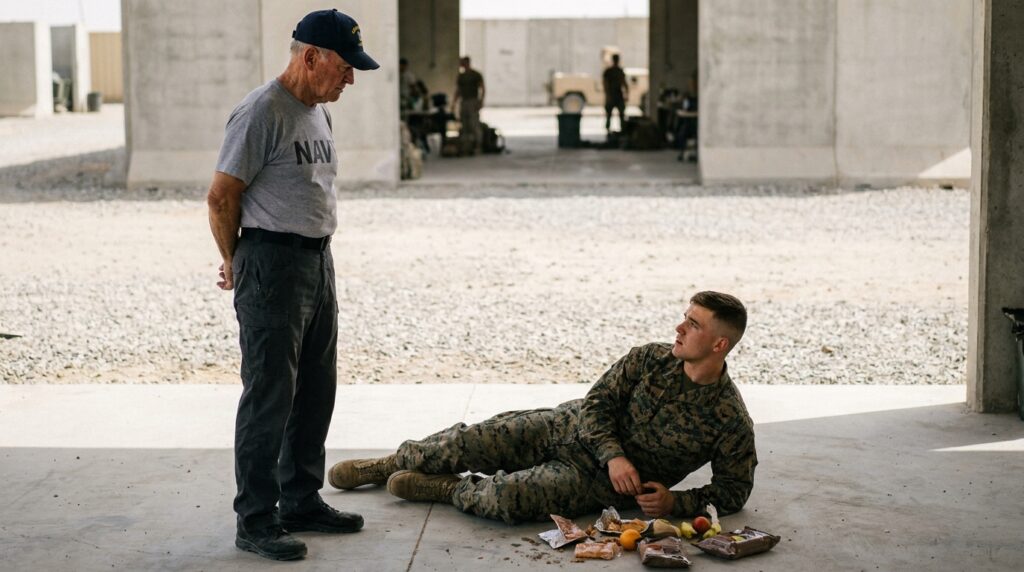
The Measured Line: A Single Breath of Unyielding Command and Stunned Silence on the Active Tarmac

CHAPTER 1: THE SHARP EDGE OF UNYIELDING CONCRETE

The sharp sound of cracking plastic and wet grease hitting the sun-bleached concrete cut through the low hum of the training yard’s diesel generators before anyone could check the perimeter line.

My knuckles didn’t shake as the tray left my fingers. I kept my weight settled low, deep in the heels of my dark tactical pants, tracking the gray shadow of the fallen rations as they pooled against the white painted boundary lines of the tarmac. The hot afternoon sun beat down on the back of my neck, trapped beneath the stiff cotton sweatband of my navy blue cap. To the twenty-odd recruits standing in a loose semicircle ten paces back, I was just a collection of slow angles and silver hair—a frail intruder who had drifted too close to the active training deck.

“You’re cluttering up a real training deck, old man,” the voice came from directly ahead, sharp, transactional, and swollen with the unblemished authority of crisp digital camouflage.

The Challenging Serviceman took another step forward, his polished black leather boots crunching against a dry piece of gravel. He was barely out of his twenty-four-month enlistment, his chest broad under the stiff fabric of his utility uniform, his eyes locked onto the gold lettering of my cap with a smug, calculated dismissal. He wanted an audience. He wanted to show his squad how clean his eviction technique was before the afternoon readiness inspection.

I didn’t answer him. I didn’t offer a name, a rank, or a justification. In the fleet, you learn to look at a man’s eyes to see where his balance lives, and this boy’s weight was leaning too far onto his toes, driven by the easy pressure of his peers’ low snickers. My left hand moved an inch inside my pocket, my calloused thumb brushing the rough canvas wrapper of the jammed silver pocket watch. The iron smell of the yard’s industrial floor wax mixed with the dry dust kicked up by a distant transport truck.

“Pick up your trash and get behind the line,” he repeated. His right shoulder dropped slightly—a classic, unpolished telegraph of intent. He was crowding the distance now, trying to use his height to force my spine back against the chain-link boundary. He thought the weathered veins on my hands meant the bone beneath had turned to chalk.

Behind him, the low murmur of the platoon died down into a brittle, expectant stillness. No one moved to help. No one stepped between the active-duty squad leader and the old man in the gray T-shirt. They just watched the space between us shrink to less than an arm’s length.

The young soldier’s right hand came up, fingers hooking into a rigid claw, aiming directly for the center seam of my collar to drag me off the tarmac. He didn’t see my right foot drop back an inch into the concrete, anchoring my center of gravity into the stone itself. He didn’t notice that my breath had completely flattened out.

The moment his fingers brushed the cotton of my shirt, his forward momentum became my property. I didn’t strike. I didn’t swing. I simply caught the inside of his wrist with two fingers, shifted my hips three inches to the left, and let his own rushing weight slide past my ribcage into the empty air. The physics of the redirect were small, dark, and absolute. There was a brief, sharp friction of boot rubber against concrete, the heavy thud of a solid frame losing its root, and then the loud, metallic crack of his gear hitting the deck flat on his back.

The spilled food splattered across his sleeve as he settled into the stone. The yard went completely cold.

I didn’t step back. I stood directly over him, the shadow of my navy cap cutting across his wide, unblinking eyes as he gasped for the air his lungs had forgotten.


CHAPTER 2: THE BRITTLE CIRCLE

“Get up.”

The words didn’t carry the heat of anger; they had the cold, flat density of an iron door slamming shut in an empty corridor. My voice sounded thin against the expansive concrete of the training yard, but it carried. It clipped the edges of the surrounding platoon, cutting off the last vestige of the nervous, low-tier snickers that had drifted from the back ranks only moments before.

The Challenging Serviceman didn’t move immediately. He lay flat on his spine, a human shape framed by the scattered debris of broken plastic and the dark, wet smear of split rations soaking into the sun-bleached deck. His eyes were wide, fixed on the brim of my navy cap with a look that belonged to a man who had stepped out of an aircraft into empty air without checking his pack. The digital camouflage across his chest rose and fell in short, erratic jerks as his lungs fought against the solid impact of the tarmac.

Two seconds ago, he had been the center of this yard’s gravity. Now, his weight was entirely spent, his status leaking into the stone beneath his shoulder blades.

To his left, a junior corporal with two fresh grease-pencils tucked into his sleeve pocket made a small, instinctive movement—a half-step forward, fingers twitching toward the black nylon holster at his hip. It was an institutional reflex, the young guarding the young when the hierarchy suffered a sudden, inexplicable puncture.

I didn’t turn my head toward him. I simply shifted my gaze three degrees to the left, catching the corporal’s boots in my lower peripheral vision. “Stay behind the yellow line, son,” I said, my voice dropping into the lower register that thirty years of deck-level command gives a man. “Your squad leader is still on his clock.”

The corporal froze. The loose circle of recruits seemed to tighten and turn rigid at the same time, their boots scraping against the grit in a brief, collective hesitation before they settled into an absolute, breathless stillness. The hot afternoon sun hit the chain-link fences behind them, casting a grid of sharp, diamond-shaped shadows across the concrete, trapping us all inside a cage of our own making.

On the deck, the challenger finally found his hands. His knuckles, scraped raw where they had skimmed the aggregate during his descent, dug into the concrete. He rolled his weight onto his side, his breath coming in a wet, ragged hiss as he forced his knees under his chest. He didn’t look up at me. His eyes were pinned to the spilled gravy and the broken white plastic by his left boot—the exact spot where his youthful overreach had been measured and found wanting.

“You wanted to prove a point,” I said, stepping closer until the toe of my dark tactical shoe was inches from his forearm. The proximity was a chess move, a deliberate compression of his personal space designed to test if there was any fight left in his spine. “Now stand up and face me.”

He didn’t rise. His shoulders remained hunched, the muscles in his neck tightening until the cords stood out like old hemp rope under his tan skin. The arrogance that had carried him across the yard—the clean, unblemished confidence of a boy who believed the modern world belonged exclusively to the fast and the heavy—had vanished. In its place was something cold and brittle. He could feel the eyes of his entire detail pressing into the small of his back. Every second he stayed on his knees was a year stripped off his reputation on this base.

I watched his right fingers twitch against the concrete. For a fraction of a second, I calculated the risk of a low leg-sweep, a desperate, dirt-tier recovery from a boy who didn’t know how to lose gracefully in front of his men. My right hand remained in my pocket, my fingers tightening around the canvas-wrapped silver pocket watch, using its dead, unmoving weight to gauge the precise rhythm of the silence.

But the movement didn’t come. The challenger’s shoulder dropped, the tension draining out of his frame in a long, submissive exhale that rattled through his teeth.

“I understand,” he muttered. The words were sparse, transactional, stripped of the cadence he used when he was barking orders at the recruits. He kept his chin tucked low into his collar, his voice barely lifting above the low drone of the distant diesel generators. “I’ll… I’ll back off.”

“Speak into the deck, you stay on the deck,” I said, my voice dropping an octave, steady and sharp as a razor. “Say it so the rear rank can hear you.”

A dark flush crept up from his collar, turning the skin behind his ears a deep, furious crimson. He swallowed once, his chest heaving as he forced his head up just enough to look at the lower hem of my gray T-shirt, though he still couldn’t bring his eyes to meet mine under the shadow of the cap.

“I understand, sir,” he said, the honorary title slipping out through sheer, unadulterated institutional conditioning. His voice cracked slightly against the dry heat of the yard. “I’ll back off.”

The silence that followed was different now. It wasn’t the shocked pause of a crowd watching a sudden accident; it was the heavy, suffocating weight of an established reality. The recruits behind him didn’t look at each other. They didn’t smile. They stood like concrete pilings driven into the tarmac, their small-unit cohesion shattered by the realization that the man they thought was a ghost was the only solid thing in the yard.

I looked past him then, my eyes tracking across the grey, desaturated expanse of the training facility toward the low-slung administrative barracks three hundred yards out. A black government sedan had pulled up beside the secondary security gate, its exhaust shimmering in the heat distortion rising from the blacktop. Someone was watching from the rear passenger window—a pale silhouette behind tinted glass that didn’t belong to the local training cadre.

I reached into my back pocket, my fingers wrapping around the stiff corners of the aluminum clipboard I had carried past the main gate. The blue ink of the transit log was visible under the clear plastic guard, listing three specific structural codes for the foundation pilings supporting the heavy crane rigs at the western edge of the tarmac. The notations were marked with red grease-pencil—the kind used only by engineering inspectors with deep-tier clearance.

The challenger was still on his knees, his hands trembling slightly as he began to collect the larger pieces of broken plastic from the concrete, trying to rebuild his dignity through small, menial movements.

“Leave the tray,” I said, turning my back on him without checking his recovery. It was a calculated risk, but a man who has surrendered twice in the same minute doesn’t have the stomach for an off-angle strike. “You’ve got an inspection in twenty minutes, squad leader. I’d suggest you find a fresh set of utilities.”

I walked toward the gate, the soles of my shoes clicking a steady, even meter against the concrete. Behind me, the platoon didn’t break formation. They stayed exactly where they were, waiting for a command that their leader was currently too broken to give.

CHAPTER 3: THE FRICTION LINE

The heels of my tactical shoes struck the transition line where the main tarmac met the heavily reinforced concrete beds of the western crane tracks. The vibration traveled straight up through my shins, hard and unforgiving, a reminder that underneath the thin film of motor pool dust lay five million tons of structural stone designed to withstand industrial-grade stress. Behind me, the training yard remained frozen in its silent, fractured geometry; ahead, the shadow of the black government sedan lengthened against the corrugated steel facade of Maintenance Hangar Four.

I didn’t slow my pace. I adjusted the aluminum clipboard under my left arm, the cold metal edge biting through the fabric of my gray shirt, while my right hand slid from my pocket. My calloused fingers left the canvas-wrapped watch and reached instead for a mechanical grease-pencil tucked behind my belt.

Every yard on this installation had an architecture. If you knew how to read the expansion joints and the wear patterns on the structural iron, you knew exactly who had laid the operational baseline and where the shortcuts had been buried. The young squad leader back on the deck had been a symptom; the real structural rot was always systemic, recorded in the data logs that civilian contractors tried to slide past the gate guards before the morning shifts.

I stopped at the edge of Piling Track Seven. The concrete here was discolored, a dark, greasy bloom radiating outward from a hairline fracture that ran parallel to the high-tension tie-downs. I knelt down, the joints in my knees clicking with a dry, metallic precision that matched the environment. The stark daylight caught the edge of a non-standard brass casing wedged deep inside the expansion joint—not a training round, but a live 5.56 primer, crushed flat by something massive and unmonitored.

“You’re thirty minutes ahead of the logistics detail,” a voice said from the shadow of the sedan’s open rear door. It was a dry, thin sound, lacking the military cadence of the base personnel but carrying the specific weight of someone who spent their life writing the budget codes that bought the camouflage.

I didn’t look up immediately. I pressed the tip of the black grease-pencil against the fracture, tracing the stress line across the concrete until it met the steel tracking shoe. “The log said the structural anchor at Track Seven was clear,” I said, my voice flat, keeping its steady, low-frequency rhythm. “The log was lying. This track has shifted an inch and a half to the west under live load.”

A man stepped out of the black vehicle, his polished oxfords clicking against the aggregate with a clean, sterile rhythm that didn’t belong on a live deck. He wore a dark civilian suit that looked too heavy for the mid-afternoon heat, his eyes hidden behind narrow glasses that reflected the silver glare of the hangar roofs. He held a leather folio closed against his chest like a shield.

“The transit log was signed off by the engineering command at the sector office,” the civilian said, his eyes scanning the yard behind me, tracking the distant, unmoving circle of the recruits who were still trying to parse what had happened to their squad leader. “It’s considered a closed matter for the upcoming readiness review. You shouldn’t be out here marking the pavement, Chief.”

“The sector office doesn’t live on this deck,” I said, rising slowly to my feet, letting my spine straighten section by section until I was looking down at him from beneath the low brim of my cap. I held the clipboard out, the red markings on the white paper clear under the harsh sun. “They didn’t see the crane rig tilt three degrees during the midnight shift. If they run the heavy armor over this line during tomorrow’s demonstration, the entire western anchor is going to shear off at the base.”

The man in the suit didn’t reach for the clipboard. He kept his hands locked on his folio, his jaw tightening until a small muscle twitched beneath his ear—the same tiny physical tell I’d seen on a hundred junior officers right before their logistics lines folded under pressure. He knew about the fracture. He knew exactly how many tons of unauthorized cargo had been run over this track to warp the steel shoe.

“The demonstration is scheduled for zero-eight-hundred,” he said, his tone dropping into a sharp, transactional hiss that barely cleared the distance between us. “The invitations went out from the general’s office last week. There are people arriving from Washington who don’t care about an inch of concrete deviation. They care about seeing the new close-quarters defense units operate in real-time.”

“They’re going to see them drop twenty feet into a drainage vault if you put three Bradleys on this line,” I said.

I took a deliberate step into his personal space, the shadow of my navy cap falling across the lapels of his heavy suit. It wasn’t an aggressive movement—it was a positioning play, a quiet compression of the lane that forced him to either step back against the sedan’s hot metal frame or look directly into my eyes. He chose the frame, his shoulders bracing against the black painted door with a faint, metallic click.

The civilian looked down at my hands, his eyes lingering on the old, thick scars that crossed my knuckles—the permanent record of thirty years spent holding the lines together when the steel gave way. He wasn’t a soldier, but he had enough analytical intellect to calculate the risk of an old man who didn’t show any fear of the office he represented.

“You’re making this very difficult for the local command,” he murmured, his voice tightening as he reached inside his jacket, his fingers searching for something that wasn’t a weapon, but carried the same weight on a military base—a phone with a direct line to the provost marshal. “We brought you in to look at the vintage hardware in the memorial hall, Chief. Not to re-engineer the active transit lines.”

“The transit lines are my business because the foundation prints have my initials at the bottom of the column,” I said, letting the aluminum clipboard drop against my thigh with a dull slap. “And if your office tries to run that armor before I verify the secondary anchors under Hangar Four, the provost marshal isn’t going to be the one cleaning up the yard.”

A sudden, sharp whistle blew from the secondary gate behind us, a high, piercing sound that broke through the low hum of the generators. Two white-capped security vehicles turned the corner of the fence line, their tires throwing up small sprays of gravel as they accelerated down the main access road toward the track, their red and blue lights cutting through the white glare of the afternoon sun.

The man in the suit smiled then, a small, thin line that didn’t reach his eyes. “Looks like someone reported an unauthorized civilian interfering with base personnel on the eastern pad,” he said, stepping out of my shadow. “You should have stayed in the history room, old man.”

I didn’t turn to face the approaching vehicles. I kept my eyes locked on the fracture at his feet, my left thumb already tracing the edge of the canvas wrapper in my pocket, counting the beats before the tires hit the line.

CHAPTER 4: THE STILL GEOMETRY

The first security vehicle cut its wheels hard, its front bumper snapping an inch away from the yellow boundary paint of Piling Track Seven. Gravel sprayed against the side of the black government sedan with the dry rattle of automatic fire. Before the dust could fully settle into the hot air, the doors of both patrol trucks kicked open in perfect, rehearsed unison.

Four active-duty security officers emerged, their boots landing with heavy, synchronized thuds against the aggregate. Their hands hovered with disciplined precision near the retention hoods of their sidearms, their eyes scanning the space between me and the civilian in the dark suit. They moved with the aggressive, territorial confidence of modern base security—young, fast, and entirely trained to treat an un-uniformed civilian as an immediate variable to be isolated.

I didn’t lift my hands from my sides. I stood perfectly still, my weight balanced evenly between my feet, allowing the shadow of my navy blue cap to keep my eyes completely obscured from the glare of their windshields. In a tactical box, the man who moves first is usually the man who is trying to find his balance; the man who stays anchored forces the perimeter to adjust around him.

“Step away from the civilian vehicle, sir,” the lead patrol sergeant ordered, his voice clipped and dry, carrying the unmistakable rasp of a man who spent his days barking through a tactical intercom. He didn’t unholster his weapon, but his thumb was locked on the retention strap, his eyes tracking the aluminum clipboard resting against my thigh.

The civilian in the dark suit took a deliberate step backward, separating himself from my line of sight and positioning his frame behind the lead sergeant’s right shoulder. “He’s interfering with a cleared logistics route, Sergeant,” the civilian said, his voice regaining its sharp, institutional edge now that the white-capped trucks formed a wall between us. “He’s marking active tarmac without an escort. Check his credentials.”

The sergeant didn’t look back at the civilian. He kept his eyes locked on my chest, his boots shuffling two inches to the left to close off the only clear exit lane between Hangar Four and the secondary gate line. “Your base pass, sir. Right now.”

I shifted my left arm slowly, letting the aluminum clipboard tilt toward the light so the sergeant could see the blue ink of the transit log. I didn’t reach for my pocket; I didn’t give them a reason to break their focus. “The pass was issued by the base commander’s chief of logistics at zero-seven-hundred,” I said, keeping my voice flat, maintaining that steady, low-frequency resonance that overrides tactical shouting through sheer composure. “And I’m not interfering with a route. I’m stopping a structural failure.”

“Let me see the sheet,” the sergeant said, extending his left hand while keeping his right firmly planted on his hip. He took one step inside my defensive circle—a calculated probe to see if I would flinch or step back.

I didn’t move an inch. I let him take the clipboard.

As the sergeant lifted the aluminum frame to read the log, the glare of the afternoon sun hit the reverse side of the white transit sheet. Through the thin paper, a faded, purple ink-stamp became visible under the clean plastic guard—a geometric emblem showing an anchor crossed with a double-edged combat blade, bearing an obsolete Department of the Navy serial number that hadn’t been issued since the late 1980s.

The sergeant’s eyes stopped tracking the red grease-pencil markings. His gaze stuck on that small purple emblem, his fingers tightening against the metal edge of the clipboard until the aluminum groaned slightly under the pressure. The cocky, high-tempo posture he had carried from his patrol truck seemed to drain out of his shoulders, section by section, replaced by a sudden, rigid hesitation that the recruits back on the eastern pad wouldn’t have understood.

He knew that stamp. Every hand-to-hand instructor and security detail leader on this installation had to memorize the lineage of the defensive curriculum they used to train the recruits—and that specific cross-blade anchor was the signature of the man who had written the original operational baseline before the current squad leaders were even born.

“Where did you get this log, sir?” the sergeant asked. His voice had lost its clipped, intercom delivery. It was quieter now, transactional but guarded, his eyes flickering up from the paper to the weathered lines of my face beneath the cap.

“I didn’t get it,” I said, my voice cutting through the dry heat like a cold chisel. “I wrote it. Thirty-four years ago, when the foundation columns for Hangar Four were poured. And if you look at the reverse stamp, you’ll see the maximum load limit for Track Seven isn’t eighty tons. It’s forty. Your civilian friend here has been running hundred-ton logistics rigs over this joint for three weeks to beat the readiness deadline.”

The civilian’s jaw tightened, his face turning a dull, irritated gray under the sun. “That’s classified logistics data, Sergeant. The old man is guessing. Secure the area and clear him off the tarmac before he compromises the morning demonstration lines.”

The sergeant didn’t answer him. He stood in the narrow space between us, the clipboard held between his hands like a piece of unexploded ordnance, his eyes shifting from the faded purple stamp to the deep hairline fracture split across the concrete at his feet. The tactical certainty of his four-man team had completely stalled, trapped inside a silent friction that money couldn’t solve.

CHAPTER 5: THE COLD ARCHITECTURE

“Stand down, Sergeant.”

The order came from forty paces back, slicing cleanly through the thick afternoon heat and the high-pitched whine of the security trucks’ idling engines. It didn’t have the raspy velocity of the patrol leader’s commands; it carried the quiet, unchecked gravity of someone who didn’t need to check the stripes on his sleeve to know if the room was listening.

The lead patrol sergeant didn’t hesitate. His spine snapped into a rigid, vertical line, his fingers dropping instantly away from the metal edge of my aluminum clipboard. The other three security officers followed his movement like a single mechanism, their boots pivoting on the aggregate as they cleared the narrow lane between Piling Track Seven and the hangar doors.

A tall man with a severe, clean-shaven jaw and deep-set eyes walked through the gap. He didn’t wear the field utility camouflage or the white-capped helmet of the patrol units. His olive-drab command uniform was pressed flat, the two silver stars pinned to his collar catching the direct glare of the sun with a cold, metallic intensity. He held a pair of black leather gloves loosely in his left hand, tapping them against his thigh with a slow, even rhythm that matched the ticking of a radiator.

The civilian in the dark suit immediately stepped out from behind the sergeant’s shoulder, his posture shifting into a quick, defensive lean. “General, this individual is actively disrupting the preparatory route for the demonstration,” he said, his hand pointing toward the grease-pencil lines I’d drawn across the concrete. “He’s unauthorized on this pad, and he’s claiming the structural logs are compromised.”

General Vance didn’t look at the civilian. He stopped five feet from me, his eyes tracking from the worn gold lettering on my navy blue cap down to the faded gray T-shirt, and finally down to the knuckles of my right hand, which still remained loosely tucked into my pocket. He didn’t ask for a pass. He didn’t look at the patrol sergeant who was still holding the clipboard.

“It’s been twenty-two years, Chief,” Vance said. His voice was low, carrying a faint rasp that sounded like it had been dragged over coarse sand. “The last time I saw you, we were pulling an engine block out of an iron-hull tender in Subic Bay.”

“Twenty-three, General,” I said, my voice maintaining its flat, unhurried resonance. I didn’t salute. A retired fleet master chief doesn’t break posture on an active tarmac for stars he helped polish when the current command was still running supply errands. “And the tender was a concrete-hulled fuel barge. The iron ones didn’t leak that bad.”

A microscopic shift occurred around Vance’s mouth—not a smile, but a brief acknowledgment of the line. He turned his head slightly, his eyes falling on the deep, grease-blackened split that ran through Piling Track Seven. “The patrol desk said an older civilian just dropped my senior close-quarters instructor on the eastern pad with a single structural pivot.”

“He was leaning on his toes,” I said, my thumb tracking the canvas strip inside my pocket. “His root was shallow. If you don’t teach them how to drop their center of gravity before they lock the collar, they’re just heavy targets.”

The civilian stepped closer, his voice rising an octave under the pressure of the standoff. “General, with all due respect to the Chief’s history, the logistics trucks are scheduled to move three hundred tons of support armor onto this pad in twelve minutes. We have a timeline signed off by the secretariat.”

“Your timeline is running on a broken shoe,” I said, pointing the toe of my tactical shoe toward the base of the track housing. “Listen to the line.”

Before the civilian could speak, a heavy, dull thump reverberated through the concrete beneath our feet—a deep, low-frequency shudder from the structural housing box beneath the track. It wasn’t the sound of a modern engine; it was the specific, terrifying groan of structural iron shearing under an unmonitored load. A thin, bitter smell of scorched rubber and ground lime drifted up from the fracture line as the gap widened by another eighth of an inch.

Vance’s face went completely still. He stepped over the split, his leather gloves snapping tight against his palm as he reached out and took the aluminum clipboard from the sergeant’s hand. He turned it over, his eyes fixing on the purple cross-blade anchor stamp on the reverse side of the log.

“This is the original build sheet from eighty-eight,” Vance murmured, his finger tracing the obsolete serial number. He looked up, his deep-set eyes locking onto the civilian with a cold, administrative finality. “The maximum load-bearing limit for this sector was calculated for standard support vehicles, not the tracked armor your office brought in from the port.”

“The new units are within the global tolerances—” the civilian began, his fingers twitching against his folio.

“The global tolerances don’t apply to a pad that sits on top of a late-Cold War drainage vault, Mr. Miller,” Vance cut him off, his voice dropping into a register that made the patrol sergeant step back another six inches. “The Chief designed this deck layout when you were still writing high school essays. If he says the line is going to shear, the line is closed.”

The civilian looked at Vance, then at me, the reality of his political timeline collapsing right into the cracked cement. He didn’t offer another counter-move. He simply pulled his phone from his jacket pocket and began walking back toward the black sedan, his shoes shuffling through the loose aggregate with a panicked, uneven cadence.

Vance turned back to me, extending the clipboard. “The secretariat isn’t going to cancel the morning show, Chief. They’ll just move the armor over the secondary tracks by Hangar Five.”

I took the metal frame back, my thumb locking over the blue ink entries. “Hangar Five uses the same sub-surface tie-downs, General,” I said, looking him dead in the eye. “And the blueprints for that pad aren’t in the local office. They’re locked in the central repository under an operational code your logistics people don’t even have on their screens.”

Vance stood silent for three long seconds, the wind catching the edge of his command collar as a new, larger shadow began to fall from the high rafters of Hangar Four. The small victory over the civilian was a false flag; the real failure hadn’t even reached the yard yet.

CHAPTER 6: THE FRACTURED HORIZON

The high-frequency scream of a secondary siren tore across the tarmac before General Vance could take the aluminum clipboard from my hand.

It didn’t come from the gate houses. The sound ripped straight out of the maintenance sub-stations behind Hangar Four, a mechanical wail that signaled an automated lockdown of the underground high-tension lines. In a split second, the blue-and-red strobe bars on the patrol vehicles seemed to intensify, their rapid pulses striking the corrugated metal walls of the facility like a succession of clean knife strokes.

The four security officers shifted their boots instantly, their perimeter formation collapsing as three additional dark-paneled transport vans roared around the corner of the logistics office. They didn’t slow down for the painted yellow boundaries. They slammed to a halt in a staggered, aggressive configuration, their tires smoking against the dry concrete aggregate, kicking up a gritty wave of grey dust that bit into the back of my throat.

“General, we have an active breach protocol on the central repository line,” the lead patrol sergeant said, his hand snapping down to his tactical radio before the vehicles had even finished settling. “The administrative server just went black. All transit clearances are suspended by executive order.”

Vance’s jaw didn’t move. His deep-set eyes narrowed by a fraction of an inch as he looked over my shoulder toward the newly arrived units. These weren’t local base police. The men spilling out of the back of the transport vans wore dark, unmarked tactical vests over sterile charcoal fatigues, their gear stripped of names, ranks, and divisional patches. They moved with a silent, heavy precision that didn’t belong to a standard readiness detail.

The civilian in the dark suit, Miller, had stopped ten paces away, his phone still pressed tight against his ear. A small, ugly smile emerged on his thin face, though his shoulders remained tense against the glare of the strobe lights. He didn’t look at Vance; he looked directly at me, his fingers tapping a rhythmic pattern against the side of his leather folio.

“The Chief’s pass is terminated,” Miller called out over the drone of the alarms, his voice losing its defensive tone, hardening into a cold, bureaucratic finality. “The secretariat just pulled the archival exemption for the eighty-eight build records. This area is under federal quarantine.”

Two of the unmarked operators moved into the space between me and General Vance, their heavy boots stepping directly over the expanding fracture line on Piling Track Seven. They didn’t look down at the crack. They didn’t care about the structural shearing of the stone. Their focus was entirely fixed on the aluminum clipboard under my left arm, their shoulders squared to block my access to the western logistics lane.

“Hand over the log, sir,” the closest operator said. His voice was completely flat, an artificial, transactional baritone that had been scoured of any personal inflection. He didn’t reach for a weapon, but his weight was settled forward on his toes—the exact, over-committed posture I had broken on the eastern pad twenty minutes ago.

I didn’t flinch. I kept my left hand clamped over the metal frame of the clipboard, my right hand resting deep inside my tactical pocket, my thumb feeling the cold, cracked crystal of the silver watch. “The log stays with the inspector of record,” I said, my voice dropping beneath the frequency of the sirens, striking the space between us with an unyielding, iron-rooted density. “This sheet isn’t an archival file. It’s a live safety manifest.”

“There is no inspector of record on this base who isn’t active duty, old man,” the operator replied, his left hand rising to shadow the upper edge of the clipboard frame. He didn’t see my right foot pivot three degrees outward, dropping my center of mass into the concrete to anchor against a sudden push.

Behind them, I caught the interior floor of the lead transport van through its open side door. Resting on the low metal deck was a heavy, military-issue titanium lockbox bearing a stamped model designation that wasn’t listed in any standard logistics handbook—a specialized asset retrieval container designed to isolate high-tier cryptographic materials or core design schematics before an installation changed hands.

The decoy secret was unraveling right there on the aggregate. The civilian office hadn’t run the hundred-ton rigs just to meet a readiness deadline; they were pulling something massive out from the sub-surface drainage vaults under Hangar Four before the general’s office could audit the inventory. The structural failure on Track Seven hadn’t been an accident of weight—it had been a deliberate overloading of the line to force a structural evacuation of the repository.

“Chief,” General Vance said, his voice cutting through the operational noise with a low, चेतावनी frequency. He didn’t order his sergeants to counter the unmarked units. His fingers were locked tight on his leather gloves, his eyes fixed on the purple cross-blade anchor stamp visible through the clear plastic guard of my folder. “Give them the sheet. If the central line is black, there’s nothing we can verify from the deck level anyway.”

“The line isn’t black because of a server failure, General,” I said, looking past the operator’s shoulder straight into Vance’s eyes. “It’s black because someone just dropped a manual bypass switch into the vault foundation to stop the monitoring sensors from recording the vault’s displacement.”

The unmarked operator didn’t wait for Vance to resolve the line. His hand shot forward, his fingers clamping onto the upper lip of the aluminum clipboard with a quick, aggressive wrench designed to tear the metal away from my ribs.

The movement was precise, but his grip was purely digital—he was relying on the strength of his fingers rather than the alignment of his spine.

I didn’t pull back. I let my left shoulder drop with his pull, utilizing his own backward traction to slide my weight inside his guard. My left elbow came up in a short, non-graphic horizontal arc, striking the inside of his forearm near the tendon line, a clean skeletal redirection that shattered his leverage before his fingers could lock. The clipboard didn’t move an inch from my side, but the operator’s boot skidded three inches across the aggregate as his balance failed, his shoulder dropping into the grey dust with a dull, heavy thud.

The second unmarked operator moved instantly to close the lane, his hand dropping toward the nylon restraint straps at his belt, while the sirens from Hangar Four shifted into a continuous, high-pitched scream that signaled the arrival of a structural emergency.

The victory on the tarmac was gone. Every light on the installation was turning red, and the absolute reality of what was buried beneath the concrete remained strictly locked behind a perimeter that was tightening by the second.

CHAPTER 7: THE RISING DEMAND

“Hold your line.”

General Vance’s voice didn’t rise to compete with the automated emergency wail, but it had the specific, razor-sharp density that froze the second unmarked operator mid-stride. The man’s fingers remained inches from his tactical utility belt, his eyes darting toward the first operator, who was currently rising back onto his heels from the dust of Piling Track Seven. The perimeter remained a series of jagged, unresolved angles under the rhythmic, red flash of the security strobe bars.

The civilian, Miller, had stopped barking into his phone. He stepped forward again, his leather folio pressed tight against his ribs like a shield that had begun to split along the seams. “General, this is an active obstruction of a federal asset reclamation,” Miller hissed, his face tight and gray under the glaring halogen lights of Hangar Four. “The Chief just assaulted a departmental operator. You are tracking the career consequences of this standoff, I assume.”

Vance didn’t look at Miller. He took two measured steps into the narrow pocket between me and the charcoal-clad security units. His polished command shoes crunching softly over the cracked aggregate. He extended his hand, his eyes fixed on the aluminum clipboard I held firmly against my side.

“Let me see the secondary ledger on that sheet, Chief,” Vance said. His voice was flat, transactional, completely ignoring the operator who was still dusting grey grit off his tactical vest. “The one matching the vault foundation codes.”

I shifted my left arm slightly, allowing the metal frame to slide into his grip without breaking my balance. My right hand stayed inside my pocket, my fingers brushing past the canvas-wrapped pocket watch to find a small, flat piece of metal resting at the very bottom of the seam—a worn copper-alloy key with an old three-digit Navy identification tag stamped into its face. It matched a sub-deck containment box that wasn’t supposed to exist in the active logistics registry.

Vance pulled the white transit sheet back, his thumb pressing down on the corner where the purple cross-blade anchor stamp was inked. As he bent the paper under the harsh red glare of the emergency strobes, a series of hand-written coordinates became visible along the margin—not structural dimensions, but operational layout vectors for the sub-deck training rooms built beneath the hangar floor in 1988.

The second operator took a half-step forward, his shoulder blocking the glare of the flashing light bar behind him. “General, those schematics are designated under a closed operational quarantine. You don’t have the active clearance token on your screen to read those vectors.”

“I don’t need a token to read the handwriting of the man who built the deck I’m standing on, son,” Vance said, his tone dropping into a freezing, low-frequency register that forced the young officer to halt his forward lean. He looked up from the paper, his eyes boring straight through the operator’s unmarked visor. “Mr. Miller’s trucks didn’t bring in heavy armor to test the readiness lines. They brought in hydraulic retrieval rigs to pull the original close-quarters combat baseline matrices from the sub-surface vault before the inspection cadre arrives from Washington.”

The civilian’s jaw tightened until the skin across his cheekbones turned a sharp, bloodless white. He knew the decoy secret had collapsed completely. The entire confrontation on the eastern tarmac hadn’t been an accident of youthful arrogance or a random dispute over base boundaries; it was a deliberate, high-stakes compression of the timeline to erase the historical record of who had actually authored the installation’s elite defensive systems.

“The curriculum belongs to the department now, General,” Miller said, his voice dropping its bureaucratic mask, exposing a cold, predatory pragmatism. “The legacy files are obsolete. We are moving the modern instructional assets to a private sector installation at zero-eight-hundred tomorrow. The Chief is an un-vouched variable holding a piece of proprietary paper.”

“The paper is a safety manifest for a structural anchor that is currently failing because your people overloaded the crane lines,” I said, my voice cutting through the wail of the sirens with an iron-rooted composure that didn’t shift for his threat. “And the legacy files aren’t in your data trucks, Miller. They’re locked behind a manual hydraulic block that requires a physical key your programmers couldn’t find with a three-month sweep.”

The lead operator’s hand twitched again, his boots shifting on the concrete aggregate as a loud, metallic crunch echoed from the dark interior of Hangar Four. The structural failure was accelerating; the heavy steel tracking rails were beginning to buckle upward as the sub-surface vault shifted its weight into the old drainage channels.

Vance snapped the clipboard back into his leather gloves, his face settling into a grim, unyielding mask that signaled the final closing of the lane. He didn’t order the patrol units to make an arrest; he didn’t call for a retreat. He looked at me, then at the two unmarked officers who were still holding their tactical ground between us.

“The pad is officially red-lined,” Vance announced, his voice carrying across the entire yard like a closing bulkhead. “Sergeant, clear these civilian vehicles off my tarmac. Chief, you’re with me. We’re going down to the sub-deck before the western foundation shears completely.”

The operators didn’t step back, but their tactical certainty had stalled out in the red glare. The absolute reality of who had designed the lines was still locked behind the stone, and the final confrontation hadn’t even hit the floor yet.

CHAPTER 8: THE MEASURED ANCHOR

The iron rung of the maintenance hatch cut hard into my palms, the metal cold and greasy with old graphite lubricant as we dropped straight down into the unlit vault line. Above us, the continuous wail of the sirens became a muffled vibration, choked off by the three-foot slab of reinforced concrete that formed the active training deck.

The air down here was thick with the scent of damp rust and the sharp, electrical tang of overtaxed hydraulic lines. A single string of emergency yellow halogens cast long, staggered bars of light down the narrow corridor, stretching our shadows into jagged, overlapping silhouettes against the wet concrete block walls.

General Vance came down the ladder right behind me, his heavy leather command gloves squeaking as they gripped the iron. He didn’t ask me for a bearing. He had spent enough time on these installations to know that every baseline built in eighty-eight had a central utility core that ran straight from the hangar floor down to the drainage mains.

“Miller’s retrieval rigs are hooked into the secondary power junction at the end of the line,” Vance said, his breath coming in measured, even cycles that matched the low thrumming of the auxiliary pump house ahead. “They’re trying to cycle the locking solenoids from the upper terminal.”

“They can cycle the power until the breakers fry, General,” I said, my voice echoing flatly down the concrete tube. “The original hydraulic block doesn’t respond to an electronic signal. It’s a dead-man’s weight system.”

My shoes clicked against the iron tracking rails that lined the vault floor. Every three feet, an expansion bolt was driven deep into the stone, its head stamped with that same cross-blade anchor symbol I carried on my clipboard. We were walking through the literal skeletal frame of the curriculum—the physical blueprint where my team had spent forty months mapping the leverage points and structural geometry of close-quarters combat systems long before the department tried to convert it into private code.

We reached the central vault bulkhead three hundred yards in. The steel door was eight inches thick, its outer face warped slightly from the massive weight of the hundred-ton logistics rigs that had been run over the tarmac above. Stuck right in the center of the locking ring was a heavy, industrial-grade hydraulic control panel, its mechanical pressure gauges flickering erratically in the red danger zone.

Resting on the steel deck beneath the panel was Miller’s civilian tech team. They had three diagnostic monitors hooked into the auxiliary wiring harness, but their screens were flashing a repetitive, unyielding loop: ACCESS BLOCKED—PHYSICAL LINK REQUIRED.

Miller was there too, his dark wool suit unbuttoned now, his face slick with sweat under the dim halogen glare. He spun around when my shoes hit the concrete floor, his leather folio shaking slightly against his ribs. “Secure them!” he yelled toward the two unmarked operators who had followed him into the vault. “They’re trespassing on a closed federal retrieval site!”

The operators took a half-step forward, their boots sliding through a thin pool of hydraulic fluid that had leaked from the main seal. They were broad, heavy, and over-conditioned—their shoulders squared in an aggressive frame designed to box me against the raw stone wall.

I didn’t lift my hands. I didn’t shift my posture into an offensive stance. I simply stood my ground, letting my center of gravity sink deep into my heels, my right hand finally sliding out from my pocket. I didn’t hold a weapon. I held the old, canvas-wrapped pocket watch I had carried through every gate on this base.

I pulled the canvas strip away, letting the silver casing catch the sharp yellow light of the halogen bar. On the reverse side of the watch, stamped deep into the nickel-plated backing, was an intricate, triple-digit engraving: 0-8-8.

It wasn’t a serial number. It was a mechanical key configuration.

I reached out and pressed the watch face directly into the circular recess at the center of the manual hydraulic dial. The identical engraving on the vault gate lined up with the watch casing with a clean, metallic clink that sounded like a rifle bolt closing home.

The two operators froze mid-stride, their boots skidding slightly in the grease as a deep, structural groan echoed from the interior of the steel bulkhead. The hydraulic fluid in the sight glass suddenly dropped from red back into a calm, steady green.

“The curriculum isn’t data you can load onto a truck, Miller,” I said, my voice completely flattening out the room, striking the stone with the absolute weight of a master chief who had never left the deck. “The close-quarters defense baseline was never a digital program. It’s an anatomical system built on unchanging skeletal leverage. You wanted to buy the rights so you could sell it back to the recruits as a proprietary secret, but you can’t patent the physics of a human frame.”

Miller looked from the watch to the general, his lips moving but no sound escaping his mouth. The diagnostic monitors on his tech table suddenly went entirely dark, their links severed by the mechanical drop of the dead-man’s weight inside the bulkhead. The decoy secret had broken completely; the private contract was dead before the first invitation could leave the base gate.

General Vance stepped forward, his leather gloves snapping against his palm as he looked at the operators. “Clear your gear off this deck,” Vance ordered, his tone carrying the cold, final velocity of a senior commander who had just reclaimed his yard. “The transit route is permanently closed. Sergeant, escort Mr. Miller to the front gate.”

The operators didn’t argue. They dropped their leads, picked up their diagnostic frames, and began moving back toward the ladder line with a quiet, disciplined retreat that proved they finally understood who had written their operational parameters. Miller followed them without looking back, his leather folio trailing in the dirt as his shoes slid through the hydraulic oil.

The vault door didn’t slide open to reveal a massive warehouse; it remained firmly locked, an immovable iron anchor safeguarding the legacy of the discipline that had defined thirty years of quiet service.

I reached out and pulled my pocket watch from the dial, wrapping the canvas strip back around the cracked crystal before settling it deep into the seam of my tactical pants.

Vance looked at the cross-blade anchor stamped on the steel gate, then turned his head to look at me under the low brim of my navy cap. “The demonstration is going to be quiet tomorrow, Chief,” he said.

“The uniform changes, General,” I said, turning my back on the steel door and walking back toward the ladder with a steady, unhurried meter. “The discipline doesn’t.”

Similar Posts

Leave a Reply

Your email address will not be published. Required fields are marked *






