The Iron Gate of Oak Ridge and the Price of a Quiet Neighborhood
CHAPTER 1: THE ENCOUNTER AT THE THRESHOLD
“You need to control that dog, I’m not backing down here!”
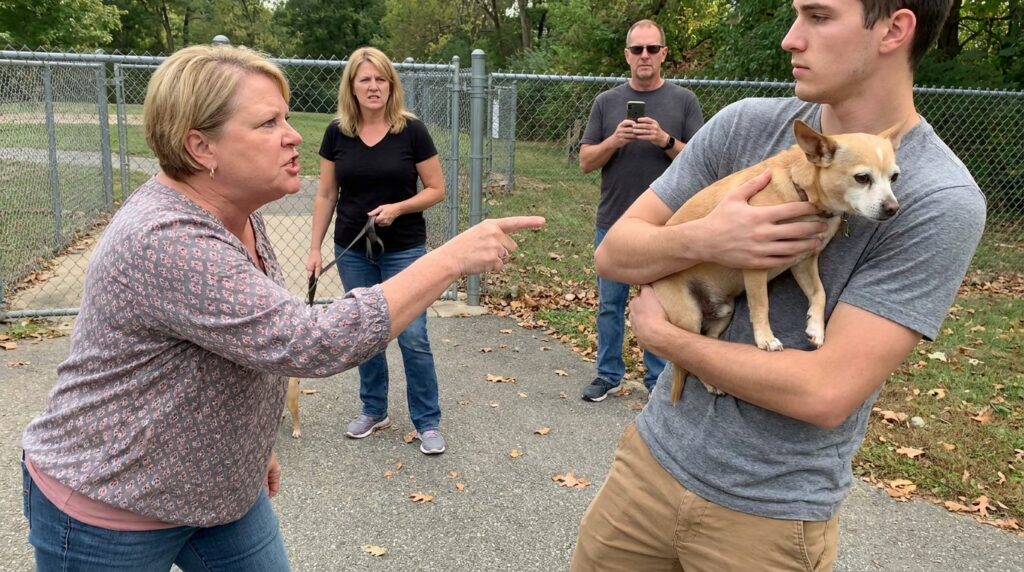
The voice did not arrive as a request; it hit like a iron wedge driven straight into the hot midday air. Clara Hensley stood less than two feet from the gate post, her stocky frame leaning forward so heavily that her shadow cut across the dry, cracked pavement, blotting out the scattered oak leaves beneath Leo’s boots. The pink and gray patterns of her blouse blurred against the sharp, silver grid of the chain-link fence behind her. Her arm was extended, rigid as a structural timber, her index finger jabbing repeatedly into the empty space between them. It stopped inches from the gray fabric covering Leo’s chest.
Leo didn’t drop his gaze. His jaw remained locked, the muscles along his cropped chin tightening as he calculated the distance between his heels and the heavy galvanized metal gate post. He could feel the small, compact weight of the tan dog pressed hard against his ribs. His forearms were clamped across the animal’s flank like a pair of vise grips, holding the pale muzzle safely upward, away from Clara’s advancing finger. The dog’s large, pointed ears twitched against Leo’s collarbone, its breathing fast but entirely silent.
Around them, the park lane died.
To the left, Sarah Miller froze. The heavy black nylon leash in her hand went dead straight, the woven fibers groaning under the sudden, tense weight of her own retriever pulling backward toward the grass. Her face was gray under the harsh, unfiltered suburban sun, her eyes darting between Clara’s extended finger and the small, tarnished brass clip on Leo’s dog collar. She didn’t move. Nobody on the concrete path moved. The entire afternoon had narrowed down to the click of dry leaves sliding across concrete and the rhythmic, aggressive snap of Clara’s jewelry as her hand shook with performative outrage.
Further back, near the shaded line of the maples, Marcus Vance stood perfectly still. The dark lenses of his sunglasses hid his eyes, but his hands were steady at chest level, the glass face of his smartphone reflecting the clean, white glare of the sky. He wasn’t breathing loud. He didn’t speak. He simply held the frame, locking the two figures into a digital matrix that Clara couldn’t see.
Clara took another half-inch of the path, her sunglasses slipping down the bridge of her nose, revealing the hard, pale skin around her eyes. She wanted the shout. She wanted the defensive retreat that would justify the call already half-typed into the screen tucked inside her pocket.
Leo shifted his weight. It wasn’t a retreat; it was a internal reorganization, a slight three-inch drop of his center of gravity that anchored his boots into the pavement. He let the silence stretch until the gathering crowd could hear the individual rustle of the wind through the chain-link.
“Please step back,” Leo said. His voice was flat, stripped of pitch, matching the cold gray of his shirt. “I’m holding my dog.”
Clara’s open mouth twitched, her finger stalling in the air as if hitting an invisible glass pane. In the reflection of her glasses, Leo caught the slight, metallic glimmer of something he hadn’t noticed before—a small, blue municipal security fob hanging from the underside of her clipboard, a key that didn’t belong to any residential lock in Oak Ridge.

CHAPTER 2: THE LAWS OF DISPLACEMENT
Clara Hensley did not flinch, but the micro-movement of her hand told a different story. The blue municipal security fob clicked against the plastic lower rim of her clipboard, a sharp, synthetic chime that didn’t match the dull, sun-baked landscape of the Oak Ridge common area. Leo kept his weight low, the balls of his boots grinding into the gritty asphalt. The small tan dog shifted against his ribs, its ribs expanding with a fast, shallow rhythm, but it didn’t growl. It knew the rules of the house; it knew that noise brought the stick.
“I asked you a question, Leo,” Clara said, her voice dropping into a rhythmic, practiced register that carried easily toward the fence line where Sarah Miller stood. She didn’t look at the dog anymore; she looked at the space just above Leo’s left shoulder, addressing the invisible court of public opinion she always carried with her. “The neighborhood association agreement is very clear about the weight restrictions and registration procedures for common-area use. If you don’t have the laminated ledger tag visible on the harness, you are technically in violation of civil trespassing guidelines.”
“It’s a public easement, Clara,” Leo said. The words left his mouth cold, flat, and dry. He didn’t raise his hands. He didn’t point. He kept his forearms locked over the dog’s flanks, tracking the way the sun caught the edge of the blue fob. It wasn’t standard HOA issue. The neighborhood association tags were cheap, injection-molded orange plastic. This was a heavy, commercial-grade proximity key stamped with a three-digit municipal inventory code. The kind used by the county parks department to open the heavy automated vehicle barriers at the main reservoir road three miles north. “The county updated the plat maps four months ago. The sidewalk strip and the first twelve feet inside the fence line are cleared for public foot traffic.”
Clara’s jaw tightened, the skin along her throat turning a mottled, angry pink that matched the loud patterns of her blouse. “The association maintains this turf. We pay the landscaping crews. We set the logic for who uses the gates. If we allow every unregistered animal from the bypass road to tear up the sod, the value of every property on this lane drops five percent by the end of the quarter. My husband didn’t spend thirty years in corporate compliance to watch the perimeter fail because a few renters don’t want to fill out the registry.”
She took a step sideways, her thick-soled walking shoes scraping against the dry oak leaves underfoot. The movement was calculated; she was blocking the narrow gap between the galvanized gate post and the edge of the park sign. To pass her now, Leo would have to shoulder-check her out of the way or step off the asphalt into the fresh, deep mud where the HOA utility crew had been trenching for new drainage lines earlier that morning.
Leo watched her eyes behind the sunglasses. He didn’t look at her face; he watched the reflection of the chain-link fence in her lenses. He could see Sarah Miller’s silhouette in the curved plastic—Sarah was leaning slightly forward now, her knuckles white around the nylon leash, her mouth slightly open but silent. Beyond her, Marcus hadn’t moved an inch. The smartphone remained held perfectly at chest level, the lens dark and steady.
“The registry isn’t a county requirement,” Leo noted, his voice dropping an octave to match the low rumble of a delivery truck shifting gears out on the main highway. He adjusted his grip on the dog, his fingers finding the small, brass clip on the collar. The metal was cold despite the midday heat. “You’re asking for tax returns and lease agreements just to issue a gate code. That’s not administrative compliance. That’s data mining.”
“It’s called preservation,” Clara snapped, her finger rising again, this time jabbing toward the deep, black mud of the trench line. “Look at that soil. The county didn’t pay for that remediation. We did. We protect what’s ours. And if you think you can use this park as a loophole because your family’s name is on an old parcel deed from before the incorporation, you’re severely mistaken. The board has the authority to issue immediate summary fines for non-compliant utility use, and I have the ledger right here.”
She turned the clipboard toward him, the white sheets of paper glaring in the sun. Leo didn’t look at the text, but his eyes locked onto the bottom corner of the board where the blue fob hung. The municipal stamp was clear now: PROPERTY OF MUNICIPAL REGISTRY – DISTRICT 4 EASEMENT ACCESS.
A realization clicked into place behind Leo’s eyes, cold and sharp. District 4 wasn’t the residential zone for Oak Ridge. It was the public utility district that handled municipal drainage and lower-income community development grants. Clara wasn’t using an HOA key to lock the gates; she was using a county-issued master key that belonged to a department she had no legal right to represent.
“The county service truck comes by on Tuesdays,” Leo said softly, his eyes shifting back to Clara’s face. He didn’t smile, but his posture straightened, the slouched, defensive lean disappearing as he stepped fully into the center of the lane. “They use that exact fob to check the water meters behind the fence. Why do you have a public utility key on an association clipboard, Clara?”
Clara’s hand went instantly still. The confidence didn’t drain from her face—it froze into something harder, a rigid mask of defensive calculations. She didn’t drop the clipboard; she pulled it back against her chest, her fingers covering the blue plastic piece as she glanced past Leo toward the road where the distinct, low whine of a municipal siren began to rise in the distance.
CHAPTER 3: THE THREAT ESCALATION
“That key doesn’t concern you, Leo,” Clara said, her voice flattening into a low hiss that barely carried over the mechanical growl of the highway. Her fingers tightened over the plastic rim of the clipboard, pressing the blue municipal fob hard against her side, attempting to wedge the heavy proximity token between her palm and her hip. She shifted her stance by two inches, the rigid edge of her sneaker catching the clean line where the concrete path met the newly turned mud of the HOA drainage ditch. “What concerns this community is the immediate threat an unregistered, unverified animal poses to public safety. I’ve already contacted county compliance. They’re tracking the grid now.”
The wail of the siren peaked three blocks north, its high-pitched modulation dropping into a heavy, localized rumble as it turned onto Oak Ridge Lane.
Leo felt a small twitch in the dog’s flank against his chest. He tightened his forearms, locking the small tan animal into the safe, neutral space of his upper torso. His fingers traced the cold brass clip of the collar, checking the tension of the webbing. He didn’t look back toward the road. He kept his eyes locked on the tiny, metallic serial numbers stamped into the edge of Clara’s clipboard.
“You didn’t call county compliance for a dog, Clara,” Leo said. His voice remained perfectly level, matching the harsh, direct glare of the midday light off the galvanized gate posts. “You called them because the utility crew found the old surveyor stakes this morning when they started trenching the easement. You needed the gates locked before anyone from the district office checked the coordinates on the public map.”
A sharp, collective intake of breath came from the left. Sarah Miller had stepped off the concrete lane entirely, her retriever pulling her deeper into the shadow of the chain-link fence. The nylon leash stayed taut, a black line cutting diagonally across the gray backdrop of the park. She was looking at Clara now, not with the hesitant anxiety of a submissive neighbor, but with a sharp, probing focus.
“Clara,” Sarah said, her voice cutting through the heavy hum of the idling emergency vehicle now visible at the end of the access road. “What is that fob doing on your board? The board helper told us last month that the utility gate keys were lost during the winter audit.”
Clara did not look at her. Her sunglasses remained pointed directly at Leo’s throat. “Sarah, go back to your property. This is an administrative matter under section four of the residential bylaws. If you interfere with an active compliance check, the board will be forced to log a formal obstruction notice against your household.”
The threat was practiced, delivered with the mechanical efficiency of someone who had spent two decades using minor procedural fear to clear a room. But the perimeter was no longer holding.
Behind Leo, the shadow of Marcus Vance lengthened across the concrete. The smartphone remained perfectly level, its dark camera lens tracking the absolute immobility of Clara’s hand over the blue fob. He didn’t offer a word of support; he didn’t need to. His presence was an unyielding digital anchor, a silent witness converting the spatial intimidation into an permanent record.
Clara’s jaw worked, the hard, angular lines of her neck tightening as the white county cruiser cleared the final turn, its roof lights flashing red and blue against the manicured hedges of the park entrance. The vehicle stopped twenty feet short of the gate, its tires kicking up a light gray cloud of limestone dust that drifted across the path, settling over the dry leaves underfoot.
“He’s right here, Officer,” Clara called out, her voice shifting instantly back into the high, performative tone of an endangered citizen. She took a step toward the arriving vehicle, her finger rising once more to jab toward Leo’s chest, using the movement to shield the lower half of her clipboard from the driver’s side window. “He’s refusing to clear the easement, his animal is unsecured by standard association harness logic, and he’s actively threatening the board’s safety markers.”
The car door swung open with a heavy, metallic thud. A tall deputy in a crisp gray county uniform stepped out, his utility belt clicking as he adjusted his stance against the sun. He didn’t draw a weapon; he didn’t move fast. He held a thick, yellow carbon-copy violation book in his left hand, his eyes scanning the narrow gate lane, the rigid chain-link border, and the precise, unyielding way Leo stood his ground by the concrete threshold.
Leo did not drop the dog. He watched the deputy’s boots clear the limestone dust, tracking the geometry of the encounter as the local authority figure stepped directly into the center of Clara’s calculated trap.
CHAPTER 4: THE DIGITAL COUNTERTRAP
The deputy’s boots crunched heavy across the white gravel, his shadow elongating until it touched the cold toe of Leo’s boot. He didn’t look at Clara first. His eyes, half-shielded by the stiff brim of his Stetson, tracked the geometric layout of the gate—the freshly turned black mud of the trench, the silver link of the fence, and the exact position of Leo’s forearms locking the tan dog against his gray T-shirt. The air tasted of limestone dust and raw iron.
“Bylaw enforcement isn’t a county dispatch priority, Mrs. Hensley,” the deputy said. His voice was a low, slow drawl that carried the dry scratch of a man who spent his afternoons idling on county blacktop. He stopped three feet short of the threshold, his right hand resting loose on his utility belt, right next to the heavy leather casing of his radio. “Dispatch logged this as a public safety obstruction. Who’s blocking the right-of-way?”
“He is,” Clara said instantly. She didn’t drop the clipboard. Instead, she pushed it closer to the deputy’s vest, her extended index finger practically touching the yellow carbon pages of his citation book. Her sunglasses flashed under the direct vertical glare of the sun. “He’s operating an unregistered, non-compliant animal within the shared perimeter. He refused to provide his administrative verification when challenged, and he’s actively interfering with the community drainage infrastructure work.”
The deputy shifted his gaze to Leo. The dark brim of his hat tilted up by a fraction of an inch. “Son. You got the registration tags for the animal?”
“The animal hasn’t left my arms, Deputy,” Leo said. He didn’t loosen his grip. His skin felt tight across his knuckles, his fingers remaining motionless against the cold brass clip of the collar. “He’s within the twelve-foot boundary of the public utility easement. The registration tags are stamped by the municipal registry office, not the Oak Ridge homeowners association. They’re locked onto the lower D-ring of his webbing.”
“He’s lying,” Clara snapped, her voice rising an octave, cracking against the hard galvanized surface of the gate post. “The board holds the master title for this parcel. The registry office doesn’t have jurisdiction over private common turf. We’ve logged three separate spatial violations against his household this month alone.”
“The master title was amended four months ago, Clara,” a new voice cut in.
Sarah Miller stepped fully out of the maple shadows, her boots striking the concrete path with a sharp, rhythmic click. Her retriever followed, its ears low, its leash hanging loose between her fingers now. She didn’t look at Clara; she looked straight at the deputy’s badge. “The board helper showed us the county zoning notice three weeks ago during the drainage vote. The association didn’t buy this strip. They leased the access, and the lease expired when the county authorized the low-income infrastructure extension.”
Clara’s stocky frame went rigid. The pink patterns of her blouse seemed to flatten against her chest as she turned her head toward Sarah, her jaw working silently. “Sarah, you don’t know what you’re talking about. That was a confidential administrative assessment.”
“It’s on the public portal,” Leo said softly. He didn’t take his eyes off the deputy. He noticed the slight shift in the officer’s stance—the way his weight moved from his heels to the outer edge of his boots, a universal indicator of a professional reassessing a bad line of code. “And the blue proximity key hanging under your clipboard doesn’t open an HOA gate. It opens the county district four water main vault. The one your utility crew is trying to build a retaining wall over right now.”
The deputy didn’t answer. He reached out, his thick fingers catching the edge of Clara’s clipboard before she could pull it back against her hip. He didn’t yank it; he simply applied enough steady, downward leverage to force the plastic board flat under the midday light. The blue municipal security fob dangled from the silver clip, its inventory code catching the white glare of the sun.
“Mrs. Hensley,” the deputy said, his drawl dropping into something flat and metallic. “Where’d you get this fob?”
“The board… the previous maintenance chair left it in the office log,” Clara said, her voice dropping its performative volume for the first time. She didn’t let go of the board, but her fingers were shaking against the grain of the plastic. “It was provided for emergency perimeter access during the winter freeze.”
Behind them, the shadow of Marcus Vance finally moved. He took three calculated steps forward, his boots clearing the dry leaves until he stood right at Leo’s shoulder. He didn’t drop the smartphone. He turned the screen toward the deputy, revealing the continuous, unbroken video log running in real-time. The digital frame showed the entire interaction from the micro-second Clara had stepped into the lane—it showed her stocky forward-lean, her finger jabbing toward Leo’s chest, and the clear, unobstructed view of the blue fob hanging visible before Leo had even spoken a word.
The deputy looked at the screen, then back at the blue fob. His hand moved down to the heavy yellow ledger on his belt, his thumb flicking the carbon pages open with a loud, dry snap that sounded exactly like a trap closing in the quiet park lane.
“Step back from the gate, Mrs. Hensley,” the deputy said.
CHAPTER 5: THE AUTHORITY COLLAPSE
“Step back from the gate, Mrs. Hensley.”
The command hung in the humid, midday air like a lead weight. Clara did not move immediately. Her sneakers stayed wedged against the asphalt line, her fingers white where they clamped the upper rim of the clipboard. But the deputy’s hand remained steady on the plastic board, his thick thumb pressing down against her fake ledger sheets until the cheap aluminum clip groaned under the strain.
“Deputy, you are misinterpreting the physical boundaries of this development,” Clara said, her voice dropping its standard, sharp resonance, turning thin and rapid as the paper under her hand began to wrinkle. “The association paid for the gate posts. The drainage trench is an authorized capital improvement project. You don’t have the administrative standing to seize private property markers.”
“This isn’t private turf, ma’am,” the deputy said. He didn’t raise his voice, but his boots shifted, his heavy utility belt clicking as he leaned slightly forward, cutting her off from the pathway. With a slow, deliberate twist of his wrist, he unclipped the blue municipal security fob from her board. The metal ring snapped like a small pistol shot in the silence of the lane. “This fob belongs to District Four Water and Infrastructure. It was logged missing from the county garage ledger three months ago. Possession of municipal utility keys by unauthorized personnel is a Class A misdemeanor under state civil code.”
Leo let his shoulders drop by a fraction of an inch, though he didn’t loosen his forearms around the dog. The small tan animal had finally stopped its rapid rib movement, its pale muzzle resting flat against the gray fabric of his T-shirt, its large ears pointed toward the deputy’s ledger. The weight of the animal felt solid now, no longer a liability to be hidden, but a fixed marker of his presence on the path.
Sarah Miller stepped closer, her retriever sitting quietly by her heel. Her face had completely cleared of the suburban anxiety that usually governed the block. “The county notice came from the regional registrar’s office, Clara. The registry showed that this whole strip—the park, the gate, the first twenty lots along the bypass road—was designated as a non-exclusive public access corridor back in ninety-four. You’ve been fabricating the registry fines because the digitization project was scheduled to go live this month. If the families left before the county updated the spatial parcel maps, the association could claim adverse possession.”
The truth didn’t enter the space as a dramatic twist; it landed with the dull, heavy thud of an iron door closing.
Clara’s hand slowly released the clipboard. Her arm dropped to her side, her extended index finger finally curling back into her palm. Without the board, her stocky frame looked smaller, the loud pink and gray patterns of her blouse suddenly looking out of place against the raw, unpainted metal of the chain-link fence. The sunglasses hid her eyes, but the sharp, downward turn of her mouth revealed the absolute ruin of her calculations.
“We were preserving the perimeter,” Clara whispered, her eyes fixed on the limestone dust settling over her sneakers. “The county doesn’t care about the maintenance logic. They don’t care about the equity built into these lanes. If you open the gates, the outside road comes straight through the center of the community.”
“The road belongs to the county, Mrs. Hensley,” the deputy said. He pulled the yellow carbon citation book from his belt, his pen scratching against the page with a dry, rhythmic hiss that was the only sound left on the paved path. He tore the top sheet off—a bright, official slip of paper that he held out directly against her chest. “This is a formal citation for public nuisance, spatial gatekeeping violations, and unauthorized possession of municipal property. The county surveyor’s office will be out here at eight tomorrow morning to pull your trenching crew off the easement.”
Clara didn’t take the paper immediately. It fluttered in the light breeze, the yellow corner scraping against her blouse before her fingers closed around it like a dry leaf. She didn’t look at Leo. She didn’t look at Sarah or the steady, dark lens of Marcus’s phone. She turned around, her thick-soled walking shoes dragging through the loose gravel as she began the long, silent walk back up Oak Ridge Lane alone.
Leo watched her shadow shrink against the white glare of the asphalt until she cleared the first row of hedges. He slowly lowered his arms, letting the small tan dog’s paws touch the cool, dry grass inside the fence line. The dog shook itself once, its brass collar clip ringing softly against the D-ring, then trotted two feet forward to sniff at the base of the galvanized gate post.
Sarah Miller let out a long, slow breath, her hand loosening its grip on the heavy nylon leash for the first time in an hour. “She’s been running the board for twelve years, Leo. Nobody had the records to challenge the logic.”
“The records were always public, Sarah,” Leo said. He adjusted the gray fabric of his shirt, his chin turning toward the road where the county cruiser’s lights were finally shutting off. “She just counted on everyone being too tired to look them up.”
Marcus Vance lowered the smartphone, his face remaining perfectly neutral as he slipped the device into his pocket. He gave Leo a single, brief nod—a silent calculation concluded, a hard boundary permanently restored at the threshold of the gate.