The Weight of Fences and the Cold Friction of Modern Suburban Concrete

CHAPTER 1: THE INCH OF GLASS

The air conditioning inside the sedan was a dry, expensive luxury that smelled faintly of old dust and synthetic leather, but it wasn’t enough to kill the heat radiating off the passenger-side door. Through the double-paned glass, the cul-de-sac looked desaturated, bleached out by a June sun that turned the asphalt into a soft, oily sponge. Then the shadow fell across the seat.

It didn’t slide or drift; it dropped like a heavy wet sheet.

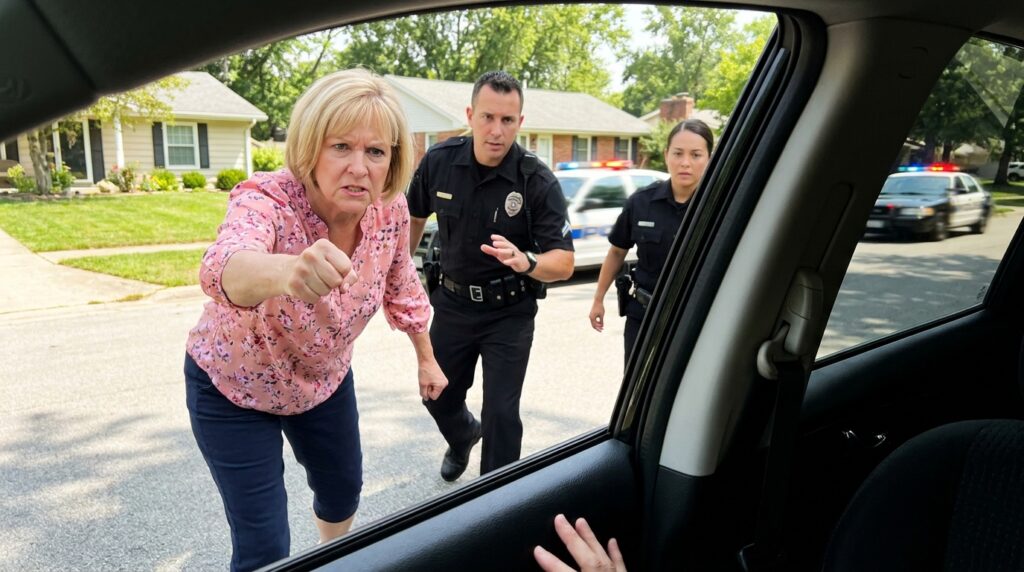
Evelyn was already leaning forward before the car had completely settled into park, her sandals leaving gray scuff marks on the dry perimeter of the curb. Her blonde bob was stiff, frozen in place by a lacquer that seemed to defy the humidity, and her pink floral blouse vibrated against the stark white vinyl of her clipboard. I didn’t open the door. I didn’t shift my weight. I reached out with one finger and nudged the power window toggle down an inch.

The heat hit first—a thick, metallic draft that carried the scent of fresh fertilizer and hot tire rubber. Then came her voice, pitched at that precise, nasal frequency designed to carry across two property lines.

“You think you can just park the chassis over the line because the string isn’t up yet?” she asked. Her face was tight, the skin around her mouth pulled into white, bloodless pleats. She didn’t look at my eyes; she looked at the dashboard, at the small leather pouch on the passenger seat, at anything she could catalog for the next committee report. “The association mandate is clear about commercial-grade vehicles or anything exceeding a four-cylinder displacement left idling within twelve feet of a shared driveway. I have the log right here.”

She tapped the zinc clip of her board against the glass. The sound was a sharp, skeletal click.

Beneath the steering column, my right foot remained flat on the brake pedal, feeling the low, iron tremor of the engine. I didn’t speak. In the dusty gray reality of this block, every syllable spoken through an open window was currency you couldn’t get back. I simply shifted my hand three inches to the left, letting the camera lens on the console catch the precise angle of her fingers as they hovered over the weather stripping.

“I’m talking to you,” she said, her voice dropping into a register that was far too quiet for a woman standing on a public easement. She leaned down, her face filling the one-inch gap, her sunglasses sliding down the bridge of her nose to reveal eyes that were small, pale, and entirely devoid of rhythm. “You can’t judge me when you haven’t lived my side of this block. You haven’t paid the assessments I’ve paid.”

Through the narrow slit of air, I watched a tiny drop of sweat track its way through the foundation powder near her ear. And then, far down the line of identical mailboxes, a low, mechanical growl began to rise—the heavy, double-clutch downshift of an municipal engine turning into the lane.


CHAPTER 2: WHITE KNUCKLES ON THE WEATHER STRIPPING

“You think you’re invisible behind that tinted film,” Evelyn spat, her knuckles whitening as her fingers hooked tighter over the raw, unpainted edge of the door frame. The smell of her cheap floral perfume mixed violently with the sharp, sour tang of the hot asphalt underneath the chassis. “The board receives the photographic logs every Thursday at midnight. Your vehicle’s track width has been documented three times this month as overlapping the common-use easement by a margin of forty-two centimeters.”

I didn’t answer. I let my wrist rest against the gear shifter, the skin slick with the damp warmth of the cabin. My gaze stayed fixed on the side-view mirror, watching the silhouette of her hands. Her fingers were trembling, not with anger alone, but with the specific, rhythmic twitch of a person whose internal machinery was running on the absolute last thread of its gears. The zinc clip of her board dragged across the window trim, scraping a small, gray flake of oxidized clear-coat from the metal.

“Forty-two centimeters,” she repeated, her voice dropping an octave into a gravelly, frantic hum. She leaned closer, her sunglasses dipping further down her nose until I could see the pale, water-logged skin around her lower lids. “You look at me like I’m a nuisance. You look at me from inside this little iron box and you think you can wait me out. My grandfather built the drainage channels on the northern ridge of this development before the county even named the access roads. I know where the gravel ends. I know exactly where the limestone base switches from municipal to private deed.”

My index finger remained lightly pressed against the smartphone’s side button, the screen dead in the shadow of the parking brake but the microphone drawing in every jagged breath she pulled across the sill. Through the one-inch gap in the glass, the heat of her skin felt like an open oven door. She was over-enforcing. Every tenant in the outer circle knew her schedule, but this wasn’t the methodical, bureaucratic harassment she usually traded in. There was a frantic, desperate velocity to the way her heels dug into the parched turf of the parkway strip.

“Look at the sod,” she demanded, her left hand letting go of the door to point toward the boundary hedge where the boxwoods met my driveway. Her index finger was crooked, the nail split along the side and packed with dry garden dirt. “The root systems are choking because your runoff isn’t filtered according to Section Four of the architectural guidelines. You’re killing the barrier. You’re doing it on purpose so the street can look directly into my kitchen.”

I turned my head slowly, letting her see my eyes for the first time through the dark gap. I didn’t let my expression shift. In the dusty gray of a cul-de-sac dispute, an expression was an invitation for an argument, and an argument gave her status. Instead, my eyes traveled past her shoulder, down to the lower stem of the privacy hedge where the soil had eroded during the May storms.

There, half-buried under a clump of dead crabgrass and a discarded plastic lawn chemical tag, a square block of weathered concrete showed its face. Protruding from its center was a rusted brass pin—a surveyor’s benchmark, old and pitted with green oxidation.

Evelyn’s gaze followed mine. For a fraction of a second, her entire body went rigid. The frantic momentum in her jaw ceased, the skin around her mouth tightening until her lips vanished into a thin, colorless line. Her fingers didn’t just grip the weather stripping now; they dug in until the black rubber groaned under the pressure. She knew exactly what that brass pin meant. It sat three feet deep on her side of the current vinyl fence line, a silent, unyielding witness buried in the dirt long before she started printing her violation notices.

“That’s old data,” she whispered, her voice losing its public volume, replacing it with a cold, dry venom that rattled against the glass. “The county updated the plat maps during the road widening in ninety-eight. You don’t know what you’re looking at.”

Before she could pull her hand away from the car, the shadow in the rearview mirror split into two distinct, hard-edged shapes. The low, mechanical thrum of the municipal engine I had heard earlier didn’t pass by the intersection. It died right at the mouth of the driveway, followed by the heavy, metallic clack-clack of standard-issue utility doors swinging open against their hinges.

The blue and red strobes didn’t scream through a siren, but when they kicked over, the light was intense enough to turn the green of the lawns into a strange, artificial violet. Evelyn didn’t turn around immediately. She stayed frozen against the car door, her knuckles still locked on the black trim, trapped between the small, hidden brass stake in the mud and the sudden, heavy crunch of leather boots hitting the gravel behind her.

CHAPTER 3: THE PULSE ON THE ASPHALT

“Keep your hands right where I can see them on that frame, ma’am,” a new voice commanded from behind the vehicle. It was flat, unhurried, and carried the heavy weight of someone who spent ten hours a day climbing in and out of a utility cabin.

Evelyn didn’t move. Her shoulders pulled inward, the stiff, lacquered blonde bob tilting forward as if she could hide her profile from the rearview mirrors. The flashing lights from the two cruisers parked at the mouth of the cul-de-sac were already beginning to wash out the noon-day glare, turning the dry dandelion heads on the parkway into tiny, violet targets. The rhythm of the strobe was a silent, relentless metronome against the neighborhood’s brick facades.

I shifted my weight slightly, my fingers easing off the smartphone screen but keeping the lens angled perfectly through the gap. In the door mirror, the tall silhouette of the responding officer solidified. His black uniform looked heavy, thick with the density of synthetic weave and the iron bulk of a duty belt that clicked with every deliberate step. Behind him, a second officer—a woman with her dark hair pinned flat against her skull—moved along the outer rim of the driveway, her palm resting naturally on the butt of her holster.

“He’s overlapping the easement, Officer,” Evelyn said quickly. The nasal frequency of her voice was gone, replaced by a brittle, defensive register that cracked around the consonants. She didn’t let go of the weather stripping; her fingers seemed stuck to the black rubber trim like iron filings to a magnet. “I have the log sheets right here. Twelve feet from the shared boundary line. Section Four clearly dictates that no commercial displacement—”

“Ma’am, I didn’t ask about the log sheets,” the responding officer interrupted. He stopped two feet from her elbow, his frame wide enough to block out the remaining sunlight on the passenger side. His clean-shaven jaw was set, his skin gray under the shadow of his uniform cap. He didn’t look at her paper folder. His eyes were locked entirely on her right hand, the knuckles still white against my door frame. “I asked you to keep your hands still. Sir, roll the window down far enough so we can communicate.”

I tapped the toggle. The glass dropped four more inches with a heavy, mechanical groan, letting in the full, unvarnished roar of the cruiser engines idling thirty feet away. The heat inside the cabin vanished instantly, swallowed by the harsh smell of unburned diesel and the parched scent of the neighborhood’s over-treated dirt.

“State your name for the log, please,” the officer said, looking past Evelyn’s shoulder directly into the dark interior where I sat.

“David Vance,” I said. My voice sounded flat in my own ears, entirely clear of the frantic velocity that was currently vibrating through Evelyn’s frame. “I’m parked inside my deeded boundary. My front tires are clear of the common asphalt by eighteen inches.”

Evelyn let out a sharp, wet hiss through her teeth. “He’s using old plat data from the ninety-eight widening. He knows the architectural committee revised the setback requirements when the north ridge drainage was put in. The fence line has been established for twenty-six years!”

The female officer stepped into the gap near the front fender, her boots crunching over a small pile of dried lawn clippings. She didn’t look at Evelyn either; she looked down at the base of the boxwood hedge where the rusted brass benchmark sat wedged beneath the roots. Her hand moved to her utility belt, pulling a small, heavy tactical flashlight from its sheath. She clicked it on, the blue-white beam cutting through the midday heat to illuminate the green oxidation on the ancient metal pin.

“Officer Miller, check the curb stamp,” the responding officer said, his voice remaining down in that low, professional register that treated every suburban crisis like a broken piece of concrete.

I reached forward with my left hand, keeping my movements deliberate and visible to both pairs of eyes outside. My fingers hooked into the plastic latch of the passenger-side glove box. It dropped with a soft, weighted click, revealing the thick, blue-bound folder issued by the county registrar’s office three weeks ago. The paper inside was heavy, the ink smelling of stale toner and the dry cellar where the municipal records were kept.

“I have the certified copy of the plat map right here,” I said, my voice steady against the low thrum of the engine beneath my feet. “The one that shows the three-foot encroachment on her side of the current vinyl barrier.”

Evelyn’s hand finally left the weather stripping, her arm dropping to her side as if the bone had suddenly lost its density. Her clipboard tilted, a single white sheet slips from the zinc teeth and drifting down toward the hot asphalt. She looked down at the paper, then back at the rusted brass stake in the mud, her mouth working silently as if she were trying to find a rule in the bylaws that could rewrite the physical placement of the earth.

“That map doesn’t account for the lean,” she muttered, her voice so low it was nearly swallowed by the vibration of the cruiser’s radiator fan. “The board knows about the lean. They promised it would stay private.”

The responding officer took one step forward, his boot pinning the fallen sheet of paper to the driveway before the hot breeze could carry it across the lawn. He didn’t pick it up. He just looked at her, his head tilting slightly as he read the pale, sweating lines on her face.

CHAPTER 4: THE GAP IN THE SETBACK

The metal-on-metal rattle of the responding officer’s duty belt was the only sound for three long seconds as he squeezed his frame into the tight thirty-six inches separating Evelyn from my passenger door. The heat radiating off his heavy black synthetic uniform carried the scorched-oil smell of a vehicle that had been running its AC at a dead idle for four hours.

“Ma’am,” he said again, his tone completely flat, devoid of any neighborly patience. He didn’t look at the sky or the houses across the street. His focus remained entirely on the physical space she had occupied. “Step back from the vehicle door. Now.”

Evelyn didn’t pull back so much as she was displaced by his bulk. Her sandals slid an inch across the gritty lip of the asphalt curb, the thin soles making a dry, scratching sound against the concrete. Her pink floral blouse caught the midday glare, looking absurdly bright against the heavy, unreflective black of his utility vest.

“Officer, you aren’t examining the log entries,” she insisted, her voice tightening into that desperate, erratic whine. Her fingers twitched toward the folder pinned under her left arm, but she kept her hands clear of her pockets. “The code violations are cumulative. If the tractor-trailer width exceeds the residential tolerance—”

“I am checking the property markers, ma’am,” the officer cut her off. He didn’t raise his voice, but he shifted his boots, his heavy leather sole coming down squarely over the fallen sheet of paper she had dropped. The white sheet crumpled under his weight, the sharp crease of his boot-heel tearing directly through her neatly typed grid of dates and times. “Officer Miller has the brass datum pin in sight. Sir, hand that folder through the window.”

I extended the heavy, blue-bound county registrar’s folder through the open five-inch gap. The paper felt thick, cold, and rigid from the car’s air conditioning, a stark contrast to the boiling midday air that rushed into the cabin the moment my hand crossed the frame. The officer took it without looking at me, his gloved thumb flicking the brass grommets open with a practiced, mechanical rhythm.

“This is the certified plat from the June filing,” I said from the shadow of the interior, my wrist resting flat against the wheel. “The county surveyor verified the iron pin settings after the retaining wall failed on the eastern ditch. Her entire rear vinyl fence line sits thirty-six inches onto my deeded gravel.”

Evelyn’s mouth opened, a small, dry fleck of white spit appearing at the corner of her lips. Her blonde bob shook as she looked from the blue folder to the female officer who was still kneeling by the boxwood hedge. “That’s an unapproved variance! The board hasn’t ratified that map. The board holds the supreme easement rights for the entire cul-de-sac circle!”

“The board doesn’t outrank the county registrar, ma’am,” the responding officer said, his eyes scanning the technical coordinates on the blueprint.

Then, everything went wrong.

Evelyn made a frantic, desperate grab for the blue folder in his hands. It wasn’t a calculated move; it was the raw, unthinking reflex of an animal trying to claw its way out of a closing gate. Her fingernails scraped against the officer’s heavy leather glove, her pink blouse twisting as she lunged across his shoulder to reach the paper. The sudden friction of her movement kicked her own legal folder from beneath her armpit.

The plastic binders hit the asphalt with a loud, hollow crack, the rings bursting open under the impact. Dozens of papers scattered across the hot gravel, caught by the dry wash of the cruiser’s radiator fan.

“Hey! Back up!” the female officer shouted, dropping her flashlight and moving instantly from the hedge line, her boots striking the concrete with terrifying speed.

But I wasn’t looking at Evelyn, and I wasn’t looking at the officers. My eyes were fixed on the reverse side of the legal documents that had just erupted from her personal folder onto the ground. Mixed in with her meticulous, hand-written neighborhood parking logs were three heavy sheets of neon-green stock paper.

Even from the shadow of the passenger seat, the bold, black typewriter print across the top of those green pages was instantly readable. It wasn’t an HOA violation notice. It was a formal corporate demand notice, bearing the red stamp of a regional legal firm, listing her specific street address under a mandatory asset assessment.

Evelyn dropped to her knees on the hot asphalt, her fingers scrambling through the dirt to cover the green sheets, her lacquered hair finally breaking loose from its hairspray to fall over her eyes in damp, gray streaks. Her face was gray, the skin beneath her makeup looking hollowed out and ruined by something far heavier than a property line dispute. She didn’t look like an authority faker anymore; she looked like someone trying to hold the walls of a collapsing basement together with her bare hands.

“Don’t read those,” she whispered, her voice dropping into a ragged, broken hum as she pinned the green papers against the gravel with both palms. “Those are private association records. They aren’t part of the public code.”

The responding officer stood over her, his shadow completely covering her small, kneeling form, his thumb still resting on the edge of my county plat map. The paradigm had shifted in a single second, the simple line dispute cracking open to reveal a deeper, uglier fracture beneath the manicured lawns.

CHAPTER 5: THE WEIGHT OF A HEAVY PALM

Evelyn’s knuckles scraped against the sun-baked grit of the driveway as she pulled the scattered white sheets inward, her fingers twisting and tearing the edges in her rush to clamp them beneath her chest. Her pink floral blouse was dark with sweat across the spine now, the bright fabric smeared with a gray streak of oil from where it had brushed my front tire during her lunge.

“Ma’am, sit back on your heels and keep your hands flat on the concrete,” the responding officer commanded, his tone dropping into a lower, heavier register that vibrated through the floorboards of my cabin. He didn’t bend down to help her. His shadow stayed wide, fixed, and unyielding across her shrinking frame, his black leather-gloved palm dropping low to hover four inches above her shoulder—not touching her, but setting a ceiling she couldn’t cross.

“They’re not public,” she choked out, her face tilted toward the dirt, her stiff blonde bob finally unraveling as graying strands hung damp against her temples. “The audit isn’t final until the third quarter. The president said if we cleared the outstanding easement infractions on the western circle, the committee would extend the grace period before the lien was recorded at the county seat.”

I shifted my weight toward the passenger seat, my eyes fixed on the single green sheet that had escaped her frantic sweep. It lay face-up against the base of my front tire, held down by the dead weight of a chunk of road gravel. The blue-white beam of Officer Miller’s tactical flashlight passed over it once, illuminating the stark, legal block text that outranked any neighborhood warning. It was a formal corporate foreclosure notice from the subdivision’s own developer-backed master association, demanding immediate satisfaction for a balance totaling five digits, or the immediate vacancy of the plat.

The decoy of her petty clipboard kingdom had cracked completely open. She wasn’t fighting for the integrity of the cul-de-sac’s setback rules; she was an asset-trapped resident weaponizing the board’s architectural guidelines to save her own home from the very institution she pretended to represent.

“Vance,” the responding officer said, his voice cutting through the dry, mechanical idle of the cruisers behind him. He didn’t turn his head away from Evelyn, but his eyes shifted slightly toward the open gap in my window. “You have the certified survey plat from the June filing. Does that document explicitly note the legal boundary coordinates for the western common-use easement?”

“Section Three, page four,” I answered, my voice steady, stripped of any transactional filler. “The registrar marked the original iron datum pins. The boundary doesn’t slide based on committee grace periods. Her rear fence encroaches thirty-six inches onto my deeded property line, and the common-use easement ends at the concrete curb stamp behind her shoulder.”

Evelyn let out a low, ragged sound—a dry, rattling breath that sounded like a shovel striking gravel. Her fingers lost their tension, her palms slipping against the crumpled white parking logs she had spent three months compiling. “If the fence comes down, the appraisal drops below the secondary mortgage threshold. The bank won’t carry the gap if the square footage drops.”

Officer Miller didn’t look back down at the boxwood hedge. She stepped around the front fender, her heavy utility boots clicking with a slow, deliberate cadence that ended right beside the fallen green paper. She bent at the waist, her stiff leather duty belt groaning under the movement, and pinched the edge of the corporate notice from beneath the stone.

“Officer,” Evelyn whispered, her chin trembling as she looked up through her tangled hair at the responding officer’s unyielding cap line. “We can settle this within the committee. It’s a internal administrative matter. The police don’t have jurisdiction over the architectural covenants.”

“We don’t enforce the covenants, ma’am,” the officer said, his hand remaining low, his shadow dark enough to turn the pink of her blouse into a muddy purple. “But we do enforce the penal code regarding criminal trespass, physical intimidation, and the falsification of municipal civil records to slide a boundary line. Officer Miller, call the county supervisor’s office to verify the active civil filing on this plat.”

The female officer didn’t answer with words; she simply reached for the small, black radio pinned to her shoulder strap, her thumb hitting the toggle with a sharp, static click that cut through the midday heat like ice.

Evelyn stayed on her knees, her empire of violation sheets pinned beneath her shins, completely displaced from the window frame she had tried to trap me in. The absolute final truth of what she had hidden behind her clipboard was laid bare on the hot asphalt, but as Officer Miller’s radio began to hum with the supervisor’s incoming data, a new name crackled through the small speaker—one that didn’t belong to Evelyn, and didn’t belong to the local association board.

CHAPTER 6: THE SILENCE BEYOND THE BOUNDARY

The static from Officer Miller’s shoulder radio was thin and dry, a jagged electronic hiss that cut straight through the low, oily rumble of the idling cruiser engines. Evelyn remained motionless on her knees, her fingers still pinning the corners of the green corporate foreclosure demand notice against the sun-baked asphalt of the curb.

“Dispatch, copy,” the dispatcher’s voice cracked through the small, black speaker grille, flat and completely automated by years of municipal repetition. “County records indicate the master lien on Plat Forty-Two was initialized by the holding corporation’s executive trustee. Current registered owner of record for the primary deed is listed as—”

The radio rattled off a name that didn’t belong to a faceless corporate board. It belonged to the subdivision’s original developer, the very entity that had appointed Evelyn to her self-styled fiefdom twenty years ago. The grace period she had been weaponizing wasn’t a neighborhood dispute; it was a pre-arranged liquidation. The board wasn’t protecting her. They were using her meticulous infraction logs to clear the encumbrances on the circle before the foreclosure sale went live.

Evelyn’s chin dipped lower, until her lips almost touched the gritty white margins of the papers scattered across her shins. The stiff, lacquered blonde bob split completely down the crown, revealing the graying, unpainted roots beneath the dye. The entire architecture of her clipboard empire didn’t collapse with a scream; it went silent, dissolving into the unvarnished gray heat of the cul-de-sac.

“Ma’am,” the responding officer said, his hand finally dropping from its position above her shoulder. His leather glove made a heavy, dry snap as he folded his fingers together behind his utility belt. He didn’t look at her face. He looked at the crumpled sheet of parking logs pinned beneath his own boot-heel. “Gather your papers. The county surveyor’s office will be out to mark the easement fence line tomorrow morning. If the vinyl panels aren’t cleared back thirty-six inches from the brass benchmark by noon, the public works crew will remove them at the owner’s expense.”

He turned his head slowly, his eyes finding the narrow five-inch gap in my passenger window. His clean-shaven face was completely illegible, the skin dark under the shadow of his cap brim. He reached out, his thick leather index finger tapping the plastic folder I had handed him, then slid it back through the glass into the cool shadow of the cabin.

“Vance,” he said, his voice down in that low, professional register that treated every suburban trauma like a simple code entry. “You’re clear of the asphalt. Keep your documentation in the console. Have a good day, sir.”

I didn’t answer. I took the blue-bound county registrar’s folder, its pages cold from the vehicle’s air conditioning, and placed it flat inside the passenger glove box. It shut with a single, heavy click that sounded like a deadbolt falling into place.

Beside the car, Evelyn was rising. Her movements were slow, her sandals scraping against the concrete as she dragged her body weight up by pinning her hands against her knees. She didn’t look at me through the window. She didn’t look at the officers. She began picking up the remaining scattered logs, her fingers gray with dust and weed fragments, stuffing them into the broken plastic rings of her binder without checking the order. The pink floral blouse looked limp now, the fabric hanging loose from her shoulders where she had leaned against my tire.

Officer Miller unhooked her tactical flashlight from her belt, clicking the blue-white beam into darkness before sliding it back into its nylon sheath. She gave a single, minimal nod toward the responding officer, and together their shadows pulled back from the side door, their boots crunching over the dried lawn clippings as they walked toward the cruisers parked at the mouth of the lane.

I reached out with my left hand and touched the power window toggle.

The glass rose with a smooth, heavy hum, the thick rubber trim swallowing the smell of unburned diesel and the dry, parched scent of the neighborhood dirt. The final inch of the seal locked home, cutting the low murmur of the radio static down to a faint vibration in the steering column. The cabin was a single, silent vault again, isolated from the blinding midday glare that made the houses across the street look like identical rows of bleached cardboard.

In the side-view mirror, Evelyn was already turning away from the curb. She walked with her head down, her folder clutched against her stomach like a shield, her sandals leaving small, uneven tracks through the parched turf of the parkway strip. The two police cruisers slowly backed down the cul-de-sac circle, their red and blue strobes shutting down one by one until only the desaturated reflection of the mid-July sun remained flat against the black gloss of my hood.

I engaged the shifter, the transmission clicking cleanly into drive. The sedan rolled forward eighteen inches, my tires moving parallel to the rusted brass pin hidden beneath the boxwood hedge, completely clear of the asphalt, locked within the boundary.

Similar Posts

Leave a Reply

Your email address will not be published. Required fields are marked *