
CHAPTER 3: THE UNEARTHING OF IRON
The absolute dark did not last. A sudden beam from a heavy, industrial flashlight sliced through the black air of the dry-kiln, bouncing off the damp limestone walls and catching the edge of the iron staircase. The glare was harsh, fracturing the shadows into jagged lines.
“I know you’re down there, old man,” a voice called out. It wasn’t the boy’s voice. This voice had a dry, rhythmic wheeze, like an old bellows pumping coal dust. “Vance said he sent his best collector to clear out the grease. I didn’t think he’d send a ghost.”
Arthur slipped the manila folder beneath his wool coat, pressing his spine flat against the rusted iron support beam of the stairs. His thumb remained clamped tightly over the lens of his dead penlight. His heart rhythm didn’t spike; it slowed down, his internal systems adjusting to the parameters of a breach. The sovereign protector didn’t panic when the walls narrowed; he calculated the entry point.
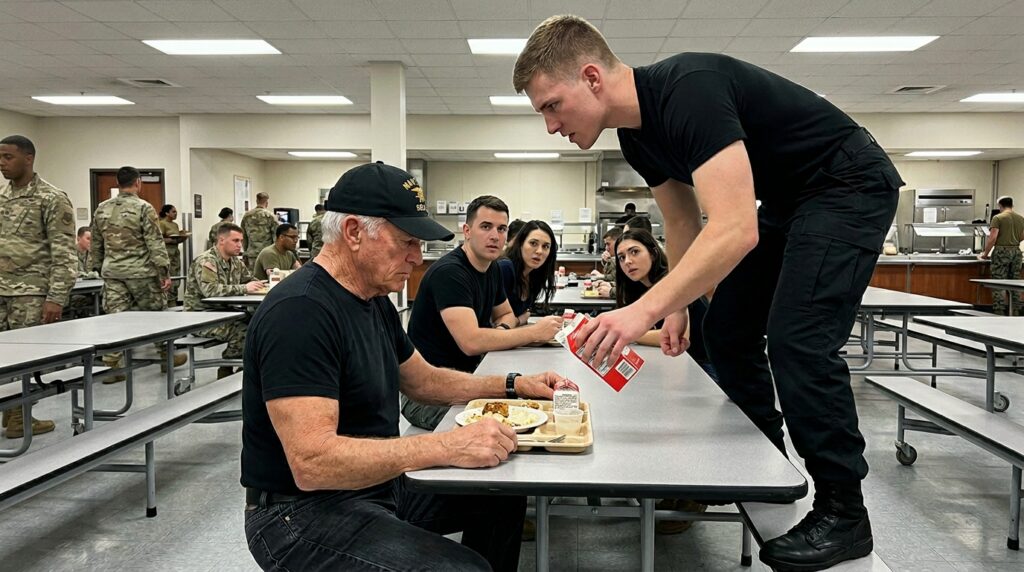
A shadow broke the plane of the flashlight beam at the top of the stairs. It wasn’t the Miller boy. This man was broader, older, wearing a grease-stained canvas maintenance jacket that smelled heavily of diesel oil and cold hydraulic fluid. It was Miller Senior—Thomas. His nose was crooked, poorly set from an old break, and his right shoulder hitched higher than his left with every dragging step he took down the metal rinks. Behind him came the boy, his collarbone wrapped tightly in a clean white medical sling, his face pale and marked with dark purple bruising around the eyes.
“He’s got the key, Dad,” the boy muttered, his voice muffled through a swollen lip. “He took it from the mess hall floor.”
Thomas Miller stopped halfway down the stairs. The beam of his flashlight tracked across the limestone dust, pausing on the fresh footprints Arthur had left near the filing cache. “He’s got more than the key, Danny. He’s standing right behind the separator housing.”
Arthur did not wait to be hunted. He stepped out from the shadow of the beam, his movements heavy but intentional, his boots crunching softly against the fallen grit. The desaturated yellow light caught the front of his stained wool shirt.
“Thomas,” Arthur said, his voice flat as iron plate. “You’re trespassing on facility foundations.”
“Foundations?” Thomas let out a short, wet bark of a laugh that ended in a rattle. He didn’t lower the light; he aimed it straight into Arthur’s eyes, trying to force a blind spot. “This whole valley is built on what you buried under these kilns, Arthur. My boy didn’t come here to steal. He came to find the manifest you signed off on in ninety-one. The one Vance used to tell the state board that our ordnance unit never handled the zinc-dipped casings.”
Arthur held his ground, his eyes narrowing against the glare. The rusted metal sliver in his palm felt hot, the sharp edges pressing into his leather skin. “The records are what they are, Thomas. The unit was decommissioned. The storage was classified under standard detachment protocols.”
“Classified?” Thomas took another step down, the iron grate groaning under his heavy work boots. The smell of cold sulfur and damp earth rose with his movement. “You call it protocols. I call it thirty years of my lungs turning into wet tissue paper while Vance bought a third car and you sat in the dining hall looking like a monument to the good old days. Look at the boy, Arthur. Look at his hands.”
Arthur’s gaze flicked past the light to the young man. Even in the dim, yellow glare, he could see the gray, flaky texture of the skin around the boy’s fingernails—the same chemical vitrification that had taken the men of the old ordnance logistics detachment.
“The boy didn’t serve,” Arthur said, his mind tracking the logic, searching for the structural leak.
“He works the scrap yard at the rail-cut,” Thomas spat, his hand trembling slightly as he held the light. “The same yard where the facility board sold off the old subterranean drainage pipes three months ago. He handled the scale-crust without gloves, Arthur. He’s got the same rattle I have. Vance told us the line was clean. He signed the clearance ledger himself.”
The decoy secret locked into place within Arthur’s calculations. The boy hadn’t been acting out of generational spite; he had been digging for evidence of a recent administrative cover-up—a corrupt deal where Vance sold off contaminated surplus pipe to line the facility’s private maintenance fund, using the old ninety-one denial files as his legal shield. It was a perfect, self-contained truth that explained everything. The boy was the victim of Vance’s current greed, and Thomas was the vengeful hand trying to extract a settlement from the old ledger.
But the metal tag fragment in Arthur’s pocket—the one that had jammed his watch—didn’t belong to a drainage line. It belonged to the primary valve of the deep-core storage cisterns. The ones Arthur had been told were welded shut from the inside before the concrete caps were poured.
If that fragment had shaken loose now, it meant the deep cisterns weren’t sealed. They were leaking into the water table beneath the dry-kiln right now. And Vance wasn’t covering up an old pension lie; he was covering up a dead zone.
“You think Vance is the only one who signed those papers, Thomas?” Arthur asked, his voice dropping into a deeper, colder register.
“He’s the one with his name on the board,” Thomas said, reaching into his canvas jacket. His fingers closed around the rusted handle of a heavy, twelve-inch pipe wrench. The iron tool caught the yellow light, its teeth packed with old black grease. “And you’re the one who keeps his secrets for forty dollars a month and a free bed.”
“Dad, wait,” the boy whispered from the top of the stairs, his voice suddenly small, stripped of its cafeteria bravado. “Someone’s coming down the upper chute.”
A distinct, rhythmic sound vibrated through the iron framework of the kiln—the crisp, synchronized snap of leather soles on the upper concrete floor. Not the dragging gait of a veteran. Not the heavy stomp of a laborer.
The light from Thomas’s flashlight wavered as he swung it toward the upper landing. The glare illuminated a third figure standing at the top of the staircase, silhouetted against the gray drizzle of the lot outside.
It was Director Vance. He wasn’t holding a typewriter ribbon. In his right hand, the dull gray barrel of a standard-issue security piece caught the reflection of the limestone dust, pointing down into the dark.
“I told you to clean the friction, Arthur,” Vance’s voice echoed down the shaft, dry and completely devoid of its administrative patience. “I didn’t tell you to have a town meeting.”
Thomas shifted his weight, his pipe wrench raised, his body coming between the light and his injured son. The micro-tension in the vault solidified into a dead lock, where every participant’s intellect was calculated to the millimeter, and every move carried a heavy cost.
Arthur’s hand slipped slowly into his pocket, his fingers wrapping around the cold, mechanical watch that had ceased to tick. The ultimate final reality remained buried beneath their feet, but the immediate survival loop had just narrowed to zero.








