
CHAPTER 6: THE CRASH AND THE SHATTERED FRAME
The rumble of D. Vance’s panel truck faded as it turned out of the cul-de-sac, leaving behind a blue haze of diesel exhaust that hung motionless in the heavy afternoon air.
I stood at the edge of my driveway, looking down at the round hole left in the asphalt. The steel stake was gone, but the impression remained—a four-inch puncture through three decades of sun-baked tar. The small brass cap buried at the root of the palm tree stayed gleam-bright where Vance’s wire brush had scrubbed away the dirt, its directional arrow pointing like a loaded barrel straight at Evelyn Krauss’s garage foundation.
Across the gravel line, Evelyn’s house was dark. The thick fabric blinds covering her front windows didn’t twitch. But the silence didn’t feel like surrender; it felt like the quiet inside a pressure tank right before a seam splits.
I walked back up the walkway, my boots crunching softly on the sand that had blown across the concrete. I picked up the six-foot palm frond that had dropped during Evelyn’s initial walk-up. The fibrous stem was dry, jagged at the point of fracture, its fan of serrated leaves stiffened by months of sun and neglect.
Before I could drag it toward the side gate, the high-pitched chime of my smartphone rang from my back pocket.
I pulled out the phone. It wasn’t a call. It was a push notification from the doorbell security application: MOTION DETECTED – PORCH CAMERA.
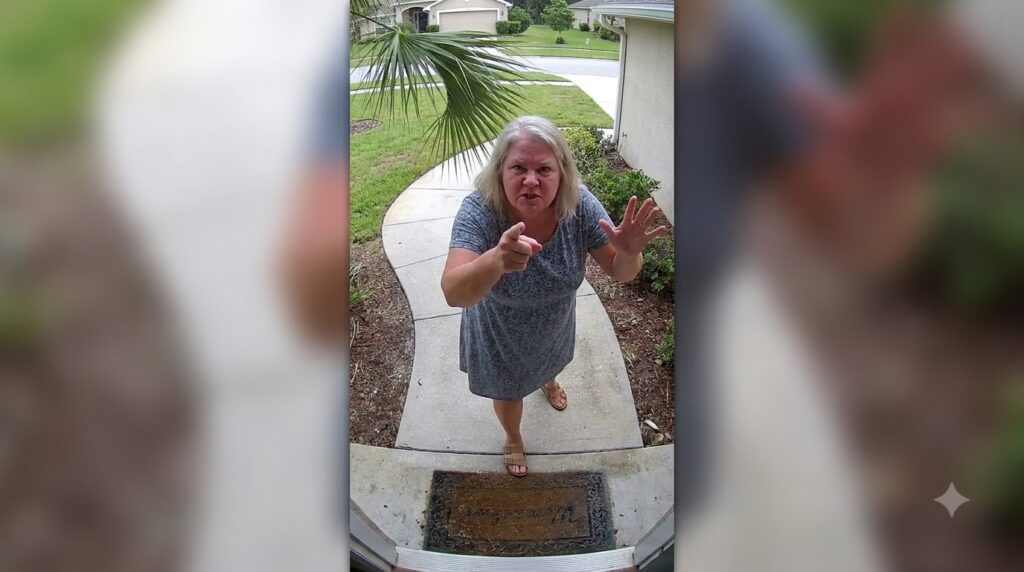
I frowned, tapping the screen. The live feed loaded instantly in a wide-angle fisheye frame.
The porch was empty. My own legs and the tip of the palm frond were visible at the bottom edge of the view. But across the top of the feed, where the camera captured the curved concrete walkway leading down toward the street, a figure was walking up from the sidewalk.
It wasn’t Evelyn.
It was Miller from across the street. He was still wearing his grease-stained blue work shirt, his cloth rag tucked into his rear pocket, his face weathered and dark from forty years under the Florida sun. He walked slowly, his heavy work boots dragging across the concrete, his hands buried deep in his pockets.
I set the frond down and turned around just as he reached the bottom step of the porch.
“You ought to leave that brass cap covered up, son,” Miller said. His voice was a low, gravelly rasp, shaped by decades of tobacco and engine exhaust. He didn’t look at my face; his eyes stayed locked on the green-tinted brass marker gleaming between the roots of the palm tree.
“You knew it was there,” I said, stepping down to the second stair so I was eye-level with him.
Miller took a slow breath, pulling a crumpled pack of cigarettes from his chest pocket. He didn’t light one; he just rolled the paper cylinder between his thumb and index finger.
“Vance—the old man, the electrician who built this place before you—he dug that pin out twenty years ago,” Miller said softly. “When Evelyn and her husband started putting up that brick garage. Old Vance came out here with a spade and a transit, found the benchmark, and realized the developer’s crew had laid out the lot lines six inches wide all the way down the block.”
“Why didn’t he file it with the county?” I asked.
Miller let out a dry, humorless chuckle that sounded like stones grinding together in a bucket.
“Because filing it meant pulling the permits for every house on this side of the street,” Miller said, pointing the cigarette toward his own driveway across the asphalt. “If Evelyn’s garage is sitting six inches inside the public right-of-way, my front porch is sitting eight inches over mine. The whole damn subdivision was poured off a crooked baseline back in nineteen-ninety-four. The developer went bankrupt two weeks after the last roof went on. Nobody wanted to dig it up.”
He stepped closer, his boots crunching on the gravel. He pointed a gnarled, calloused finger at the yellowed vellum map I still held folded in my hand.
“Evelyn’s husband knew,” Miller continued, his eyes darkening. “He knew before he died five years ago. That’s why she keeps that ledger. That’s why she walks this street every afternoon citing people for three-inch grass and unpainted shutters. It ain’t about the rules, son. It’s about keeping everybody so busy defending their own little yards that nobody ever looks down at the ground to see whose foundation is sitting on stolen dirt.”
Before I could answer, a loud, metallic pop echoed from the far side of my porch—the sharp, unmistakable sound of high-tension wire snapping under extreme stress.
I spun around.
The black dome of the doorbell camera mounted beside the front door was dangling from its mounting plate by a single thin copper wire. The plastic housing had been shattered, a heavy iron bolt—thrown or launched from the dense line of hibiscus bushes bordering Evelyn’s driveway—embedded two inches into the wooden doorframe right where the lens had been pointed.
The blue LED ring flickered twice, then went completely dark.
Miller didn’t jump. He just looked up at the dangling camera, then turned his gaze toward the dark, quiet windows of Evelyn’s house. He placed a heavy, calloused hand on my shoulder, his grip tightening just enough to pull my attention back to his face.
“She ain’t going to the city council tomorrow,” Miller murmured, his voice dropping into a harsh whisper. “She’s going to the county courthouse. And when she comes back, she won’t be bringing a utility kid with a hammer. She’ll be bringing a sheriff with a demolition order for that tree—and anything else sitting on that line.”








