
CHAPTER 5: THE THRESHOLD AND THE EYE OF THE CAMERA
The brass cap felt like ice against my fingertips, cold despite four decades under the sun-baked soil.
I didn’t scrape away the remaining dirt with my boots. I stayed on one knee, using my index finger to trace the deep, chiselled groove of the directional arrow stamped into the brass plate. The copper oxidation left a bitter, sour film on my skin. The arrow didn’t point down the property line toward the curb; it pointed at a precise thirty-five-degree angle directly across the strip of crushed white gravel, aiming straight at the southwest corner of Evelyn Krauss’s brick garage.
Behind me, the sound of D. Vance’s steel-toed boots shifted on the asphalt. He stepped over the low curb, his heavy shadow falling across my back as he leaned down to look into the hollow between the palm roots.
“What is that?” Vance asked, his voice losing its flat, bureaucratic drone. He dropped to a crouch beside me, the leather of his tool belt creaking under his weight. “That’s not a standard property pin. Property pins are rebar with plastic caps.”
“It’s a brass benchmark,” I said, wiping the green residue against the thigh of my jeans. “Set by the county public works department during the original subdivision grade.”
Evelyn didn’t move from her gravel border, but her posture went rigid as a fence post. The blue-backed certified plat copy in her hands rustled softly in the faint breeze coming off the asphalt.
“That is an abandoned benchmark,” she said, her voice rising half an octave, sharp and thin. “It has no legal standing in a residential property dispute! The updated survey from the county clerk—”
“The clerk’s office doesn’t supersede a primary survey monument, ma’am,” Vance interrupted, reaching into his vest pocket to pull out a small brass-bristled wire brush. He didn’t ask my permission; he leaned in and scrubbed the dirt out of the stamped lettering surrounding the arrow.
The brass gleamed dull yellow under the afternoon sun as the lettering emerged through the grime: MUNICIPAL EASEMENT CONTROL MARKER – SUBDIVISION 112-114.
“That marker sets the baseline for the entire block,” I said, standing up and dusting the damp soil off my knee. I looked past Vance, straight into Evelyn’s pale, wide eyes. “Which means the six-inch offset isn’t an encroachment by my driveway into your yard. The original road easement was cut six inches further east than the current fence lines.”
I pulled the folded sheet of vellum out of my back pocket again—the hand-drawn site map from the yellowed envelope—and unfolded it against the hood of Vance’s utility truck.
“Look at the red line,” I said, pointing to the grease-pencil mark that cut across the driveway margin. “The line wasn’t drawn to show where my concrete ends. It was drawn to show where the county’s public right-of-way actually sits.”
Vance leaned over the hood, tapping his pencil against the translucent paper. His eyes tracked the coordinates written in cramped, faded pencil on the reverse side. He looked at the vellum, then looked up at the corner of Evelyn’s brick garage, then back down at the brass cap gleaming in the dirt at the foot of the palm tree.
“If this benchmark is active,” Vance said slowly, calculating the angles in his head, “and your driveway follows the vector from this pin… then the six-inch discrepancy isn’t on your lot.” He turned his head toward Evelyn. “It means your garage wall is sitting six inches inside the county easement line.”
The silence that settled over the front porch was heavier than the humid heat.
Across the street, Miller had stepped off his tractor entirely, leaning his elbows against the chain-link fence bordering his yard. Down the cul-de-sac, two more neighbors had walked out onto their front porches, their eyes locked on the yellow utility truck, the orange cones, and Evelyn standing motionless at the edge of her lawn.
Evelyn’s face didn’t flush red. It went a dull, chalky white, the skin around her nostrils pinching tight.
“That’s absurd,” she whispered, though her voice carried across the driveway with terrifying clarity. “That garage was inspected and approved thirty years ago. My husband built that structure in full compliance with town ordinances!”
“He built it using the preliminary plat draft from Book 42,” I said softly, stepping closer to the driveway edge until I was standing just five feet from where she stood on her gravel border. “The same draft you tried to use to cite me this morning. The builder used the wrong boundary marker, didn’t he, Evelyn? And when the county resurveyed the block in ninety-eight, someone found the mistake and buried the notice.”
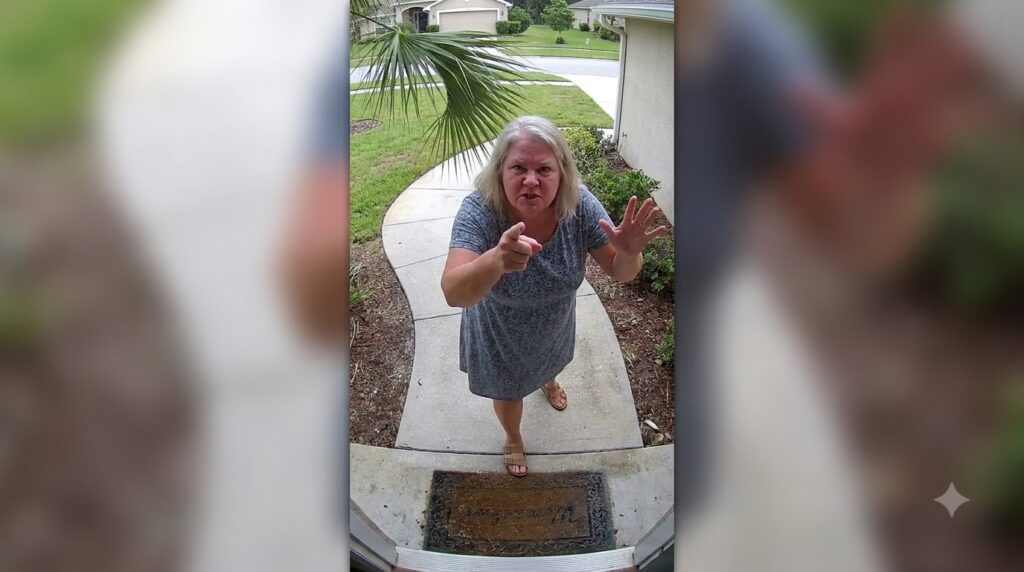
Evelyn’s chest heaved once, a short, ragged breath. Her eyes flicked toward the front door of my house—toward the small black dome of the doorbell camera mounted beside the threshold, its blue LED ring glowing steadily, recording every word, every shift in her posture, every line written on the paper spread across the truck hood.
She didn’t look at Vance. She didn’t look at the map. She stepped backward, her tan sandals crunching loudly in the white gravel.
“You think you’re clever,” she spat, her voice dropping into that harsh, iron-on-stone rasp, though her hand trembled as she clutched the blue folder against her waist. “You think finding a piece of buried brass absolves you of your obligations to this community. This street has standards, and a misaligned monument doesn’t change the fact that your property is an unmaintained disgrace!”
She turned on her heel and marched up her concrete walkway toward her front door, her head held unnaturally high, her shoulders squared against the gaze of the four neighbors watching from their driveways.
Vance watched her front door slam shut with a sharp, echoing bang. He let out a long, low whistle, picking up his sledgehammer from the pavement.
“Well,” Vance said, pulling the steel marking stake out of my driveway asphalt with a single firm yank. “I can tell you one thing for sure, boss. I ain’t driving another pin on this block until the County Engineer comes out here with a transit level.”
He tossed the steel rod into the back of his panel truck and began loading his orange cones, leaving a clean, round hole in the asphalt where the stake had been driven.
I stood alone on the driveway, the hot sun beating down on my neck. The immediate threat to my concrete was gone, the six-inch citation shattered by the old map and the buried brass marker.
But as I looked down at the vellum map resting on my workbench inside the open door, my thumb brushed the cramped pencil handwriting on the back once more: Check the survey pin under the second palm root. She knows.
I hadn’t written those coordinates. Vance’s father hadn’t written them. And as I looked across the gravel line at the blank, windowless brick wall of Evelyn’s garage, I realized the decoy secret—the six-inch driveway dispute—was only the surface of a much older, deeper fracture built into the very foundation of the block.








