
CHAPTER 4: THE IRON PIN IN THE BASEMENT ARCHIVE
The vibration ran up through the soles of my work boots before the sound reached my ears.
Clang.
It was the heavy, flat sound of steel striking steel—the county worker driving a half-inch rebar rod straight through the edge of my driveway asphalt.
I stepped onto the porch without grabbing a shirt or wiping the plaster dust from my forearms. The afternoon air was thick as warm grease, carrying the smell of exhaust and crushed granite from where the utility truck sat idling at the curb.
The worker was leaning over the head of the sledgehammer, his neon-yellow vest stiff with salt rings across the shoulder blades. He didn’t look up when the screen door slammed shut behind me. His name tag read D. VANCE in faded black marker—a young guy, mid-twenties, with dust caked in the creases of his neck.
“You’re driving steel into private concrete, son,” I said, my voice staying low, carrying just enough edge to cut through the idle rumble of the V8 engine.
The kid paused, his calloused hands resting on the hickory handle of the hammer. He wiped his forehead with the back of his leather glove, leaving a dark streak of grease across his brow. He didn’t look angry; he looked exhausted.
“County work order, sir,” he said, tapping a plastic clipboard resting on the hood of the truck. “Boundary verification request filed three hours ago at the municipal clerk’s office. Emergency priority.”
“Filed by who?”
“Evelyn Krauss,” a voice called out from fifty feet away.
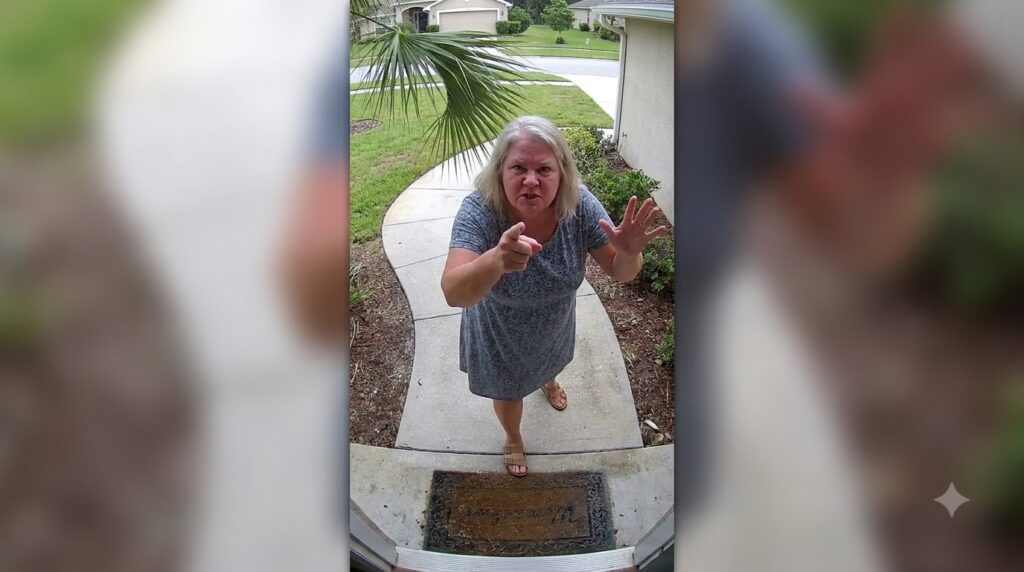
Evelyn was standing right at the edge of her property line, her feet planted precisely on her side of the narrow strip of crushed white gravel separating our yards. She wasn’t holding her ledger anymore. In her hands was a pristine, blue-backed document bound with silver staples—a certified plat copy fresh from the county printer. Her white polo shirt was spotless, her gray-blonde hair slicked back tighter than before.
“Section 12-B of the municipal code permits immediate marking upon submission of a certified survey discrepancy,” she said, her voice dry, precise, completely free of the panic that had sent her scrambling backward through the dirt an hour ago. She didn’t mention the palm frond. She didn’t look at the porch threshold where the dead branch still rested in the grass. “You have six inches of illegal concrete resting on easements deeded to the utility district in 1994.”
I walked down the three concrete steps, my boots crunching softly on the driveway sand. I stopped three feet from the kid with the hammer, looking down at the steel rod he’d driven four inches into the edge of my driveway.
“You checked the origin pin?” I asked the kid.
- Vance blinked, shifting his grip on the hammer handle. “Sir?”
“The origin pin,” I repeated, my eyes turning slowly toward Evelyn. “The iron monument set by the county surveyor back in ninety-four when they laid out Lot 112 and Lot 113. Before you cut concrete or flag a line, you’re supposed to pull reference from the origin pin under the south palm root.”
Evelyn’s hands tightened around the blue folder. For a fraction of a second, the paper creased under her thumbs, the clean white margin folding under the sudden pressure of her grip.
“The county records are unambiguous,” Evelyn declared, stepping two inches closer to the gravel line, though her tan sandals stayed strictly on her side of the boundary. “The plat map on file in Book 42, Page 118 clearly demonstrates that your driveway encroaches on the district right-of-way.”
“Book 42 was superseded by the ninety-eight resurvey,” I said, holding her gaze. I drew the folded piece of vellum out of my back pocket—the thin, translucent sheet with the hand-drawn India ink lines I’d just pulled from the envelope behind the iron railing. “The map you pulled at the clerk’s office was the preliminary draft. Someone left the actual deeded easement map right on my porch.”
The kid, Vance, looked between the two of us, his gaze lingering on the yellowed, brittle paper in my hand.
“Let me see that,” Vance said, reaching out a gloved hand.
“Don’t touch that document,” Evelyn snapped, her voice cracking slightly before she caught herself, smoothing her tone back into the flat, authoritative drone of an official. “He’s presenting unverified, uncertified papers. I have a stamped injunction order from the city code enforcement division pending approval tomorrow morning.”
Vance didn’t take the paper, but he didn’t raise the sledgehammer again either. He set the head of the hammer down on the pavement, wiping his mouth again.
“Look, folks,” Vance muttered, looking down at his clipboard. “I just drive the pins where the work order tells me to drive ’em. If there’s an origin pin under the tree root that contradicts the current map, I can’t touch the driveway until a certified county surveyor clears the line. That’s policy.”
“There is no pin under that tree!” Evelyn’s voice rose, sharp and thin against the afternoon heat. “That tree was planted twenty years ago! Any historical markers were destroyed when the previous owner poured that unauthorized slab!”
I didn’t answer her. I turned my back on her and walked toward the base of the massive trunk near the corner of the porch.
The soil at the foot of the palm tree was dark, packed hard by decades of rain runoff from the eaves. A thick network of fibrous roots jutted out from the base, weaving over and around a rusted iron casing that sat flush with the earth.
I knelt down in the dirt, my knee pressing into the dry grass. I reached into the gap between two thick, woody roots, my fingers digging through years of decayed palm fronds, soil, and coarse builder’s sand until my knuckles struck something hard, cold, and square.
It wasn’t a standard half-inch rebar pin.
My fingers brushed against a heavy brass cap set into a cast-iron collar—a municipal benchmark, green with copper oxidation, buried six inches deeper than any standard residential boundary marker ever should have been.
And cut straight across the tarnished brass surface was a deeply grooved arrow, pointing not toward my house, but directly across the gravel strip toward the corner of Evelyn Krauss’s pristine, brick-faced garage.








