
CHAPTER 3: THE PAPER ARCHIVE IN THE HALLWAY
The paper felt brittle enough to snap.
I didn’t open the envelope out on the porch. The sun was too sharp, and across the cul-de-sac, Miller was still sitting motionless on his tractor seat, watching the empty space where Evelyn Krauss had stood moments before. I carried the envelope inside, using my boot to nudge the oak door shut until the heavy deadbolt clicked into its brass strike plate.
The hallway was quiet, cooled to sixty-eight degrees by the window unit humming in the back room. The air carried the flat, chalky tang of fresh joint compound and the damp scent of unpainted drywall.
I laid the manila envelope on the improvised workbench—a pair of folding steel sawhorses supporting a door slab I’d pulled out of the garage three weeks ago. My fingers left dark smudges of dry palm dust on the yellowed paper.
Whoever had shoved the envelope into the iron scrollwork hadn’t sealed it. The flap was tucked neatly inside the pocket. When I tilted the envelope, two folded sheets slid out onto the raw wood grain.
The first was a carbon copy of an official municipal notice, dated eight years prior. The ink had faded from navy to a dull plum color, but the typewriter impressions were deep enough to leave ridges on the back of the page. It was addressed to the property’s previous owner—an elderly electrician named Vance who had lived here thirty years before his heart gave out in the back garden.
The text was brief, written in the stiff, combative legalese of county zoning boards:
NOTICE OF NON-CONFORMING USE / INGRESS EASEMENT C-14.
Be advised that the concrete slab serving as the primary vehicular driveway for Lot 112 extends beyond the platted private boundary line by approximately six (6) inches along the eastern border…
I shifted my gaze to the second page. It was a hand-drawn site map, rendered in faded India ink on translucent vellum. The lines were precise—drawn with a draftsman’s t-square and hatching pens—showing the boundary line between Lot 112 (my property) and Lot 113 (Evelyn Krauss’s pristine, manicured parcel next door).
A thick red grease-pencil line cut through the eastern edge of my driveway, right where the concrete met the narrow strip of crushed granite and azalea bushes Evelyn spent every Tuesday morning weeding.
I leaned closer, tracing the red line with a thumbnail. According to the drawing, the entire six-inch concrete curb—the structural lip that kept my driveway from slumping into her flowerbed—wasn’t mine. It belonged to Lot 113.
And according to the date stamp at the bottom, the county had flagged it nearly a decade ago, long before I ever signed a deed or picked up a paintbrush.
A low horn sounded out on the street.
I walked over to the front window, drawing back the corner of the canvas drop-cloth covering the glass. A yellow panel truck with MUNICIPAL UTILITY COMMISSION painted on the side was idling at the curb near my mailbox.
The driver didn’t get out right away. He sat in the cab with the window rolled down, his arm resting on the door frame, a clipboard cradled against his steering wheel. He wasn’t looking at my house. He was looking at his side mirror, watching Evelyn Krauss as she stood at the head of her own driveway fifty yards away.
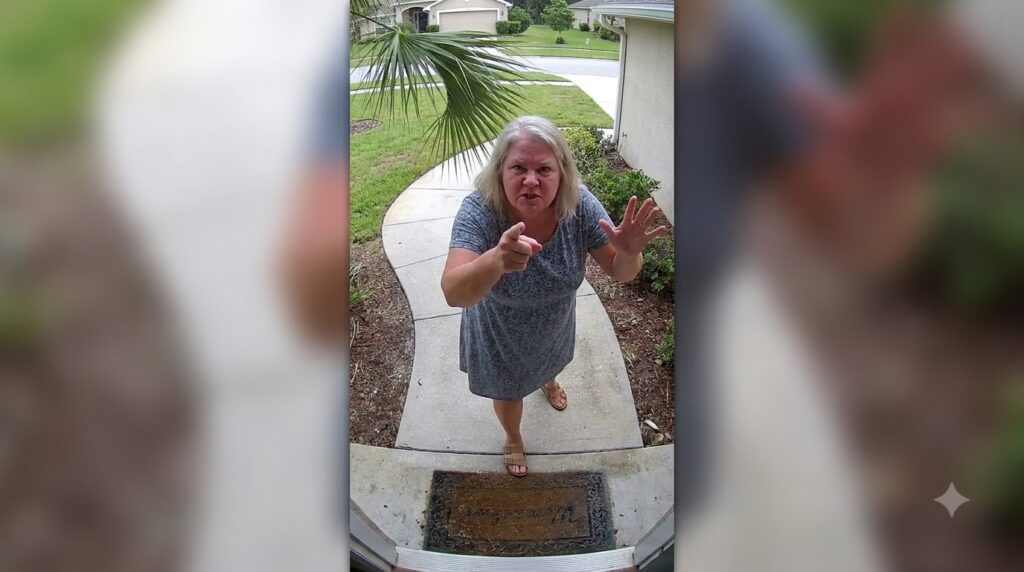
Evelyn had changed her clothes. The dirt-smeared gray-blue dress was gone. She was now wearing a crisp white polo shirt tucked into stiff khaki slacks, her gray-blonde hair brushed flat against her skull. She stood beside her mailbox, her arms crossed tight over her chest, whispering fiercely into a cordless landline phone pressed to her ear.
Every few seconds, her eyes flicked toward my front window.
The driver of the utility truck finally opened his door, his heavy steel-toed boots striking the asphalt with a metallic clatter. He reached into the bed of the truck and hauled out a pair of tall orange traffic cones and a heavy, wooden-handled sledgehammer.
I let the canvas drop-cloth fall back into place, the room darkening instantly.
I picked up the vellum site map again, holding it up against the ambient light filtering through the hallway doorway. The ink was old, but the red grease-pencil line looked fresher—the wax smooth, unblemished by dust, laid down with the steady pressure of someone who knew exactly where to draw the line to make it hurt.
Someone had tucked that envelope behind my porch railing before Evelyn ever marched up the walkway. It hadn’t been left as a warning to me; it was a blueprint.
I turned the page over. On the back, in faint pencil that had almost been erased, were three sets of GPS coordinates and a handwritten note in precise, cramped cursive:
Check the survey pin under the second palm root. She knows.
Outside, the heavy, rhythmic thud of a sledgehammer hitting iron echoed off the concrete driveway as the utility worker drove a steel marking stake directly into the curb.








