
CHAPTER 7: THE REVERSED GAMBIT
“Don’t move, Frank,” Arthur breathed, his weight freezing as the high-pitched hum of the siren cut out, replaced by the heavy, rhythmic thrum of an idling V8 engine just behind the perimeter bushes. “The cruiser’s at the gate.”
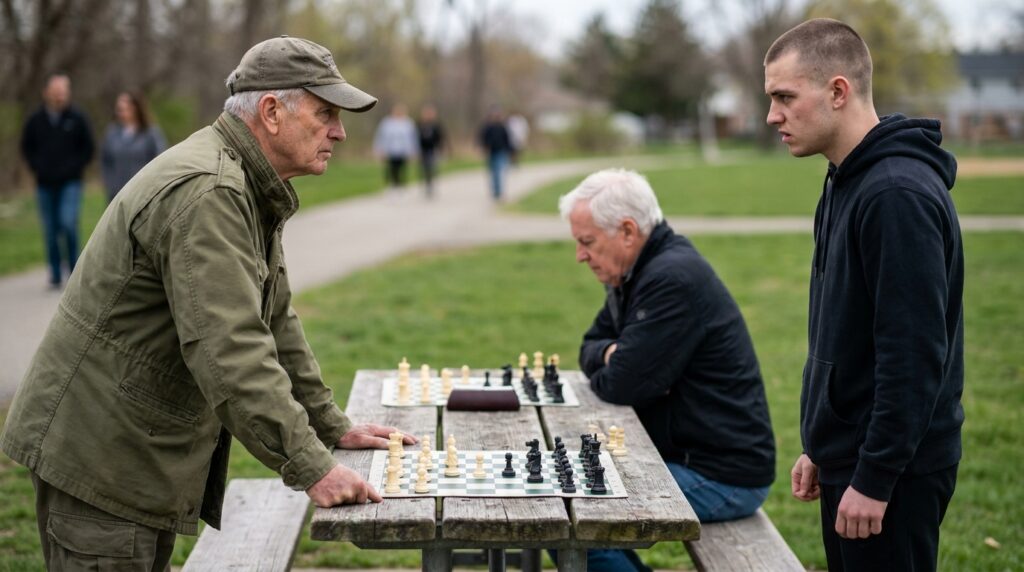
Frank didn’t drop the canvas gym bag. He held the worn strap in his left hand, the rough nylon fabric biting into his palm with a reassuring friction. He didn’t run. Running was an amateur mistake that altered the spatial geometry to the observer’s advantage, granting them immediate probable cause. Instead, he turned his torso toward the park entrance with measured deliberation, his chin up, his spine locked straight beneath the weathered olive jacket.
The white doors of the patrol car swung open, and Officer Miller stepped out into the morning heat. He didn’t draw his sidearm, but his right hand rested loosely on the polymer grip, his thumb unholstering the retention clip with a metallic click. On Miller’s wrist, the silver bezel of an expensive, high-grade tactical watch glinted in the sun—marked by the exact same unpolished, jagged notch that Frank had observed on Tyler and the other youth.
“Drop the bag, old man,” Miller said, his boots grinding against the loose gravel as he closed the thirty-foot gap. He didn’t look at Arthur, and he didn’t look at the spilled chess pieces. His eyes were pinned entirely on the blue cardboard edge protruding from the split zipper of the canvas bag. “We received a report of an active assault and property damage at this table. You’re matching the description.”
Frank stood his ground behind the concrete picnic bench, utilizing the stone as an immovable barrier between his lower lanes and Miller’s advance. He didn’t raise his hands in submission, nor did he drop them into an aggressive posture. He kept them waist-high, his thumb remaining anchored to the cold silver ring of his zipper pull.
“The description belongs to the boys you put on the payroll, Miller,” Frank said, his voice flat, dry, and lacking the pitch of hesitation. He didn’t appeal to Miller’s uniform; he addressed the structural logic of the documentation in his hand. “The ones tracking our hours in the municipal registry. The ones clearing the park so your real estate backers can clear the title.”
Miller’s stride didn’t break, but his jaw masseter muscle twitched violently—the identical physiological response Frank had observed in Tyler when the tactical calculation changed. The officer’s eyes narrowed into tiny, sharp points, his gaze shifting for a microsecond to the park perimeter, checking the empty avenue behind his cruiser. The street was quiet; the morning traffic had cleared, leaving only the dull hum of distant industrial activity.
“You’ve been sitting out here too long, Frank,” Miller said, his tone dropping from an official authority bark into the cold, sharp register of an equal intellect recognizing a threat. He stopped exactly four feet from the opposite side of the chess table, his torso leaning forward slightly, duplicating Tyler’s invasive posture. “Nobody cares about some old service files or a couple of plastic pieces in the dirt. The district is moving on. If you don’t walk out of here on your own feet, you’ll leave in the back of the wagon with a felony obstruction charge.”
Frank evaluated the final parameters. He was an octogenarian facing an armed, thirty-year-old patrolman in an isolated public park. The tactical calculation was heavily asymmetric. If Miller reached for his holster, Frank’s response window was less than half a second. But Frank wasn’t fighting for a physical victory; he was playing the long-form strategy he had refined over decades of service.
He didn’t pull the bag away. He simply reached inside the split canvas with his right hand, his fingers bypassing the ledger to grip the small, silver dictation recorder he always kept in his inner pocket to log his chess opening sequences. He pressed the brass playback button, his thumb steady against the cold casing.
“Fifty bucks, old head,” Tyler’s recorded voice cut through the heavy park air, clear, transactional, and unmistakably distinct from the device’s tiny speaker. “Or I drop this table on your legs. We run the schedule out here… the city doesn’t collect the rent on these slabs.” Then Frank’s own recorded voice followed, dry and unyielding: “Who issued the watches, Tyler?” followed by Tyler’s flat response: “You talk too much for a guy with an old heart.”
The audio played out into the small space between Frank and Miller, the magnetic tape static sounding like teeth scraping against steel. Miller’s hand froze on the polymer grip of his sidearm. His eyes tracked the small silver recorder, then dropped down to the stack of pre-stamped incident reports visible through the torn canvas bag—reports that bore his own unique signature, tied directly to the extortion threat caught on the digital track.
“The federal marshals monitor the real estate allocation funds for this district, Miller,” Frank said, his voice retaining its dry, pine-flat consistency. He didn’t shout; he delivered the data point like a mortar coordinate. “I filed the inquiry three weeks ago when the first vendor was cleared from the corner. They aren’t looking for a street gang. They’re looking for the signature on the authorization form.”
The silence that followed was dense, heavy, and absolute. The blue and red emergency lights from the cruiser’s rooftop bar continued to rotate, casting long, rhythmic shadows of crimson and violet across the weathered concrete of the table and the cracked plastic pieces in the gravel. Miller didn’t draw his weapon, and he didn’t reach for his cuffs. The athletic posture collapsed slightly, his weight shifting from his toes back to his heels as the systemic reality of the trap closed around his own perimeter.
Arthur slowly stood up from the chain-link fence, his white hair catching the flash of the emergency lights, his steadying fingers reaching down into the dirt to retrieve the split white knight. He wiped the gray dust from the plastic head and set it down precisely on the central king’s file of the painted board.
Frank didn’t offer a final speech, and he didn’t wait for an apology. He turned his back to the cruiser, picked up his olive-drab cap from the bench, and pulled it low over his gray hair. He walked out through the narrow three-foot clearance by the green trash can, his stride upright, rhythmic, and unyielding, leaving Miller standing alone in the rotating lights beside an unfinished game.








