
CHAPTER 1: THE SPATIAL THRESHOLD
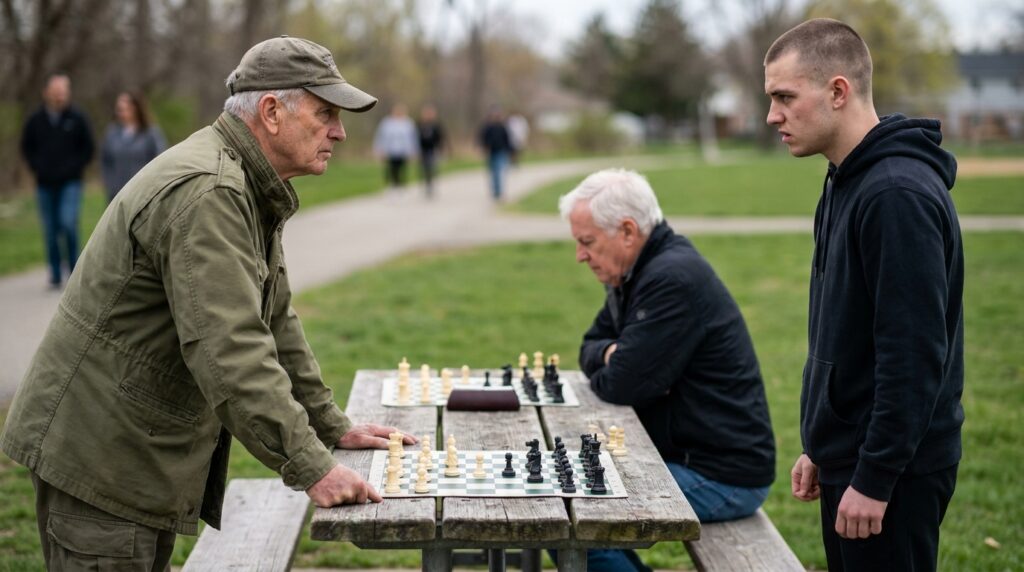
The shadow fell exactly across Frank’s remaining bishop, cutting the clean morning light into two distinct, jagged halves. It was a calculated intrusion, a heavy mass blocking the sun from the eastern side of the concrete table. Frank did not lift his chin. His eyes, trained by decades of looking through the brush rather than at it, tracked the dark fabric of an oversized hoodie and the invasive lean of a tall, athletic torso crossing the painted grid of the chessboard.
“Old man, your time on this table is up,” Tyler said, his breath carrying the faint, chemical tang of cheap energy drinks. “Grab your pieces and clear out.”
Beside Frank, Arthur’s fingers went rigid around a white knight. The polymer piece clicked against Arthur’s ring, a tiny, frail sound that signaled immediate submission. Arthur looked down, his short white hair catching the edge of the shade, his posture instantly collapsing into the standard shape of a bystander hoping to go unnoticed.
Frank’s thumb slid downward along the front of his weathered olive jacket, finding the cold, circular silver ring that served as a zipper pull. He didn’t pull it. He simply held the metal against his pad, measuring the steady, rhythmic pulse in his own hand against the erratic, high-energy shifting of the youth standing opposite him. Tyler’s weight was on his toes—an athletic build, early twenties, a freshly shaven buzz cut that caught the harsh glare of the municipal court lamps. He was leaning too far forward, crossing the vertical centerline of the table, his hands stuffed aggressively into his pockets to project absolute dominance.
To Frank, the park had ceased to be a public recreation area the moment Tyler’s shadow hit the concrete. It was now a corridor of narrow tolerances. He analyzed the environment with the cold, strategic pursuit of a man who spent his youth calculating fields of fire on wet grass. To his left, a chain-link fence offered no exit; to his right, a rusted green trash can restricted lateral movement to less than three feet. The path behind him was clear, but stepping back meant ceding the boundary.
“We’re in the middle of a game,” Frank said. His voice was flat, dry as old pine, lacking the high pitch of panic or the forced gravel of a man trying to sound tough.
“I don’t care about your game,” Tyler laughed, a sharp, transactional bark meant for the benefit of the three teenagers lingering near the basketball courts thirty yards away. He pulled his right hand from his pocket and planted it flat on the concrete, less than two inches from Frank’s pawns. The fingers were thick, unscarred, moving with the careless entitlement of youth. “You’re slow. You’ve been sitting here since eight. Move.”
Frank noticed the slight tremor in Tyler’s left shoulder—not fear, but the raw, unchanneled adrenaline of an aggressor who hadn’t yet met resistance. The boy was open, his weight entirely committed to the forward lean, his balance dependent on the friction of his sneakers against the smooth park concrete. Frank looked directly into Tyler’s eyes, seeing the shallow reflection of the city skyline behind him. He didn’t look at the hand on the table. He didn’t look at the teenagers watching from the court. He kept his spine straight under the olive fabric of his jacket, his breathing deep and silent.
A sudden, metallic scrape echoed from Tyler’s wrist as a heavy, scratched tactical watch dragged across the concrete edge, its bezel catching a small, fresh notch in the stone that hadn’t been there yesterday.








