
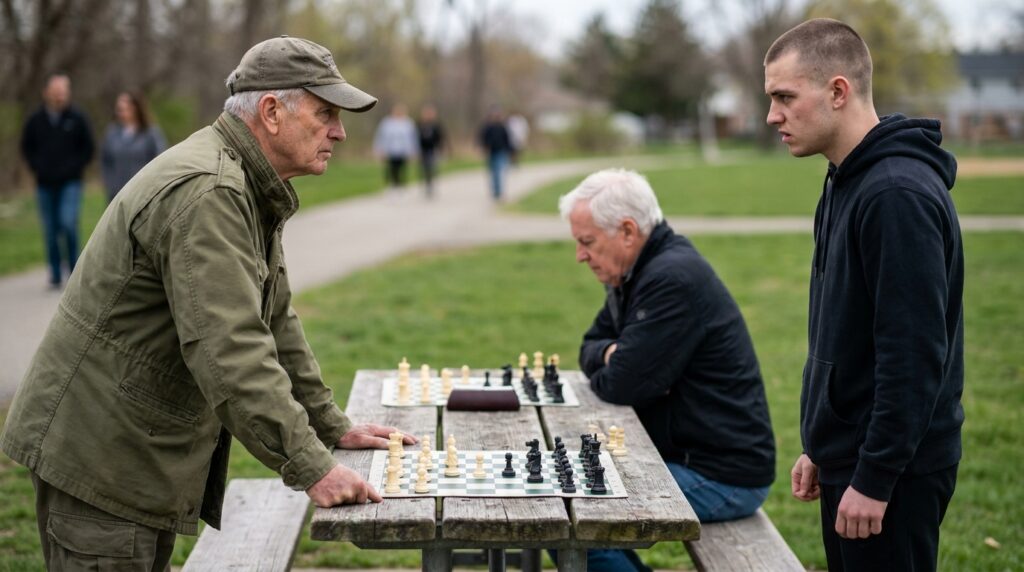
CHAPTER 5: THE DISPLACEMENT MARCH
The transition was not an explosion; it was an unyielding correction of mass. When Tyler’s knuckles grazed the black rook, Frank’s center of gravity shifted forward, his heels striking the gravel with a singular, dense crunch. He didn’t cock his arm or draw back a fist. The economy of his prior training permitted no decorative preparation. He simply rose fully into the vertical plane, his lean frame straightening beneath the olive-drab jacket with the geometric certainty of an iron lever.
Tyler’s reaction time lagged by exactly three-tenths of a second. His gaze was still pinned to the chessboard when Frank’s left palm, flat and hard as a cured structural plank, made contact with the apex of Tyler’s right shoulder. Simultaneously, Frank stepped deep into the young man’s stance, his right boot sliding between Tyler’s sneakers to delete his lateral footing.
It was a standard-issue forward-pressure displacement—minimalist, defensive, and completely unconcerned with spectacle. Frank didn’t strike the chest; he drove his entire body weight through his palm, treating Tyler’s athletic torso not as a target for anger, but as a heavy obstacle to be cleared from a narrow trench. The friction of Tyler’s rubber soles against the park concrete failed under the sudden, continuous accumulation of leverage. His spine went rigid, his chin snapping up as his lungs expelled a sharp, involuntary hiss of air.
“I warned you already,” Frank’s voice cut through the space, a clipped command tone that carried no heat, only the weight of absolute finality. “Now back off and go.”
Tyler stumbled backward two paces, his boots catching the edge of the gravel walkway. His arms flailed briefly to capture his lost balance, his dark hoodie twisting violently around his neck. He didn’t drop into a brawler’s guard; the sheer physical reality of being manually moved by a man three times his age had shattered his internal script. He stood five feet from the table, his chest heaving, his face flushing a deep, dark crimson beneath his fresh buzz cut.
From the perimeter, the two secondary observers didn’t rush forward to bridge the distance. They froze, their boots locked in the dust, their faces dropping the loose arrogance of street-level enforcers. The one with the low-slung gym bag let his fingers slip from the zipper teeth, his eyes darting frantically from Frank’s upright posture down to the scratched tactical watch on Tyler’s trembling wrist. The symmetry of their cordon had collapsed; Frank had completely cleared the interaction lane, reclaiming the table and the surrounding four feet of public territory.
Frank stood behind his pieces, his breathing deep and even, his thumb returning to the cold silver ring of his zipper pull. He didn’t chase the retreat. He didn’t drop into a defensive crouch. He simply held his ground, his eyes locked onto the small, pulsing vein at the side of Tyler’s neck, monitoring the young man’s internal debate between pride and survival.
But the victory was a false flag. As Tyler stepped back, his heel caught the strap of the canvas gym bag dropped by his partner during the initial freeze. The bag rolled over, its heavy zipper splitting completely under the strain of its contents. A thick, bound cardboard ledger slid into the gravel—not filled with casual gang tallies, but bearing the crisp, gold-leaf municipal emblem of the city parks department administration office. Beside it, a stack of official precinct incident reports fell open, each one stamped with the private signature of the community liaison officer from the local precinct.
Frank’s eyes tracked the documentation in the dirt, registering the paradigm shift in less than a heartbeat. This wasn’t a standard park shake-down for pocket change. The names of every regular elderly chess player, including his own and Arthur’s, were systematically cross-referenced with red ink marks and eviction dates. The street kids weren’t acting on local entitlement; they were working under a structured, institutional mandate designed to systematically clear the older residents from the district’s public spaces.
“Hey—we’re done here,” the youth with the windbreaker muttered suddenly, his voice thin and panicked as he lunged down to grab the scattered documents, his tactical watch scraping loudly against the loose stones. He didn’t look at Frank; he shoved the ledger back into the split canvas, his movements frantic, entirely stripped of his previous tactical discipline.
Tyler broke eye contact first, his jaw twitching under the pressure of the surrounding silence. He looked at his partners, then down at the split plastic knight near his shoe, his unearned confidence completely neutralized by the revelation of the ledger. “Fine,” he spat, his voice tight and reluctant as he stepped back toward the main avenue. “Fine. I’m leaving.”
Arthur remained pinned against the chain-link fence, his white hair messy, his knuckles white as he watched the three youths withdraw down the gravel path toward the parked cars outside the gate. The park around them returned to its regular, dull city hum, but the air between the concrete tables remained charged with the cold, unpolished truth that had just spilled into the dust. Frank did not sit down. He kept his eyes on the avenue, his thumb resting against the cold metal of his jacket ring, realizing the perimeter he had to defend extended far beyond the edges of the painted board.








