
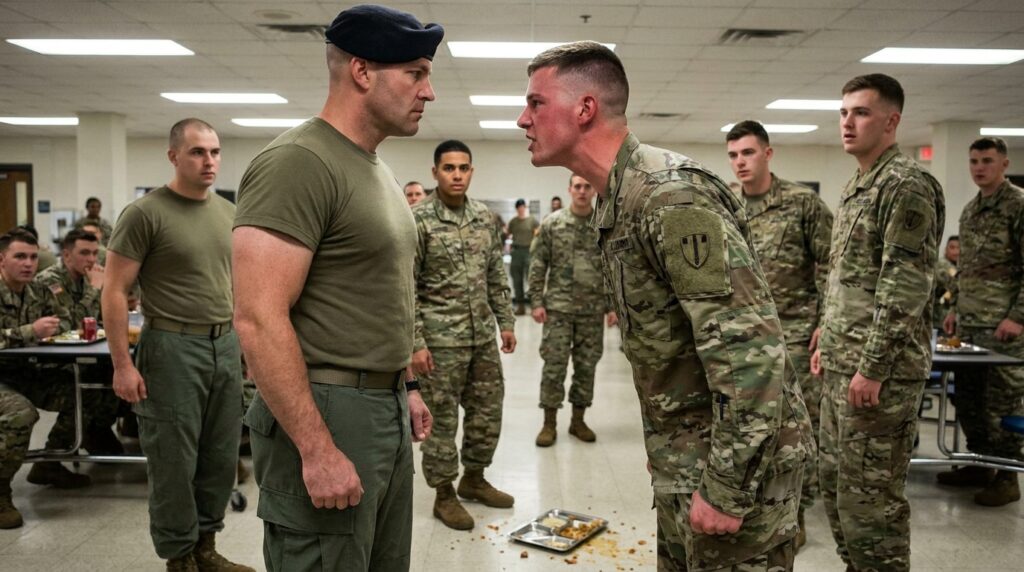
CHAPTER 5: THE APEX OF THE CROWD
“The Colonel wants the room cleared immediately, Sergeant Major,” the administrative captain said, his hand bracing the heavy steel frame of the doorway.
He didn’t step fully into the holding room. Instead, his eyes darted from Private First Class Miller’s shivering shoulders to the massive shape of Marcus Vance leaning against the back corner’s cinderblock wall. The red clearance folder clamped under the captain’s arm was thick, its edges reinforced with heavy plastic tape that caught the hard overhead glare like a blood-slick blade.
Command Sergeant Major Reynolds snapped his head around, his jawline locked so tight the skin over his limestone features turned a brittle, bloodless white. “The interrogation is active, Captain. This private is in possession of a high-security asset card. The chain of custody is compromised.”
“The chain of custody has been re-routed,” the captain snapped back, his voice tight, carrying the fast-paced panic of someone delivering a death warrant. He stepped forward exactly twelve inches, extending the red file toward Reynolds. “Special Authorization Order 40-Alpha. Signed by the Base Commander ten minutes ago. The screening cycle isn’t being halted, Sergeant Major. It’s being locked down under external oversight.”
Vance watched the exchange from his corner, his pulse remaining at a flat, calculated fifty-two beats per minute. His tactical intellect dissected the layout instantly. The captain’s boots were pristine, but there was wet red clay clinging to the inner groove of his left heel—the specific soil from the perimeter fence where the Department of the Army’s Safeguards team had set up their mobile command trailer. This clerk hadn’t come from the Colonel’s office upstairs. He had come from the wire.
Reynolds ripped the folder open, the stiff cardboard crackling in the small room like dry brush catching fire. As the Sergeant Major’s eyes scanned the typed lines, Vance stepped out of the shadows. His heavy cargo pants didn’t rustle; his movement was entirely silent, a dense shadow sliding over the concrete until he stood over Reynolds’s shoulder, his gaze dropping to the paper.
The document was an immediate transfer of authority. Third Platoon wasn’t being court-martialed for cheating; they were being isolated for immediate field deployment under a classified operational annex. The black notebook and the brass card were explicitly listed as internal training props—controlled counter-intelligence bait designed to identify personnel susceptible to coercion before deployment.
Vance’s mind cleared the board, resetting the pieces with a cold, unforgiving click.
Miller’s squad hadn’t found a leak. The server breach had been an engineered test. The red three-dot card Miller had used to mock him in the dining facility was never a stolen key; it was a tracking beacon. And by stepping in to neutralize the boy, Vance hadn’t just exposed a cheating ring—he had intercepted a live, controlled screening operation overseen by the base’s highest authorities. The decoy secret of the simple leaked keys had just fractured, exposing a far wider structure of institutional manipulation.
“They knew,” Miller whispered from the steel table, his face draining of what little color remained. He looked up at Reynolds, his fingers clawing at the cold metal edge. “The Specialist… Geller said it was too easy. They left the doors unlocked on purpose. They wanted us to take it.”
“Shut your mouth, Private,” Reynolds growled, but the flat, gravelly weight of his voice had vanished, replaced by the hollow realization of an old soldier who had just discovered he was policing a stage play. He looked up at Vance, his eyes dead and unblinking under his gray brows. “Master Sergeant… if this order is authentic, my reporting line is cut. The Colonel isn’t the one running this installation anymore.”
“He never was, Sergeant Major,” Vance murmured, his voice a low, level rasp. He reached out, his thick, scarred thumb pressing against the signature block of the order. The ink was fresh, but it lacked the standard department watermark. It was a local fabrication—an automated emergency printout meant to freeze local leadership before they could document the breach on official channels.
The captain stepped into the room now, his hand dropping to the buttoned flap of his service holster. “Master Sergeant Vance. You are a civilian consultant on this base. Your contract covers tactical instruction, not structural oversight. You will surrender the private’s notebook and vacate the administrative block immediately.”
The room’s geometry shifted toward a violent execution lane. The captain was tense, his weight distributed poorly on the balls of his high-gloss boots, his shoulder twitching with the telegraphed panic of a desk officer out of his depth. Vance stood three feet from him. The steel table was an obstacle, the hanging light bulb a visual barrier, the small concrete space a trap for anyone who couldn’t move within sixty milliseconds.
“You’re breathing too fast, Captain,” Vance said, his eyes narrowing as he locked onto the man’s posture. “And your holster flap is still secured by the storage clip. If you’re going to threaten a Tier 1 consultant in a closed cell, you should ensure your equipment isn’t configured for office work.”
The captain flinched, his fingers freezing on the leather flap. The psychological leverage of Vance’s absolute stillness slammed into him, stopping his momentum as cleanly as the collar lock had broken Miller in the cafeteria.
Vance didn’t look at the clerk’s face. He looked at the red folder in Reynolds’s hand. Underneath the primary transfer order, tucked into the plastic sleeve of the cardboard binding, was a second, smaller document—a list of five names, all senior tactical instructors assigned to the base.
Vance’s own name was at the top, marked with the same purple inspection dye he had found on the binding of Miller’s notebook.
The final reality remained locked behind the iron door, but the immediate target had changed. Vance wasn’t here to evaluate the recruits. The base command structure was evaluating him—and the test had just entered its second phase.








