
CHAPTER 4: THE PRESSURE OF THE LOCK
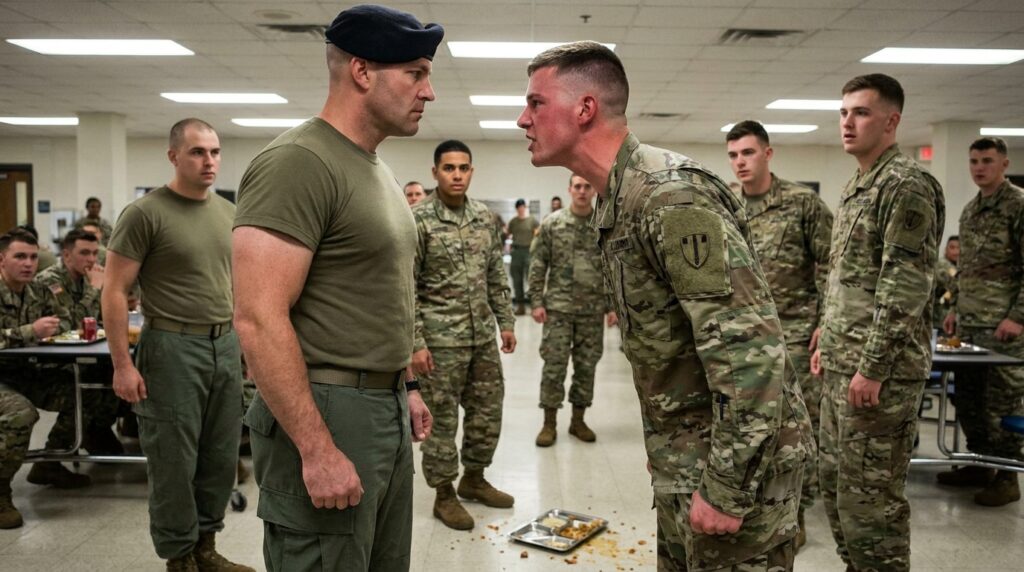
“You skipped three steps on your approach, Private,” Marcus Vance said, his boots clicking in a low rhythm against the dark concrete floor of the corridor outside the main dining hall.
Behind them, the muffled clatter of five hundred scraping trays died out, replaced by the damp, quiet chill of the headquarters basement tunnels. Command Sergeant Major Reynolds walked two paces ahead, his arms locked rigidly behind his back, his polished low-quarters moving without a single hint of hesitation toward the administrative holding blocks. Miller followed between them, his boots dragging, the knees of his camouflage uniform still wet with grease and gray dishwater from the floor.
“I didn’t… I didn’t mean to cross a line, sir,” Miller muttered, his teeth clicking together in a tight, uncoordinated rhythm. The arrogance that had inflated his chest minutes before had collapsed entirely, leaving behind only the cold, mechanical panic of a junior soldier who had just realized his entire squad was pinned to a sinking ship.
“You didn’t just cross it, Miller. You built a camp on it,” Vance murmured, not turning his head. His eyes mapped the architecture of the corridor: concrete pillars spaced every twelve feet, heavy iron electrical conduits running overhead like black veins, and the stark glare of reinforced wire-glass windows looking into empty briefing rooms. It was an environment designed to suppress noise and individual leverage. Every surface was cold, flat, and hard.
Reynolds stopped abruptly in front of a heavy steel door marked Enlisted Administration – Secure Holding. He turned his key in the lock with a sharp, double-click that echoed down the concrete passage. He pushed the door open, stepped inside, and waited until Miller and Vance cleared the threshold before slamming it shut. The heavy iron latch dropped with a finality that made the air in the room expand against Vance’s ears.
The room was small—ten by ten—with a single bolted steel table and two plastic chairs. No windows. A single, naked bulb hung from an iron box in the ceiling, casting long, sharp-edged shadows down the cinderblock walls. On the table sat the black tactical notebook Vance had spotted under the paper napkins in the dining hall, brought along by Reynolds’s orderly without a single word being spoken.
“Sit,” Reynolds barked.
Miller dropped into the nearest chair as if his joints had been dissolved by acid. His hands flat on the cold steel table, he stared down at his own knuckles, his short infantry haircut glistening with sweat under the bare bulb.
Vance walked to the far corner of the room, leaning his massive, muscular shoulders against the cold concrete block. He didn’t sit. He liked the vertical advantage; it allowed him to look down at the geometric lines of Miller’s posture, noting the twitch in the boy’s right forearm and the shallow, frantic rise and fall of his chest.
Reynolds picked up the tactical notebook, threw it flat onto the center of the steel surface, and leaned forward until his weathered, stone-carved face was three inches from Miller’s eyes.
“Where did you get the keycard, Private First Class?” the Sergeant Major asked, his voice dropped to a level that was deadlier than a shout. “And don’t tell me you found it in the motor pool. That card is serialized to the Base Commander’s inner desk. The logs show it hasn’t been checked out since the readiness evaluation materials arrived last Monday.”
Miller’s tongue darted out to wet his lips. His gaze flicked to the notebook, then up to the green beret resting low on Vance’s brow, looking for any gap in the wall. Finding none, his shoulders slumped further.
“It was Specialist Geller,” Miller whispered, his voice cracking under the pressure of the single light bulb. “He… he said the assessment keys were already leaked on the internal server. He said everybody was using them to pass the tier-one screening. We weren’t the only ones, Sergeant Major. The whole third platoon has the files in that notebook. We just needed the physical pass to clear the terminal in the study room.”
Vance’s internal ledger shifted. It was an elegant answer—too elegant. A Specialist in an infantry battalion didn’t simply find a hole in an encrypted command server, and he certainly didn’t walk out of the headquarters building with a Class-A security card without tripping three separate silent indicators. The kid was telling the truth about the cheating, but the explanation was a false flag. It was a decoy secret designed to satisfy an investigator who was only looking for a standard case of academic fraud among the ranks.
“Geller didn’t steal that card, Miller,” Vance said from the darkness of the corner, his voice causing the boy to flinch. “A Specialist doesn’t have the biometric clearance to open the secondary locker where that brass is kept. Someone handed it to him. Someone who wanted your squad to walk into that study room and download those files.”
Miller looked up, his pupils wide and dark. “No, sir. I saw the logs on Geller’s phone. It was an open link. It came from the operations officer’s clerk. We just thought… we thought someone forgot to lock the folder after the morning brief.”
Reynolds turned back toward Vance, his bushy gray eyebrows drawing together in a hard, investigative line. “Master Sergeant, if third platoon has been using leaked keys, the validity of the entire combat readiness score is compromised. I’ll have to notify the Colonel immediately. We’ll have to halt the staging sequence.”
Vance didn’t answer right away. He walked to the table, his thick, scarred fingers picking up the black notebook. He flipped through the pages, his eyes skipping past the handwritten tactical diagrams and the strings of alpha-numeric assessment keys until he found what he was looking for: a tiny, purple ink smudge on the inside margin of the binding. It wasn’t an operational stamp. It was an inspection dye—the specific kind used by the Department of the Army’s Internal Safeguards Division to track documents during counter-intelligence stings.
The trap wasn’t just local.
Vance looked at Reynolds, the reality of the situation clicking into place like the teeth of a heavy gear. If Reynolds called the Colonel to report the leak, he would be walking directly into a pre-engineered snare. The leak hadn’t been an accident by a careless clerk. It was a bait system, and Miller’s squad was just the vermin that had tripped the wire. But before Vance could voice the calculation, the iron handle of the secure room door rattled violently.
The latch clicked back, and the door swung open, revealing the sharp, high-gloss leather boots of an administrative captain standing in the cold light of the corridor, an urgent red clearance file clutched tightly in his hand.








