
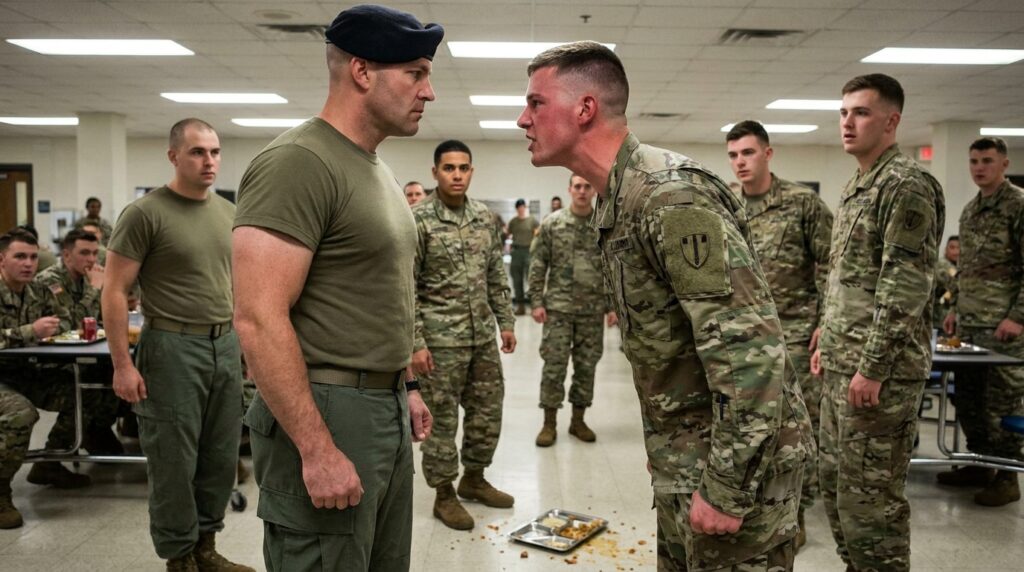
CHAPTER 2: THE SHARP EDGE OF THE CROWD
“You’re tracking something you shouldn’t be, Private,” Marcus Vance said, his voice a low, granular vibration against the roar of the dining facility’s refrigeration units.
He didn’t release the collar. The starched camouflage fabric remained gathered in his fist, a stiff knot of cotton-poly blend that kept Private First Class Miller anchored at a precise, forward-leaning tilt. Up close, the boy smelled of cheap hair pomade and the cold, metallic sweat of someone who had just realized his armor was made of paper. Miller’s eyes darted downward, his pupils dilating as he tried to follow Vance’s gaze toward his unbuttoned chest pocket.
The brass edge of the serialized keycard glinted under the harsh, unshielded fluorescent bars overhead. To an ordinary recruit, it looked like a standard facility pass. To Vance, who had spent a decade routing operational logistics through the dark corners of the Pentagon’s elite readiness groups, the specific layout of the three indented ridges near the magnetic strip was unmistakable. It belonged to the Base Commander’s inner sanctum—the secure planning room where the upcoming Tier 1 combat assessment keys were stored.
“I don’t… I don’t know what you’re talking about,” Miller stammered. His cockiness had dissolved into a frantic, shallow breathing pattern, his chest heaving against Vance’s arm. “It’s just an old locker badge. Let go of me.”
“Locker badges don’t carry the red three-dot stamp of Fort Hogan’s headquarters command cell,” Vance murmured, his voice cutting through the localized silence like a razor blade through wet canvas. “And they certainly don’t match the specific metallurgy of a Class-A encrypted lock cylinder. Try again, Private. While you still have the breath to manage it.”
Behind Miller, the three members of his squad had stopped grinning. Their bodies, previously loose and arrogant, snapped into a rigid, defensive alignment. The largest of them—a square-jawed specialist with a recent combat infantry badge pinned to his chest—shifted his boots on the linoleum, his hand dropping toward his side in a mechanical reflex that simulated a weapon draw. He took a single, heavy step into the aisle, his boots crunching through the splattered meatloaf and creamed corn.
“Hey, pal,” the specialist muttered, his voice dropping into a menacing, transactional tone. “The Private told you to let him go. You’re a civilian contractor. You touch active-duty personnel again, and this room isn’t going to be big enough for you to hide in.”
Vance didn’t turn his head toward the specialist. His vision remained fixed on Miller, but his peripheral awareness locked onto the specialist’s posture, calculating the distance at precisely five and a half feet. A lunging step would take ninety milliseconds; a swinging blow would take double that. The environment was filled with sharp edges—the stainless steel edges of the tray return line, the bolted metal legs of the dining tables, the hard concrete floor. Every object was a potential point of leverage or disruption.
“Sit down, Specialist,” Vance said, his tone entirely devoid of anger, carrying only the absolute weight of professional certainty. “Your squad leader is currently a half-second away from a structural separation of his collarbone. If you move your right foot another three inches forward, I will use his mass to break your knees.”
The specialist froze, his boot hovering a fraction of an inch above the grey linoleum. The sheer psychological dominance of the command—issued without a single trace of hesitation or theatrical bravado—slammed into the squad like a physical barrier. They were trained for violence, but they were trained within the boundaries of conventional military protocols. They had never encountered a man who measured an alley fight with the clinical indifference of an actuary.
Miller’s fingers were still clawing uselessly at Vance’s wrist, trying to find a gap in the tendon, a moment of weakness to break the lock. But Vance’s grip was absolute, maintained by decades of muscle memory that had held target indicators steady during high-altitude jumps and deep-sea insertions. He could feel the pulse in Miller’s throat spiking past one hundred and forty beats per minute.
“Who gave it to you?” Vance asked, his eyes narrowing as he analyzed the micro-expressions on the boy’s face.
“Nobody,” Miller hissed through gritted teeth, his eyes darting frantically toward his table, where a black tactical notebook lay half-hidden beneath a pile of paper napkins. “It’s none of your business. You’re just a guest instructor. You’re supposed to teach us how to shoot, not poke your nose into base security.”
Vance’s internal logic clicked into place. The squad wasn’t just bullying recruits for amusement; they were protecting an active breach. The tactical notebook, the keycard to the commander’s office, the sudden, hyper-aggressive territorial defense of a simple cafeteria aisle—they had the assessment keys. They were planning to cheat on the Tier 1 deployment readiness evaluations, a screening process designed to filter out the psychologically unstable before they were sent into high-threat operational zones.
“It becomes my business when the men I am sent to evaluate turn out to be thieves,” Vance said softly. He allowed his left hand to rise, his index finger tracing the red security stamp on the exposed card without breaking his right-handed grip on Miller’s neck. “Because a thief in a staging area is a corpse in the field. And I don’t waste my time training ghosts.”
The silence in the dining facility had deepened into something suffocating. The hundreds of recruits at the surrounding tables had entirely stopped eating, their faces turned toward the aisle like rows of grey stone markers. The air was thick with the low, electric hum of the overhead lights, casting long, sharp shadows across the concrete.
Vance could feel the tactical paradigm shifting. He had the private locked down, but the squad was getting desperate. The specialist’s jaw was clamped tight, his eyes darting toward the exit doors at the far end of the facility, looking for a distraction, a way out before the structural reality of the base crashed down on them.
Then, from the far side of the double-doored entryway, the unmistakable, heavy rhythmic click of polished low-quarters boots began to echo down the long concrete corridor, moving steadily toward the mess hall.








