
CHAPTER 8: THE HEAVY GROUND
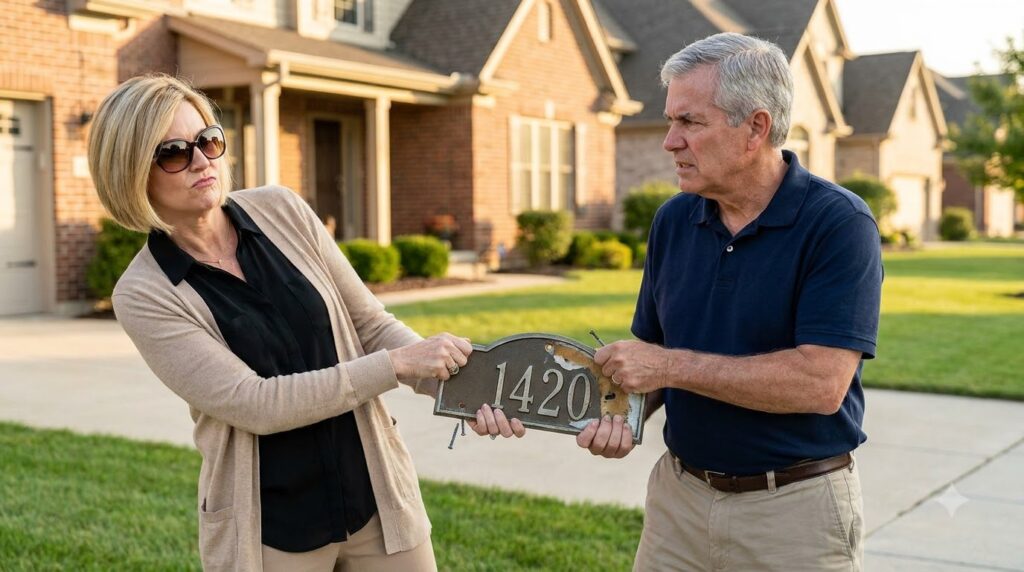
The plate was colder than the frost gathering on the grass.
Arthur carried it against his chest, two bare thumbs hooked into the recessed notches beneath the numerals, thirty pounds of blackened pig iron dragging at his shoulder blades. The wind across the cul-de-sac came hard out of the north, biting through his wool collar and whipping up a skim of fine, alkaline road dust that gritted between his teeth.
He didn’t take the asphalt. He cut straight across the manicured easement between lots 7408 and 7410, his heavy boot soles breaking through the frozen turf. Underneath the clipped grass, the soil felt dead and springy—a shallow skin of topsoil laid over three feet of uncompacted aggregate.
The clubhouse was lit up like an operating theater.
Four recessed quartz halogens washed the covered portico in sterile white, illuminating the fleet of late-model crossovers lined along the curb. Arthur didn’t knock. He set his shoulder against the double brass push-bars of the side conference entrance and leaned his weight in.
The pneumatic latch clicked, gave way with a hiss, and the heavy door swung open.
The boardroom was warm, smelling of heated carpet fibers, stale machine coffee, and lavender furniture wax. Seven people sat around an eight-foot polished walnut table, their winter coats draped over the backs of leather swivel chairs.
At the head sat Karen. Her laptop was open, its screen casting a cold rectangle of blue light onto her sharp jawline. To her right sat an elderly man in a camelhair sweater—the board treasurer—holding a fountain pen poised over a bound green ledger.
The door swung shut behind Arthur with a soft, velvet thud.
The room went dead silent.
“Arthur,” Karen said. Her voice didn’t rise; it tightened into a dry, flat wire. She didn’t look at his eyes. She looked straight at the black iron slab tucked under his arm. “This is an executive board proceeding. Non-directors are excluded under Section 9. You need to leave.”
Arthur walked down the center runner, the mud from his work boots grinding into the beige loop pile. He stopped two feet from the end of the walnut table, swung the plate up with both hands, and brought it down flat on the polished veneer.
The crash rang like a church bell in a stone vault.
A porcelain saucer jumped and shattered against the floor. The treasurer recoiled, his chair rolling back until it bumped the drywall.
“Item one on your agenda,” Arthur said.
The cast iron lay directly across Karen’s printed agenda papers, pinning them flat under forty pounds of metal and stripped lead. The exposed copper strip gleamed dull red beneath the fluorescent fixtures, the stamped Department of Environmental Protection docket legible from five feet away: TRI-COUNTY TANNERY CHROMIUM SLAG CONTAINMENT.
The treasurer leaned forward, adjusting his wire-rimmed glasses, his gaze snagging on the seal. “Karen… what is that?”
“It’s scrap iron,” she said, her knuckles turning bone-white against the edge of her laptop. She pushed her chair back, rising half an inch, trying to summon the crisp, commanding posture of a presiding officer. “Arthur has had an ongoing variance dispute regarding exterior fixtures. He’s trespassing.”
“Read the docket, councilman,” Arthur said.
He unbuttoned his canvas coat and pulled the three black surveyor’s field books from his interior pocket. He laid them beside the iron, the waterproof buckram bindings stiff and yellowed with age. Next to them, he laid the First Merchants Bank receipt, its faded purple carbon face-up on the mahogany.
“Your father paid eighteen thousand dollars in ninety-four to seal the bore logs,” Arthur said, his voice level, carrying the slow, immovable cadence of a man who had already measured the cost to his own blood. “My father took the check. He set the monument pin four inches into the brick veneer of my porch so the county wouldn’t dig where the leaching trench met the spillway.”
Karen didn’t look at the check. Her eyes remained locked on the copper plate. “My father did what was necessary to stabilize this township after the mills shut down. He brought three hundred families here. He gave this valley tax revenue when the state was ready to abandon it.”
“He built their living rooms over an open sewer,” Arthur said. “David Young’s tap water is coming out brown tonight, Karen. His little girl can’t drink out of her own bathroom sink.”
A sharp gasp came from the woman sitting at the far corner of the table—the Miller boy’s mother. She pulled her hands away from the papers in front of her as if the table itself had become hot. “Karen… is that why the baseline water pressure dropped in the north cul-de-sac?”
“The infrastructure is sixty years old,” Karen said, her voice rising now, losing its brittle cadence. She jabbed a finger at the papers under the iron slab. “If this gets logged with the state registrar, every deed in this development is frozen by morning. The banks don’t negotiate environmental superfund status. You won’t sell these houses. You won’t refinance them. You won’t even be able to bequeath them to your children without paying thirty thousand dollars in remediation escrow per lot!”
She leaned across the table, her face inches from Arthur’s, the frantic, defensive logic of a daughter defending a family empire stripped bare.
“You’re sixty-eight years old, Arthur! You live alone! What does it cost you to let the board buy David out quietly and recap the line?”
Arthur looked down at the receipt bearing his father’s initials. He reached out, his rough index finger tracing the worn edge of the bank slip.
“It costs the truth,” Arthur said.
He reached into his watch pocket, pulled out the brass key, and laid it directly across the face of the survey notch. The notched teeth dropped into the four milled slots with a heavy, precise click that resonated through the quiet room like a gun bolt seating home.
“I’m not selling my father’s silence twice,” Arthur said. “Call the county surveyor, councilman. I’ve already dialed the state inspector from the truck.”
Karen froze, her mouth slightly parted, staring at the brass key locked into the iron plate.
Down the hallway, through the glass of the front entrance, the high, rhythmic wail of a township siren cut through the freezing night, followed by the sweep of red and blue emergency flashers reflecting off the white portico columns.
Arthur turned his back on the walnut table. He didn’t pick up the iron. He didn’t take the books. He left them where they lay, heavy and unmovable in the center of the room, and walked out into the cold air to meet the flashing lights on the road.








