
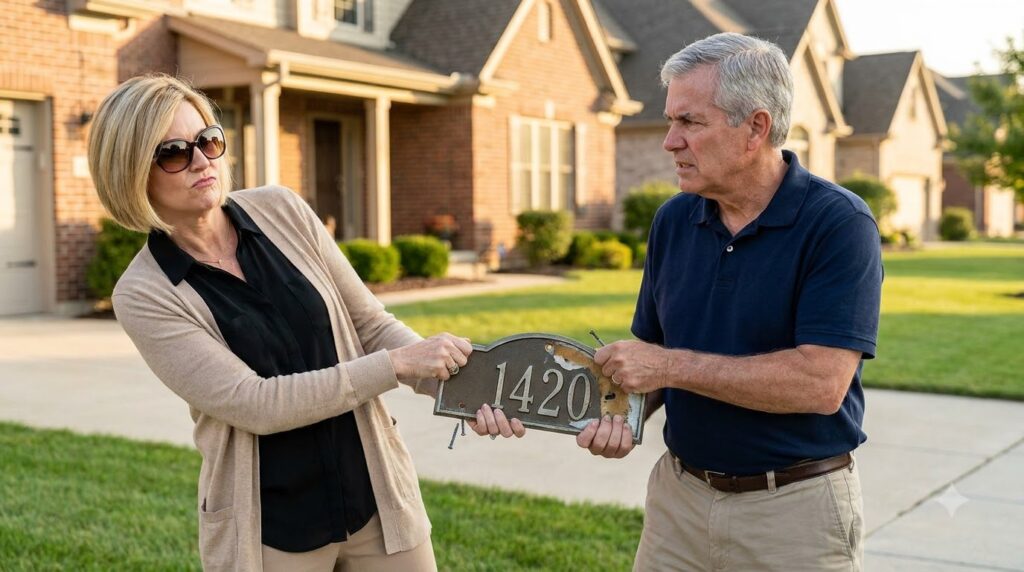
CHAPTER 4: THE SUBTERRANEAN SEAL
The dust kicked up by Karen’s tires hadn’t settled against the curb before Arthur was back through the screen door, his boots tracking dried slurry across the linoleum.
He didn’t turn on the kitchen overhead. In the utility room, the sixty-watt bulb hummed inside its wire cage, casting long, stark shadows across the pine bench. The cast-iron address plate sat where he had left it, an unyielding slab of blackened iron resting on oil-stained wood.
Arthur reached beneath the sink and pulled out a heavy jug of acetone and a steel bastard file.
His fingers didn’t tremble, but there was an ache in his forearms—the deep, dull burn of a man who had spent forty years working against the grain of stubborn materials. He poured a puddle of solvent directly into the recessed cavity behind the raised numerals. The chemical reek bloomed immediately, stinging his nostrils and cutting through the familiar smell of dried sawdust and grease.
The brass brush had exposed the survey numbers—0-9-4-B—and the notched alignment that matched the brass key. But there was a lip along the bottom border where the iron met a lead fill, smoothed over with intentional precision. Someone hadn’t just cast the plate; they had capped it.
Arthur set the teeth of the file against the seam and pushed.
The file bit into the soft lead with a dull, grating shriek. Shavings curled away, pale and toxic against the dark iron. Three strokes. Four. He worked with methodical, rhythmic strokes, peeling back thirty years of deliberate concealment until the lead core separated from the cast housing with a wet pop.
Beneath the slug lay an engraved copper strip, no wider than an index finger, sweat-soldered into the base metal.
Arthur wiped away the slurry with his thumb.
The text wasn’t an architectural serial number. It was a recorded docket from the State Department of Environmental Protection, dated August 14, 1994:
MONUMENT PIN 094-B: SEALED SPILLWAY DRAINAGE CORRIDOR. TRI-COUNTY TANNERY CHROMIUM SLAG CONTAINMENT. PERMANENT NON-BUILD EASEMENT. CERTIFIED BY COMMISSIONER R. HARPER.
Richard Harper.
Karen’s maiden name was Harper. Her father hadn’t just brokered the development; he was the county commissioner who signed the variance that allowed three hundred split-level homes to be graded over a capped chemical leaching field.
Arthur stood motionless, his thumb resting against the cold copper.
The pieces fell into place with the sickening weight of a dropped engine block. This was never about brushed nickel versus cast iron. It was never about HOA aesthetics or suburban uniformity. Karen hadn’t come to his porch with a pry bar to enforce a rule; she had come because the original foundation maps listed the master monument pin as being integrated into the exterior load-bearing masonry of the original caretaker’s cottage—the very structure Arthur’s father had reinforced and expanded into their family home.
If the plate came off, the physical marker was gone. The records in the county basement had likely already been purged or misfiled, leaving only this thirty-pound block of stamped iron to prove that every home on this street was anchored in poison.
A low vibration rattled the small window above the utility sink.
It wasn’t Karen’s crossover. It was heavier.
Arthur looked up through the glass. The halogen streetlamp on the corner cast a hard, amber spotlight over the cul-de-sac. A yellow flatbed commercial tow truck from the county road commission had pulled up across his driveway apron, blocking him in.
Behind it sat a black sedan with municipal plates, idling with its parking lights dark.
The passenger door of the sedan opened. Karen stepped out into the glare, wrapped in a heavy dark coat that hid her cardigan, her arms crossed tight against the evening chill. Next to her, a man in a khaki township uniform and steel-toed boots stepped out, carrying a yellow clip-board and a cordless rotary impact driver.
They weren’t waiting for the morning architectural review.
Arthur looked back at the iron plate on his bench. He reached for his father’s brass key, slotted it cleanly into the notch of the survey pin, and felt the small steel release spring inside the housing click. The entire core shifted forward half an inch, ready to be extracted as legal evidence.
Out front, the heavy steel gate of the tow truck groaned as it hit the asphalt. Heavy boots crunched onto his gravel.
The fight for his front porch was over. The fight for the ground under their feet had just begun.








