CHAPTER 1: THE SHEAR LINE
“You’re stripping the anchors, Karen.”
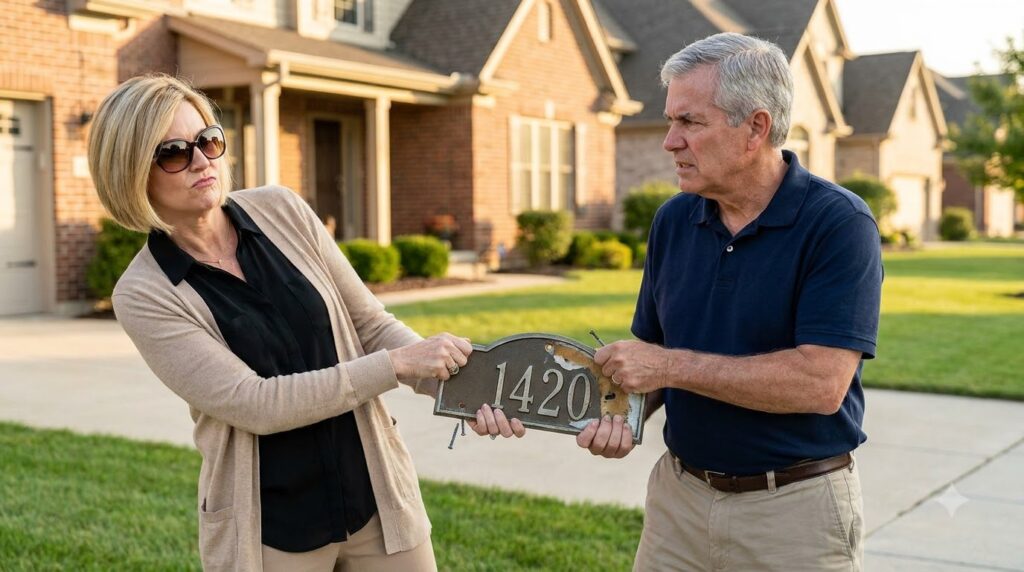
The steel claw of the pry bar shrieked against masonry, spitting a dusting of chalky gray stucco into the heat of the late afternoon. She didn’t stop. Her knuckles were bloodless inside the leather driving gloves, her beige cardigan bunched at the shoulders as she leveraged sixty pounds of municipal authority against the brickwork.
“The design manual specifies brushed nickel in Roman serif,” she said, her breath catching on the strain. She gave the bar another violent jerk. The top screw snapped with the sound of a small-caliber primer. “Not cast iron. Not hand-poured junk that looks like a rail yard salvage. I gave you fourteen business days, Arthur.”
Arthur didn’t raise his voice. He stepped off the doormat, his work boots grinding grit into the concrete porch, and clamped his left hand over the raised numerals—7404. His palm took the sharp edges of the iron. With his right hand, he caught the cold shaft of the pry bar just above her grip.
He didn’t pull it away. He simply locked his wrist, turning the tool into dead weight.
“Get your hands off my house.”
“This facade belongs to the architectural trust until you’re deeded clear,” Karen snapped, leaning into him. The oversized dark lenses of her glasses reflected the low, copper glare of the sun dipping behind the uniform rooflines of the development. Her perfume smelled like lavender trying to drown out the reek of hot asphalt. “You signed the covenant the day you moved past the gate. Every square inch visible from the curb is community jurisdiction.”
“The curb stops twelve paces back,” Arthur said. His thumbs pressed into the warm metal plate. Underneath the iron, the old cedar siding groaned against the studs. “And this plate was set before the developer put down your manicured turf.”
“It violates code.” She wrenched sideways, trying to use her hip for leverage.
The lower anchor screw yielded, pulling out a plug of pulverized mortar that trickled down Arthur’s boot like dry sand. The heavy rectangle swung loose, dangling between their four hands.
Arthur didn’t drop it. He twisted his grip, stepping in half an inch, using his shoulder to lever her off-balance just enough that she had to step back or lose her footing on the flagstones. As the plaque came free of the wall with a hollow scrape, Arthur rotated the raw, unpainted underside up toward the flat light.
“Take a look, Karen.”
“Give me the fixture, Arthur. It’s being tagged for disposal.”
“Look at it.”
Her mouth opened to summon whatever clause of the bylaws she kept chambered on her tongue, but her gaze dropped to the recessed hollow behind the 0.
The shadow caught the indentation first: not a manufacturer’s batch code, but four rough, chisel-struck figures stamped into the zinc lining, flanked by an anchor mark and a surveyor’s cross-hatch.
Karen’s chin twitched. The sharp, rhythmic snap of her voice dried up instantly.
Her gloved fingers released the pry bar. It clattered against the porch steps, chiming against the slate before coming to rest in the dry mulch below. Her hand darted out—no longer trying to pull the plaque down, but reaching with an open, trembling palm to slap flat over the stamped figures, smothering them from the light.
Arthur took half a step backward, carrying the metal out of her reach.
Her eyes lifted from the plaque to his face, the smug regulatory certainty completely hollowed out of her expression.
“Give me that,” she whispered. Her voice had dropped an octave, thin and raspy like grease on tin. “It doesn’t mean anything anymore.”
“Then why are your hands shaking?” Arthur asked.
Down the street, the whine of a lawnmower died, leaving only the sound of hot wind rattling the dry laurels between their driveways. Arthur turned the iron in his hands, feeling the cold weight of the surveyor’s notch beneath his thumb, and noticed what she had dropped in the mulch alongside the pry bar: not a citation clipboard, but a heavy brass master key bearing his own dead father’s initials.