
CHAPTER 7: THE BITTER TAP
The plastic jugs clunked hollowly against the riser of the second porch step as David Young set them down, his breath rising in white plumes against the freezing dark.
Arthur didn’t wait for a knock. He pulled the heavy front door open, stepping out into the cold without his coat, his sleeves rolled over forearms smeared with dry grease and orange rust.
David looked twenty-five, though Arthur knew he was closer to thirty-two. He had the hollowed-out look of an apprentice working double shifts to cover an adjustable-rate mortgage. His work jacket was unzipped, showing a faded company t-shirt, and his bare knuckles were raw red from the dry wind.
“Mr. Vance,” David said. His voice was unsteady, caught between embarrassment and mounting terror. “I saw the county truck leave. My wife said you had an inspector out here with Mrs. Harper.”
“Miller wasn’t doing county work,” Arthur said. He stayed on the threshold, his frame filling the doorway, blocking the view back into the utility room where the ammo can sat open on the pine floorboards. “He was doing a favor.”
David gestured toward the two clear jugs sitting in the porch light. The water inside wasn’t clear. It carried a murky, tea-colored tint, with an oily ribbon clinging to the curved plastic near the neck.
“Our basement started smelling like rotten cabbage three days ago,” David said, his throat bobbing as he swallowed. “Then this morning, my little girl turned on the bathroom tap to brush her teeth. It came out like this. Warm, too. Tasted like battery acid.”
“Don’t drink it,” Arthur said. “Don’t boil it, either. Boiling concentrates the heavy salts.”
David stepped up onto the porch, his eyes desperate, searching Arthur’s lined face for some kind of mechanical reassurance—the kind old tradesmen were supposed to give.
“I called the water authority at four o’clock,” David continued, his words tumbling out fast. “They told me the main trunk along the county road is clean. They said anything inside the subdivision boundary is private HOA infrastructure. So I walked over to Mrs. Harper’s place before she left.”
Arthur’s gaze sharpened. “What did she tell you?”
“She told me to keep my mouth shut.” David pulled a folded scrap of yellow lined paper from his jacket pocket, handing it over with trembling fingers. “She said if I called the state health department, the county would flag our deed for an environmental quarantine. She said our homeowner’s policy would be canceled before breakfast, and the mortgage company would accelerate the loan balance.”
Arthur unfolded the paper. Written in Karen’s sharp, slanted blue ink was a hastily scrawled summons:
Special Executive Session. Clubhouse Boardroom. 21:00. Mandatory attendance for designated voting trustees only. Re: Emergency infrastructure assessment and asset buyback program.
“She told me to be there at nine,” David whispered, the wind whipping his thin hair across his forehead. “She said they have a discretionary reserve to buy out troubled foundations without an appraisal, but only if we sign an NDA and waive future claims against the Harper Estate. Mr. Vance… we put every dime we had into that down payment. If the bank calls the note, we’re out on the street.”
Arthur stared down at the yellow slip.
Asset buyback.
It was the final extraction. Karen wasn’t just hiding her father’s crime; she was using the association’s reserve funds to buy out the worst-affected parcels at pennies on the dollar before the leachate breached the topsoil completely, bury the deeds in an offshore shell, and leave the remaining families holding empty titles on a toxic swamp.
And his own father’s eighteen-thousand-dollar payoff had laid the first row of bricks for the trap.
“Go back to your house, David,” Arthur said, handing the paper back.
“Mr. Vance, please. If you know what’s under those lots—”
“I know what’s under them,” Arthur cut in, his voice dropping low, stripping away whatever comfort the younger man was hoping to hear. “It’s not a cracked water pipe. It’s thirty years of industrial waste that was supposed to be hauled to a federally lined pit in Ohio. It’s sitting twelve feet beneath your living room floor, and the concrete cap is dissolving.”
David took a step back, his boots finding the edge of the step. The blood seemed to drain entirely from his features, leaving him looking like a ghost under the yellow porch bulb. “Then… we’re ruined.”
“Not yet,” Arthur said. “Get your wife. Pack two suitcases. Take your girl over to her mother’s across the ridge tonight. Don’t run the dishwasher, don’t flush the downstairs toilet, and don’t sign anything Karen puts in front of you.”
“What about the meeting at nine?”
Arthur looked down at the two cloudy jugs on his porch, then past David toward the clubhouse at the end of the cul-de-sac, where the high-pressure sodium security lamps were already flickering on, bathing the white vinyl trim in a cold, artificial glare.
“The board won’t have a quorum tonight,” Arthur said, the iron in his voice hardening into resolve. “Go on now. Pack your family.”
David hesitated, his eyes lingering on the water jugs, then turned and broke into a hurried jog back toward his idling truck.
Arthur didn’t watch him leave. He went back inside, kicked the bronze slide latch shut, and walked straight to the utility room.
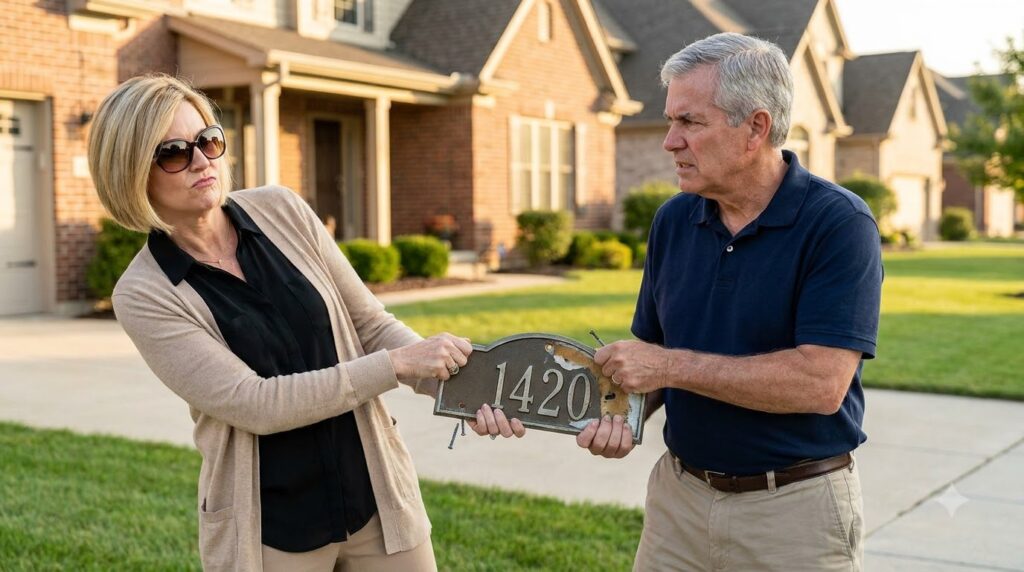
The brass key sat on the workbench beside the thirty-pound iron plaque. He picked up the three field journals, slid them into the deep interior pocket of his heavy canvas coat, and picked up the cast-iron plate by its raw edges.
The cold metal bit into his palms through his gloves. It was heavy, awkward, and unyielding—just like the lie that had paid for his youth.
He looked at the clock over the sink.
8:42 PM.
Eighteen minutes before Karen locked the clubhouse doors.








