CHAPTER 5: COLOR OF LAW
The front door didn’t have a deadbolt; it had a bronze slide latch forged in the rail foundry before the war, thick as three fingers and seated deep into the oak frame. Arthur slipped the latch home with a single dull clunk, but he didn’t hide behind the timber.
He didn’t touch the light switches. Moving through the dark of his hallway by the muscle memory of forty years, he took his heavy shearling coat off the peg, pulled it over his work shirt, and went out through the side porch door that opened directly toward the gravel driveway.
The cold hit his throat like crushed ice.
The tow truck was idling fast, its auxiliary hydraulic pump whining against the engine belts as a plume of blue diesel exhaust curled into the glare of Arthur’s porch bulb. The driver, a broad-shouldered kid in grease-stained canvas overalls, was already kneeling near Arthur’s rusted ’84 Chevy pickup, his heavy J-hooks clinking against the front leaf springs.
“Leave the chains where they lie, son,” Arthur said.
His voice wasn’t loud, but it cut through the diesel drone like a serrated blade.
The kid froze, half-crouched in the gravel. His eyes darted past Arthur toward the black sedan parked by the curb.
The man in the township khaki jacket didn’t look up from his plastic clipboard. He had a heavy rechargeable impact driver holstered to his work belt, and his steel-toed boots made a wet, heavy crunch in the crushed stone as he closed the distance. Behind him, Karen stayed half in the shadow of the sedan’s open door, her hands shoved deep into her designer coat pockets, her chin tucked against the bitter snap of the evening breeze.
“Arthur Vance?” the khaki-jacketed man said. He didn’t offer a hand. He smelled of menthol tobacco and damp nylon. “Name’s Miller. Township Code Enforcement, Field Operations.”
“I know who you work for, Miller,” Arthur said. He stayed on the second step of the side porch, his boots level with the man’s sternum. “And I know you don’t run municipal towing orders at eight o’clock on a Tuesday night without a police escort.”
Miller tapped a sheet of bright orange carbon paper clamped to the top of his board. “Section 12-B. Emergency structural abatement. We received a filed affidavit two hours ago regarding hazardous structural destabilization of the front facade, threatening the public thoroughfare.”
“The public thoroughfare,” Arthur repeated, cold humor threading through the gravel of his tone. “The curb is forty feet from my brickwork. The only thing threatening the road is Karen’s bumper.”
From behind Miller, Karen took two quick, clicking steps onto the drive. “The anchor screws were sheared, Arthur! You compromised the load-bearing masonry when you refused compliance. The exterior wall is bowing toward the public sidewalk!”
“There isn’t a sidewalk on this side of the ditch, Karen, and you know it,” Arthur said without looking at her. His gaze remained locked on Miller’s flat, tired eyes. “Show me the signature.”
Miller hesitated for a fraction of a second, his grip shifting on the clipboard. He held it out into the dim yellow reach of the porch bulb.
The header was official enough—heavy red block letters proclaiming an EMERGENCY ABATEMENT & ACCESS ORDER. Beneath the boilerplate language about public safety and immediate structural hazard, there was a red embossed township seal pressed hard into the paper. But where the county clerk’s docket number should have been inked in blue, the line was stark white. Blank.
“That’s an administrative summons,” Arthur said, his hand staying loose inside the shearling pocket, fingers resting against the cool, extracted survey core. “Not a judicial warrant. You don’t have a judge’s ink on this, Miller. You’ve got a stamped form your cousin in the zoning office pulled out of a bottom drawer after dinner.”
Miller didn’t flinch, but his jaw set hard. “It gives us forty-eight hours to secure the property and remove non-compliant hazardous materials from the exterior perimeter. If you interfere, it’s an obstruction misdemeanor. I take the truck, and I take the loose facade fixtures into municipal evidence.”
“You take one step onto that porch,” Arthur said, “and you’re entering private residential curtilage under color of a falsified instrument.”
“It’s not falsified!” Karen broke in, her voice shrill, carrying across the silent lawns of the cul-de-sac. The curtain on the front window of the Miller house across the street twitched, a pale hand parting the horizontal blinds to peer out into the flashing amber strobe of the flatbed. “He’s holding stolen property! That marker is registered to the developer’s estate!”
“The developer’s estate?” Arthur turned his head slowly, letting his eyes bore straight into Karen’s pale, tightened face. “You mean your father’s shell corporation? The one that dissolved thirty days after the drainage easement was capped in ninety-four?”
The silence that followed was heavier than the diesel exhaust.
The kid by the front bumper of the pickup dropped one of his hooks. The iron struck the stone with a dull thud. He looked between Arthur and Miller, then quietly stood up and took two steps away from the truck.
Miller’s eyes narrowed. He looked over his shoulder at Karen, noticing for the first time the rigid terror locked into her posture.
“What’s he talking about, Mrs. Harper?” Miller asked quietly.
“He’s defaming my family to cover his own code violations,” she said, but her voice broke on the final syllable, coming out thin and reedy. She reached out and grabbed Miller’s sleeve with frantic, demanding fingers. “Use the drill, Miller. Break the latch if you have to. The fixture is sitting on his worktable in the back. Get it out of there before he tampers with it!”
Miller pulled his arm away from her grip, his expression shifting from bureaucratic irritation to sharp, professional caution. He looked back at Arthur, taking in the old man’s unshakable posture, the calm absence of fear, and the dark window of the workshop behind him.
“You’ve got twenty-four hours to produce the plate for inspection at the county annex, Vance,” Miller said evenly, stepping back off the gravel and tucking the clipboard beneath his arm. “After that, I come back with a deputy and a signed docket.”
“Bring the county surveyor with you,” Arthur said. “And tell him to bring a core drill.”
Miller didn’t answer. He signaled to the tow truck driver with a sharp wave of his hand. The kid scrambled into the cab, threw the transmission into reverse, and backed the rig down the apron with an angry hiss of air brakes.
Karen didn’t get back into the black sedan immediately. She stood under the pale streetlamp, her chest heaving beneath her dark wool coat, staring at Arthur with a mixture of desperate fury and unvarnished panic.
“You don’t know what you’re digging up, Arthur,” she hissed, the words barely audible over the receding rattle of the tow truck. “You think you’re punishing me? You’re going to condemn every house on this ridge. You’re going to wipe out everything these people own.”
“The houses were already condemned, Karen,” Arthur said, his hand tightening around the heavy brass key in his pocket. “Your father just forgot to tell the buyers.”
She turned and marched back to the sedan, slamming the door hard enough to rattle the frame. The car pulled away, tires throwing loose gravel against the curb, leaving the cul-de-sac in a sudden, ringing silence broken only by the slow, rhythmic hum of an air conditioner kicking on down the street.
Arthur didn’t go back inside through the side door.
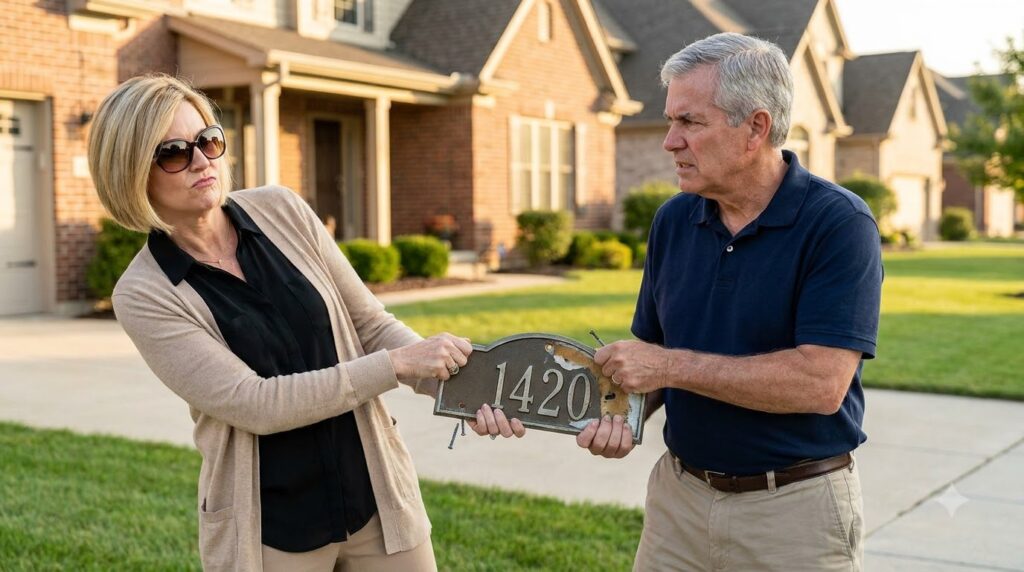
He walked around to the front porch, stepped over the broken mortar dust, and looked down at the rectangular scar on the brickwork where the numbers used to be. Right along the bottom edge of the foundation, where the brick met the poured concrete footing, a thin, dark liquid was beginning to bead along the hairline fissure—an oily, copper-colored seepage smelling faintly of sulfur and rotting leather.
He turned toward the house, his boots crunching over the flagstones. The plate was safe for tonight, but Miller would be back when the sun came up, and a blank docket wouldn’t stay blank for long.
Arthur walked into the workshop, pulled the bare light cord, and kicked aside the heavy rubber mat beneath his table saw.
Underneath the sawdust and oil lay the square outline of a trapdoor his father had cut into the floorboards during the winter of ninety-three. And resting directly across the iron hasp was a rusted padlock that Arthur had never once seen his father open.