CHAPTER 4: THE INVERTED VECTORS
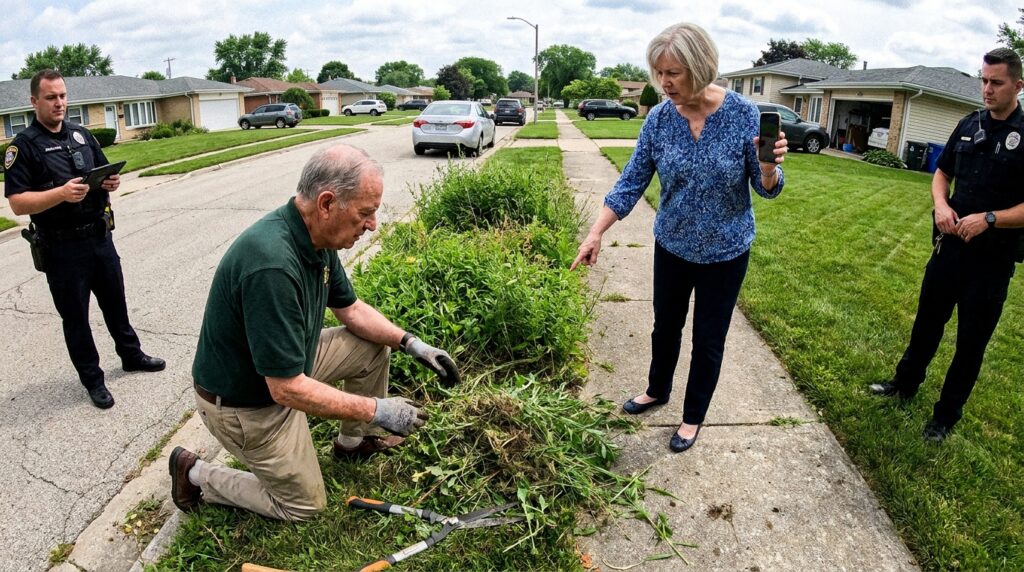
“Ma’am, step back over onto your own driveway for a moment,” the First Officer directed. His voice had lost its conversational drawl entirely, replacing it with the hard, mechanical flat tone of a deputy clearing an operational lane. He didn’t look up from the display, his gloved thumb pinning the corner of the matte-black frame as he adjusted the scale.
Mrs. Gable’s heels remained glued to the concrete seam. Her chin rose another fraction of an inch, the short blonde-gray hair catching the fierce mid-day light like spun glass. “The boundary line is quite clear, Officer. If your system is failing to register the correct residential easement allocation, I have the certified hard copies from the subdivision’s original platting inside my ledger.”
“The system isn’t failing, ma’am,” the Second Officer said, her position shifting slightly to place her body directly between Mrs. Gable and Arthur’s pile of harvested weeds. Her heavy leather duty boots kicked a small clump of dry gray silt across the expansion joint. “The layout is pulling directly from the county’s historical survey database. The forty-year-old developer records are being cross-referenced with the current GPS coordinates.”
Arthur leaned forward slightly on his folded cardboard pad, his canvas gloves scraping the coarse aggregate of the walk. He watched the red line on the screen flicker as the system tried to resolve the contradiction. He knew that specific red ink; it was the standard marker for contested municipal acquisition files. But the secondary blue line—the old vector layout—was shifting drastically to the west. It didn’t stop at the edge of his weed strip. It sliced across the sidewalk, bypassed the ditch line entirely, and ran a straight, unyielding path straight under the structural foundation of Mrs. Gable’s detached double-garage.
“Arthur,” the First Officer called out, his eyes still tracked to the blinking cursor on the display. “When you bought this lot in eighty-six, did you sign a reciprocal easement waiver with the primary contractor?”
“No waivers,” Arthur said, his raspy voice scraping through the dry air. He reached down instinctively, his split-cowhide fingers brushing the cold, rusted iron neck of his hand trowel where it lay in the dirt. “The builder told me the corner plot was clean from the street curb to the rear alley fence. I checked the deed markers myself when I poured the back patio. The iron pins are still down there near the utility pole.”
“Well, the pins might be there,” the First Officer muttered, his stylus clicking rapidly against the glass. “But the layout index shows a massive calculation shift. The original road bed was mapped six inches further east than where they actually laid the asphalt.”
Mrs. Gable finally lowered her phone, the screen falling dark as she pulled her arms tightly across the blue patterned fabric of her blouse. The rigid, administrative confidence that had carried her across the street seemed to stiffen even further, her posture turning defensive, almost metallic. “The asphalt layout has been established for over three decades. It constitutes a permanent legal boundary by default use. Arthur’s ongoing refusal to maintain his frontage according to the sector standards is what triggered the current engineering assessment. The county is simply correcting a public nuisance.”
“Except this isn’t a public nuisance file anymore, ma’am,” the First Officer corrected flatly. He turned the screen toward her, his gloved thumb pointing directly to a long string of structural data highlighted in lime green. “Your anonymous complaints about Arthur’s property didn’t just ask for a weed citation. They requested a full structural re-alignment of the frontage boundary to clear an administrative easement obstruction. You were trying to get the county to absorb his strip so your own garage setback wouldn’t trigger a municipal violation during the upcoming avenue widening project.”
The revelation hung in the stifling heat like the smell of burning oil. Arthur felt the dull ache in his knees dissolve into a cold, calculating clarity. The endless months of surveillance, the constant phone calls to code enforcement, the weaponized photography—it wasn’t a petty neighborly obsession with aesthetics. It was a pre-emptive strike. Mrs. Gable had known the city was planning to widen the avenue next year, and she knew that when the county surveyors arrived with their modern transit levels, her garage would be marked as an illegal encroachment on the public right-of-way. She had tried to sacrifice Arthur’s frontage to save her own brick and mortar.
“This is an informal field assessment,” Mrs. Gable said, her voice dropping into a razor-thin whisper that barely carried over the hum of the nearby air conditioner. “Your terminal does not carry the administrative weight of a formal zoning board ruling, Officer. The engineering department will handle the final designation based on the historical files I provided.”
“The engineering department is the one that flagged this file, ma’am,” the Second Officer said, her hand resting firmly against her utility belt as she pointed to the lower quadrant of the tablet screen. “Look at the blue marker line. The system just resolved the original developer’s error.”
Arthur squinted through the dust glare. The red acquisition line—the decoy secret Mrs. Gable had built her entire harassment campaign around—suddenly blinked twice and vanished from his section of the curb. In its place, the historical blue vector locked into position with a hard, digital snap. The line didn’t just clear Arthur’s weed strip. It pushed six inches deep into the manicured lawn across the asphalt, slicing directly through the side wall of Mrs. Gable’s pristine garage.
The First Officer looked up from the glass, his expression completely blank, his stocky frame cast in the long, grey shadow of the afternoon. “Ma’am,” he said, his voice dropping with the weight of absolute administrative finality. “According to this verified plot map, you aren’t the one defending the neighborhood boundary. Your entire detached structure is sitting half a foot inside Arthur’s deeded property line.”