CHAPTER 3: THE DECOY RECORD
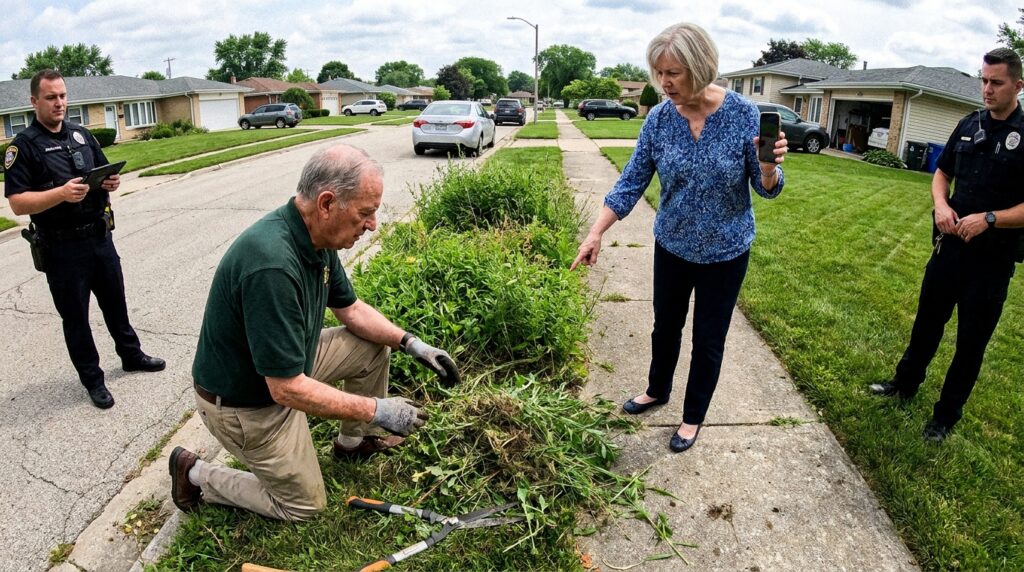
The glare on the First Officer’s tablet didn’t reveal the details easily; the display was mapped in dense, overlapping vectors of administrative ink, a grid of utility lines and drainage paths cutting across the property boundary. The Second Officer shifted her footing, the gravel on the concrete edge crunching under her sole with a small, sharp sound like a stone hitting an anvil. She peeked down at the glowing layout over his arm, her thumb hooking into her duty belt near her flashlight casing.
“Ma’am,” the First Officer said again, his voice dropping an octave as his eyes stayed anchored to a red-flagged entry blinking near the bottom corner of the digital plot. “This file isn’t a standard weed or nuisance complaint. This is a restricted county engineering file. It’s listed under a commercial frontage acquisition code.”
Mrs. Gable’s hand tightened on the side of her smartphone, the knuckles turning the color of wet lime against the dark blue plastic of the casing. She didn’t drop the lens. She simply drew her elbow closer to her ribs, her jaw locking into a tight, hard line that made the muscles at the base of her ear twitch under the direct sun.
“The county has been reviewing the drainage structure for this entire quadrant, Officer,” she said, her words dropping with a measured, deliberate precision that sounded like a read-out from a legal brief. “The frontage strip is designated as unstable. If the vegetation isn’t managed under an approved engineering plan, the township has the administrative authority to reclaim the grade for public utility enhancement. It’s a standard safety stabilization protocol.”
Arthur didn’t rise from the cardboard pad. He leaned his weight back onto his heels, his gloved palms flat on his knees as he listened to the technical language roll across his sidewalk. His old iron trowel lay three inches from his boot, its rusted tip caked with the dry, grey clay he’d dug out from beneath the curb fracture. He looked at the red-flagged line on the screen. He had worked thirty years in the regional maintenance yard before his knees gave out; he knew what an acquisition code looked like. It didn’t mean stabilization. It meant eminent domain—the legal mechanism the state used to wipe a property owner off the tax map to make room for wider lanes or structural right-of-ways.
“Who logged these structural structural safety filings, Mrs. Gable?” the First Officer asked. He turned the screen three inches to the left, blocking the glare of the sky with his stocky frame. “Because according to the county registry, these three anonymous complaints about foundation shifting and frontage degradation all originated from an IP address registered to this corner sector. Your sector.”
The silence that followed was heavy, filled only by the dry, metallic click of a cooling engine from the parked patrol vehicle fifty feet down the lane.
Mrs. Gable didn’t flinch. She lowered the smartphone by two inches, her pointed finger relaxing slightly against the edge of the screen, but her expression remained perfectly smooth, a varnished layer of civic righteousness that didn’t allow for a crack. “Every resident has a duty to report structural failures that threaten the common valuation, Officer. If Arthur’s frontage is sliding into the gutter line, it drags my parcel’s grade down with it. The county surveyors are simply doing their job by verifying the hazard.”
“The surveyors haven’t been out here yet,” the Second Officer observed, her eyes moving from the tablet back to the dry, hard dirt where Arthur’s pile of pulled thistles sat. “But the file shows a pre-authorization for a curb-widening assessment. It was requested three months ago. Before any of these weed complaints were even logged in our system.”
Arthur felt a cold, dull weight settle behind his ribs, distinct from the heat of the noon sun. For months, he had assumed Mrs. Gable was simply obsessed with the look of his lawn, driven by the petty, restless malice of an old neighbor with too much time and a neat binder. But the red line on the digital map showed something different. She wasn’t trying to make him pull his weeds; she was building a paper trail of neglect to prove his land was a public liability, forcing the county to step in and seize the frontage for a secondary easement road that would cut ten feet into his front porch.
“Arthur,” the First Officer said, looking down over the top of the tablet with a hard, probing look. “Did you receive a certified notice from the county engineering office regarding an easement inspection last month?”
Arthur shook his head slowly, his split-cowhide gloves dry and stiff as they scraped against the fabric of his khakis. “Nothing came in the mail but the regular utility bill and the tax assessment. No one told me about a degradation file.”
“They wouldn’t notice him until the public hearing phase is locked,” Mrs. Gable said smoothly, her posture returning to its rigid, confident baseline. She took a step backward, back toward her own driveway line where her spotless luxury sedan sat under the shade of an oak. “The administration handles the preliminary evaluation internally. I am simply ensuring the record is accurate before the formal enforcement team arrives.”
The First Officer tapped the glass screen twice with his stylus, his jaw tightening as he scrolled down into the deepest layer of the restricted document. The blue light of the screen caught a sudden, sharp discrepancy in the older layout file—a series of yellowed survey marks from forty years ago that didn’t align with the clean, red boundaries of the current county map. He stopped scrolling, his thumb freezing on the edge of the casing.
“Wait a minute,” the officer muttered, his eyes narrowing as he traced a line that ran from Arthur’s curb straight through the neat, manicured grass toward Mrs. Gable’s garage foundation. “This layout is completely inverted.”