CHAPTER 2: CODE OF THE PROPERTY LINE
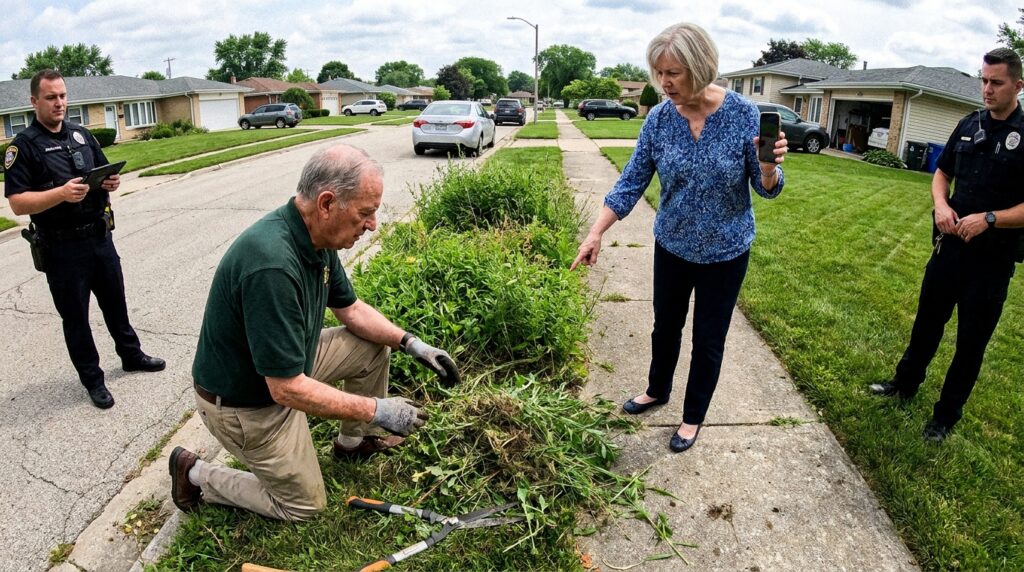
The heavy, steel-reinforced door of the municipal utility truck slammed shut with a metallic crack that echoed off the garage doors across the cul-de-sac. Arthur didn’t blink. He kept his gloved hand resting flat against the coarse, heat-baked aggregate of the sidewalk, his fingers tracking a thin, faint streak of weathered yellow wax crayon marked on the edge of the curb—an old surveyor’s notch nearly swallowed by years of grime and street sweepers.
Mrs. Gable didn’t move either, though her shoulders squared slightly as the two uniform officers stepped off the asphalt and onto the concrete path. The heat ripples rising from the road made their dark black tactical vests and utility belts look heavy, almost architectural, as they approached. The friction of their thick leather boots against the grit sounded like sandpaper on wood.
“Mrs. Gable? Arthur?” The First Officer spoke first. His voice was a flat, unhurried drawl, trained to lower the temperature of suburban property wars before they spilled over into violence. He was stocky, his clean-shaven jaw tight, his eyes already scanning the layout of the yard, the tool pile, and the phone still gripped in the woman’s hand. “We received a call about an unauthorized alteration of township property.”
“He’s destroying the designated ground cover,” Mrs. Gable said immediately, her tone shifting seamlessly from an ultimatum to the practiced grievance of a taxpayer reporting an administrative failure. She didn’t lower the phone; the screen remained alive, a bright, digital grid reflecting the glare of the sky. “The neighborhood association agreement, which operates under county civic code section four, clearly states that no resident may excavate, alter, or remove vegetation from the common frontage without a structural variance. He’s pulling the root systems. It destabilizes the sidewalk bed.”
Arthur slowly shifted his weight on the corrugated cardboard pad, his knees grinding against the internal aggregate of the joint. He didn’t look at her. He looked at the First Officer’s boots, then at the Second Officer, who had taken up a flanking position near the edge of the lawn. She stood with her hands resting casually but alertly near her utility belt, her dark hair pinned back so tightly it pulled the skin at her temples. She was watching Mrs. Gable’s wrist—and the recording lens.
“Arthur,” the First Officer said, stepping closer until the toe of his boot mirrored the line of the curb. “You want to tell me what you’re doing here?”
“Cleaning the ditch line,” Arthur said. His voice was dry, raspy from the heat and the dust he’d been breathing since noon. He pointed a thick, split-cowhide finger at the pile of limp thistles and wild mustard beside his boot. “The county didn’t send the mower this month. The stalks are high enough to block the drainage during the late summer storms. If the runoff pools against the concrete, the subgrade softens. Then the whole path cracks.”
“It’s not his responsibility,” Mrs. Gable snapped, her finger tapping the back of her phone casing with a sharp, rhythmic click. “It’s a violation. I’ve already filed three separate environmental complaints with the county clerk’s office this season regarding his frontage. There’s a structural assessment pending.”
Arthur’s thumb rubbed the yellow wax mark on the curb. Three complaints. The county didn’t usually dispatch local patrol officers for simple weed pulling unless someone had used specific keywords on the non-emergency line. Structural assessment. The phrase hung in the hot air between them, dense and deliberate. A normal neighbor complained about aesthetics or property values; Mrs. Gable was using the language of engineering and municipal acquisition.
The Second Officer took a half-step forward, her eyes narrowing as she looked down at the dirt strip. “Is that why you called us out here today, ma’am? For the weeds?”
“I called because he is violating the boundary rules,” Mrs. Gable said, her voice rising slightly, losing its bureaucratic coldness for a fraction of a second. “The code exists to maintain the structural integrity of the sector. If he alters the frontage without an engineer’s sign-off, it compromises the entire block’s safety logic.”
The First Officer didn’t answer. He reached down to his utility vest, his gloved hand unclipping a rugged, matte-black digital tablet from his chest harness. The screen flared to life, casting a cold blue tint across his clean-shaven chin as he began tapping through the localized civic registry. The sound of his stylus clicking against the hardened glass was the only noise on the street, save for the distant, rhythmic hum of a central air conditioning unit hidden behind the nearest house.
Arthur watched the officer’s face. He knew the look of a man looking at a map that didn’t match the story he’d been told. There was a specific tightness that formed at the corner of a city worker’s mouth when the digital lines began to contradict the physical reality on the ground.
“Hold on a second,” the First Officer muttered, his thumb tracing a line across the tablet screen as he cross-referenced the property coordinates. He looked up, his gaze moving past Arthur, past Mrs. Gable’s shoulder, and fixing directly on the concrete foundation of her detached double-garage thirty feet away. “Ma’am, who did you say filed that structural assessment?”
The paragraph of data on the screen didn’t just contain the afternoon’s dispatch log. As the officer tilted the screen toward his partner, Arthur caught a glimpse of a red-highlighted easement boundary line—and a secondary, blue-inked municipal survey overlay that cut dangerously close to the neighbor’s own brickwork.