
CHAPTER 8: THE BOUNDARY OF SILENCE
The cold iron blade of the spade sliced through the damp fescue with a short, metallic chunk. It was seven-fifteen in the morning, and the air still carried a faint, watery chill from the dew, though the eastern horizon was already bleached with the first white glare of the coming heat. Arthur drove his boot down onto the flat collar of the shovel, his weight settling into the tool with the rhythm of an engineer who had spent half a life maintaining the lower-deck auxiliary pumps.
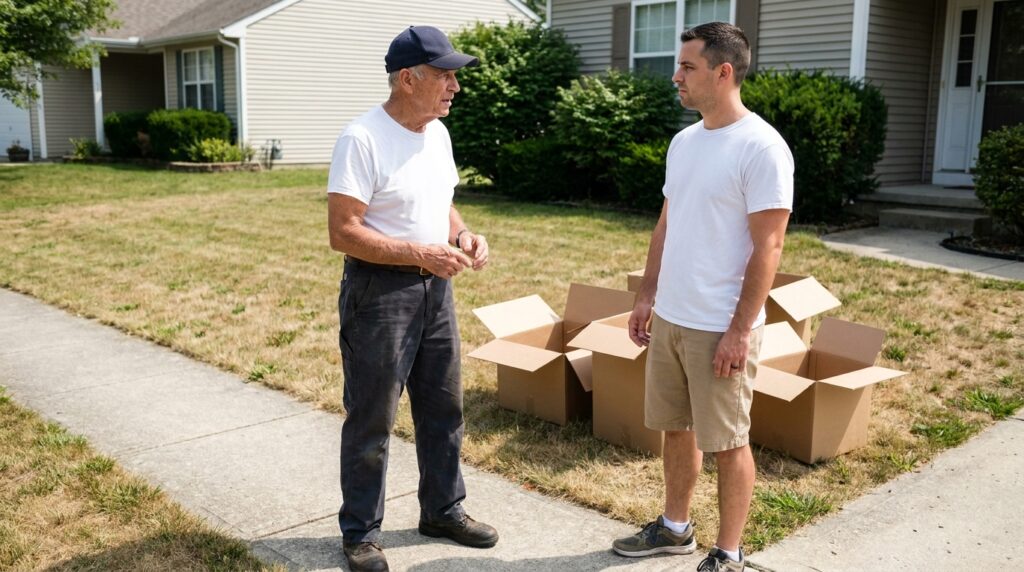
Three feet away, across the frost heave in the concrete walkway, Mark was kneeling in the loose gravel of his own drive. His heavy forearms were coated in a fine, grey powder of limestone dust. He was holding the lower rail of the wire fence, his fingers curled tight around the rusted zinc mesh as he cleared a space for the first timber skid. The flatbed truck from the lumber yard had already come and gone, its diesel rumble fading into the morning traffic three blocks north, leaving behind two heavy pallets of green, pressure-treated four-by-fours sitting neat and square on the gravel.
Neither man spoke. The lane was completely empty, the small, clean houses on either side locked behind their drawn blinds.
Arthur lifted a heavy spadeful of dark, wet topsoil and turned it over into the shallow trench he was clearing near the base of the blackberry bushes. The earth was thick, full of old limestone aggregate that clinked against the iron blade like spent brass casings. With every stroke, his movements were precise, slow, and measured, his mind tracking the physical resistance of the soil down to the stone ledge four feet below. The rusted railroad spike and the chiseled鐵 plate from 1954 were completely buried now, covered by six inches of freshly packed sod that showed nothing but the uniform gray of the morning shadow.
Mark stood up slow, his knee joints making a dull, wet pop that sounded like green wood splitting under a wedge. He took a heavy iron crowbar from the bed of his pickup and set the tip against the corner of the first lumber skid, his shoulder muscles bunching as he heaved the mass of green pine three inches closer to the garage slab. The wood groaned against the metal strapping, releasing a sharp, sour scent of chemical preservative that mixed with the smell of the damp earth.
Arthur watched the movement, his eyes catching the dark, swollen line of the bruise on Mark’s left wrist where his thumb had locked twenty hours ago. The swelling had settled into a hard, dark knot under the skin, a silent indicator of a physical limit that didn’t need to be discussed. Mark didn’t reach for the wrist; he kept his fingers wrapped around the cold iron of the crowbar, using his weight to adjust the alignment until the wood skid sat perfectly parallel to the gravel edge.
“The post holes need to be three feet deep if you’re using six-by-sixes for the frame,” Arthur said. His voice was a flat, low hum that didn’t carry past the fence line. It had the same granular density as the limestone dust on the drive.
Mark stopped heaving. He wiped his palms on his dark shorts, his face staying low, his eyes fixed on the narrow gap between his concrete apron and Arthur’s stones. “The auger rental is for twenty-four hours. I’ll have the concrete poured before the afternoon heat hits the garage wall.”
“Use the gravel at the bottom for drainage,” Arthur said, leaning his hands flat against the top of the wooden spade handle. “If you don’t clear the lime out of the hole before you mix the sack, the water from the ditch will turn the base into mush before the winter frost clears.”
Mark gave a short, single nod. He didn’t look up at the porch step where the torn linen of Arthur’s work shirt had been replaced by a fresh, unwashed blue chambray coat. He simply picked up his spade and began to clear the loose stone away from his first layout stake, his movements matching the slow, mechanical pace that the older man had established across the line.
The truth of the 1954 boundary stayed exactly where it belonged—four feet beneath the compacted dirt, locked under a limestone shelf that didn’t care about municipal titles or bank foreclosures. The seventy-two plat map on the county counter remained the law of the street because two men were willing to work the line with their hands until the dirt looked clean. It was a pragmatic peace, paid for with a torn shirt and a handful of sulfur ash, but it had the weight of an iron frame that had been driven straight into the stone until it couldn’t be turned by the wind.
Arthur turned his back on the lane then, his boots finding the split in his concrete path as he walked toward his screen door. Behind him, the rhythmic, metallic scrape of Mark’s shovel against the gravel continued—a steady, unvarnished friction that would outlast the sun.








