
CHAPTER 7: THE INCINERATION OF THE STAKE
The match head left a sudden, brilliant streak of sulfur-yellow against the rusted face of the 1954 iron plate. The sharp, chemical stink of the ignition cut straight through the heavy, stagnant smell of the parched turf and the hot, ungreased metal of Mark’s truck across the lane. Arthur didn’t watch the flame itself; he kept his eyes on the small, square-headed railroad spike that held the iron disc to the limestone ledge below.
The afternoon sun had begun its drop, casting long, lean shadows that stretched like dark girders across the narrow suburban walkways. A single car went by on the main road, its tires giving off a high, sticky whine against the soft asphalt. Arthur knelt in the weeds, his dark work pants collecting the grey, powdery dust of the dry soil. In his left hand, he held the thin, blue-ink linen drawing he had hauled up from the cedar trunk in the cellar.
“Art.”
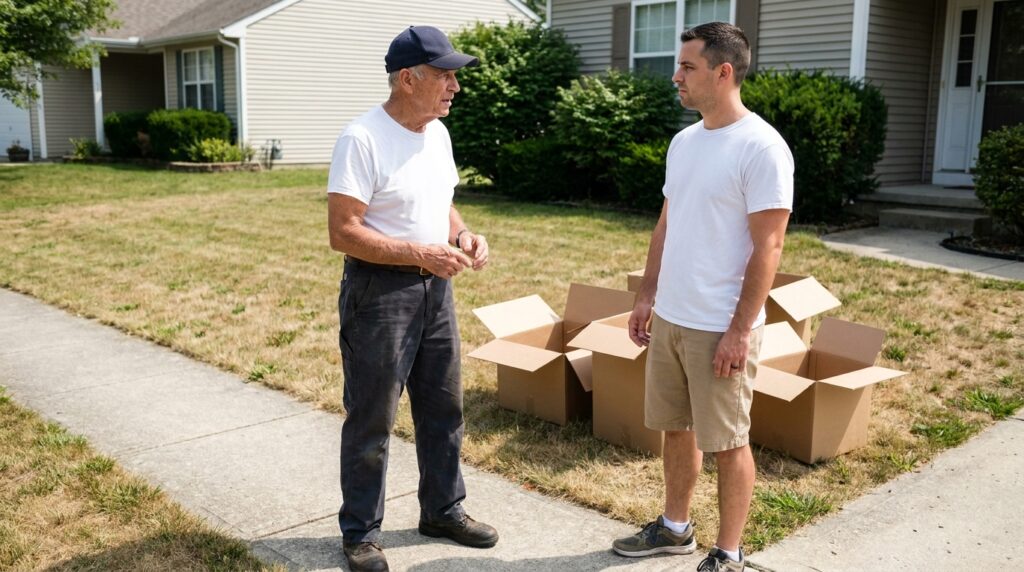
The voice came from the edge of the gravel drive. Mark was standing three feet back from the fence line, his heavy frame hunched forward, his hands buried deep inside his khaki pockets. His face wasn’t dark purple anymore; the skin around his nose was an ash-grey, dry and flaking from the heat. He didn’t look at the match. He kept his eyes on the cylinder of paper in Arthur’s grip, his jaw working slowly on a dry piece of toothpick.
“The yard called,” Mark said, his tone flat, empty of the gravel that had driven his threats an hour ago. “The skids are already on the flatbed. They won’t take the cancellation without a fifty-percent restock fee. My wife’s down at her mother’s with the kids because the district clerk told her the water meter line was under review. She thinks we’re losing the lot, Art.”
Arthur didn’t look up from the spike. He held the small, white flame to the edge of the linen drawing. The starch-stiff paper didn’t catch fast; it sizzled once, a tiny drop of old ammonia steam weeping from the blue border before the corner turned a deep, carbon black and began to curl into a grey ribbon of ash.
“Your father spent four years in the western Pacific, Mark,” Arthur said. His voice was an even, unyielding drum, the rhythm locked into the steady, mechanical beat of a cold piston block. “He didn’t build things with paper. He built them with five-inch timber and iron tie-rods because he knew that when the salt air gets into a joint, the only thing that holds is the weight of the frame itself.”
“The mortgage man has a copy of the seventy-two map,” Mark muttered, his sneaker kicking a loose clump of dead fescue into the ditch. He took his hands out of his pockets, the fingers twitching against his sides. “He says if the city inspector marks a variance on the garage foundation, the title company pulls the insurance by Friday. We can’t stay here without the insurance, Art. The state bank won’t carry the note on an uncertified slab.”
The fire caught the main grid of the map now, the yellow flames consuming the thin white lines that indicated the 1954 state highway boundary. The smoke rose straight up in a thin, grey wire that smelled of old basements and burnt glue. Arthur watched the fire eat the section marker—the specific chiseled variance that put half of Mark’s living room and the entire structural support of his front porch on the wrong side of the municipal line.
“There is no variance,” Arthur said. He dropped the last burning scrap of linen onto the corroded face of the iron plate, using the hard vulcanized rubber sole of his boot to grind the black ash into the grey grit of the stone.
Mark took a half-step forward, his heavy build freezing at the edge of the walkway. His eyes went wide as he looked at the black smudge where the 1954 record had been. “What did you just do?”
“The seventy-two map is what the county clerk has on the counter,” Arthur said, standing up slow, his joints making three short, sharp clicks in the hot silence of the yard. He tucked his thumbs back into his canvas waist, his navy service cap sitting straight and low over his brow. “The seventy-two map says the line runs six inches past my concrete path. It says your driveway is yours and my walkway is mine. That’s the record the title company carries. That’s the record your father paid his taxes on for forty years.”
Mark looked from the blackened iron plate to Arthur’s face, his lips parting slightly as the weight of the silence settled between them. The panic in his eyes didn’t vanish, but it shifted, the raw terror of the foreclosure notice meeting the hard, unyielding wall of the old man’s restraint. “The county spike under the grass… if they bring the transit out here—”
“They won’t bring a transit out here unless someone asks for a full sector review,” Arthur said, his gaze locking onto the younger man’s throat with the flat authority of a master-at-arms checking a berth before inspection. “And no one is asking. You drop your skids on the gravel tomorrow morning at seven. You build your shed three feet back from the wire fence, the way your dad built the old tool crib in sixty-eight. And you keep your boxes off my stone.”
Across the lane, the shadow behind Mrs. Gable’s hydrangeas vanished entirely. The aluminum storm door let out a final, soft squeak as she walked back into her kitchen, leaving the street completely clear under the wide, white eye of the afternoon sky.
Mark stood still on the concrete skirt of his driveway, his heavy chest rising and falling in a long, shuddering draw of the dry air. He didn’t offer his hand. He didn’t say the word thank you. A working man on this lane didn’t have the words for an act of mercy that felt like a sentence of hard labor, but his head bowed down three inches, his fingers curling into his palms as he turned back toward his closed garage bay.
Arthur didn’t watch him walk away. He turned his face toward his own dark porch, his boots finding the split heave in the concrete walkway with the absolute familiarity of a man who knew exactly how much weight the ground could bear before it broke.








