
CHAPTER 6: THE UNSEALED RECORD
The black bakelite receiver felt heavy and cold against Arthur’s ear, a stark contrast to the thick, zinc-flavored air of the front walkway. The mechanical double-chime inside the wall box cut off with a small, metallic click that left a high-pitched ring in the narrow hallway. Outside, the world was still shaking under the silver glare of the three-o’clock sun, but inside the house, the air smelled of floor wax and sixty years of quiet containment.
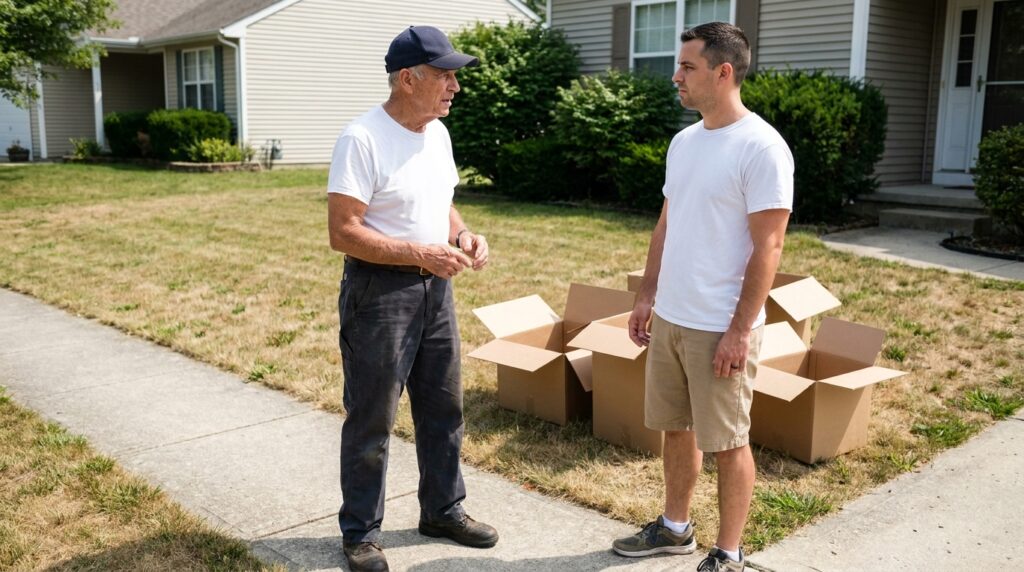
“Arthur? It’s Gable.” The voice on the wire was thin, dry, and punctuated by the hollow scratching of an old telephone line. Mrs. Gable didn’t look through her window when she spoke; she kept her eyes on the small notepad she kept by her kitchen sink. “I saw Mark hauling those boxes back toward his garage. Is he going to clear that path before the evening mail comes through?”
Arthur leaned his shoulder against the wood trim of the doorframe. His thumb traced the rough, sand-cast edge of the telephone mount. “The path is clear, Clara. He’s keeping his lumber on the gravel side.”
“He’s got no business running his mouth at you on that stone,” she said, her voice dropping into a flat, level frequency that carried the memory of three generations of neighborhood births and deaths. “His father wouldn’t have permitted that kind of noise. His father knew how to keep a line clean. But Mark’s been carrying something heavy since January, Arthur. He’s got men in gray sedans parking by his mailbox twice a week. They don’t leave notes. They just sit there with the engines idling until the sun goes down.”
Arthur didn’t answer right away. He looked through the screen door toward the driveway across the lane. The heavy wooden door to Mark’s garage stayed down, but the small, rectangular window near the top was gray with dust, blocking any view of what was happening near the workbench.
“He’s sorting freight,” Arthur said softly.
“He’s sorting more than pipe fittings,” Clara Gable spat. “The bank put a orange card on his utility box this morning, Arthur. I saw the girl from the water district driving away before you even came out on your porch. You watch your fence line. A man with a dry well doesn’t care whose grass he treads on.”
The line went dead with a sharp, heavy pop as she hung up her receiver. Arthur stayed still for a moment, listening to the dry, rhythmic hum of the empty wire before he set the bakelite back into its cradle. His hand felt dry, the palm stiff from the pressure of the brass coupling he had carried inside.
He didn’t return to the porch step. Instead, he walked down the narrow basement stairs, his boots finding the exact center of each worn oak tread. The cellar was cool, the stone walls sweating a fine, white powder of saltpeter that tasted of lime and old rain. In the far corner, behind the galvanized tank of the water heater, sat the green cedar chest his father had hauled home from the shipyard in forty-six. The brass corners were green with verdigris, the lock mechanism frozen into a single block of oxidized iron.
Arthur didn’t use a key. He took a heavy, flat-headed cabinet screwdriver from the ledge and pried the latch up until the ancient pine wood split with a short, wet crack. Inside, beneath two wool utility blankets that had turned the color of dry moss, lay a roll of heavy, blue-ink linen drawings—the regional railway variance maps from 1954.
He unrolled the linen across the top of a dusty washing machine, his calloused palms pressing the curling edges flat against the enameled tin. The paper was cold, the smell of ammonia and stale starch rising off the surface like a draft from an old well. His eyes tracked the white chiseled lines past the marsh lane, past the old culvert, straight to the small square marked Lot 4.
The red ink lines he had seen through the split carton in Mark’s yard weren’t a county mistake. They matched the chiseled hand-mark on the iron plate exactly. The state highway department in fifty-four hadn’t used the municipal reference pin; they had driven their own heavy spike into the limestone ledge four feet below the sod, creating a legal gap that had been buried under forty years of tax assessments and neighborly handshakes.
The error was systematic, a clean, mechanical split that ran six degrees off the true North alignment. According to the linen drawing beneath his thumbs, Arthur didn’t just own the six inches of crabgrass where the boxes had fallen. He owned the entire eastern half of Mark’s driveway, the concrete apron, and the load-bearing brick wall that supported the roof of Mark’s front porch. The mortgage company that had issued the foreclosure notice on Lot 4 hadn’t checked the 1954 variance; they had relied on the seventy-two plat map—a document that was worth less than the split paper it was printed on.
Arthur’s thumbs left two gray smudges on the clean white border of the map. If he brought the linen to the county building on Monday morning, the zoning board would have no choice but to freeze the deed. The bank wouldn’t just foreclose on Mark; they would invalidate the entire parcel, stripping the property of its legal title and leaving Mark’s family with nothing but a debt on a house that didn’t legally exist on any state line.
He heard a dull, scraping sound from the yard above—the heavy, ungreased rattle of Mark’s garage door rising two feet off the slab. Arthur slowly rolled the linen back into its cylinder, his movements deliberate, his mind calculating the exact cost of the friction that was waiting for them at the boundary stake.








