
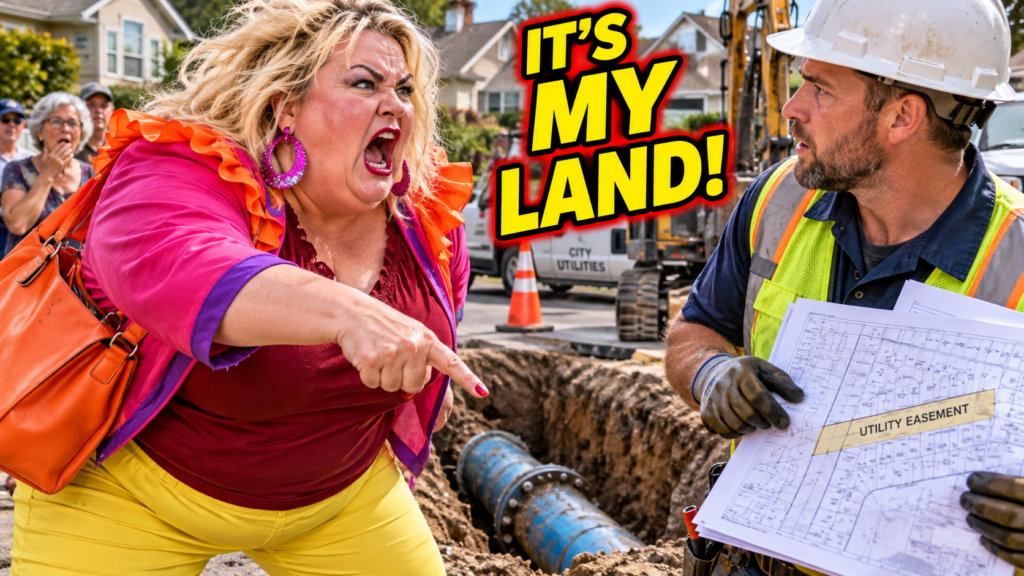
Chapter 7: What Belonged to Everyone
A month later, the neighborhood looked different.
The excavation was gone.
The street had been repaved.
The damaged section of Karen’s backyard had been restored as much as reasonably possible.
Her fountain still ran.
Her shrubs had been replanted.
But a small utility marker now stood near the rear fence.
It wasn’t beautiful.
Karen hated it.
At first.
Then something unexpected happened.
The marker became a reminder.
Not of the argument.
Of what she had learned.
The water line beneath her property was not a trespasser.
It was part of the infrastructure that connected one home to another.
It had been there before her landscaping.
Before her fence.
Before her house.
Before she had ever imagined the backyard as exclusively hers.
One Saturday morning, Evelyn walked past Karen’s house.
Karen was outside pulling weeds.
Evelyn stopped.
“I heard the county finished the paperwork.”
Karen nodded.
“They did.”
“Everything settled?”
Karen looked at the utility marker.
“Settled enough.”
Evelyn smiled.
Then Karen surprised her.
“I was wrong about one thing.”
Evelyn waited.
Karen continued.
“I thought protecting my property meant keeping everyone else out.”
She glanced toward the street.
“But I forgot that a neighborhood is full of things we don’t see.”
Evelyn smiled gently.
“Most important things are.”
They stood quietly for a moment.
There was no dramatic apology.
No crowd gathered.
No grand speech.
Just two older women standing beside a quiet suburban street where the water was finally running again.
Later that afternoon, Karen received a letter from the county.
The utility department was establishing a permanent maintenance schedule for the neighborhood.
Residents would receive advance notice before major work whenever possible.
Property owners would be informed about easements affecting their lots.
And the community would receive updated maps so future homeowners would not face the same confusion.
Karen read the letter twice.
Then she placed it in a folder.
Not because she wanted to fight.
Because she wanted to understand what she owned.
And what she shared.
That evening, she turned on the kitchen faucet.
Clear water flowed immediately.
She stood there listening.
For weeks, she had thought the pipe beneath her yard represented something being taken from her.
Now she understood something different.
The line did not make her home less hers.
It connected her home to everyone around it.
And sometimes, protecting your dignity did not mean winning every argument.
Sometimes it meant knowing the difference between something that belonged to you—
and something you were fortunate enough to belong to as well.








