
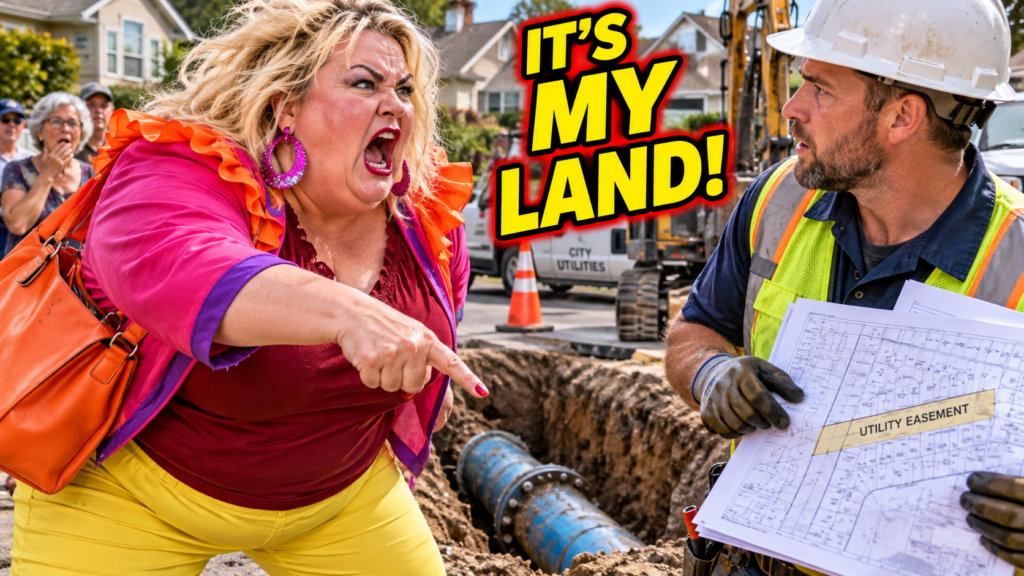
Chapter 3: The Decision Karen Made
The county did not need Karen’s permission to verify the public utility corridor, but the process would take time.
And every hour mattered.
The damaged main remained isolated.
Evelyn’s house had enough bottled water for one day.
The family next door had a baby.
An elderly couple farther down the street relied on an electric kettle because their stove had stopped working properly months earlier.
For the first time, the consequences of Karen’s decision became visible beyond the excavation.
Still, Karen refused to reconsider.
Instead, she called the HOA board.
She told them the county was trespassing.
She demanded that the work be classified as unauthorized construction.
By noon, an HOA representative arrived.
His name was David Monroe, a retired accountant who had served on the board for six years.
He listened carefully while Karen explained her version.
“They dug into my yard without permission.”
David looked toward the street.
“The excavation is actually outside your property line.”
“They were preparing to cross it.”
“Preparing isn’t crossing.”
“They were going to.”
David sighed.
Karen leaned closer.
“I want the HOA to issue a violation against the county contractor.”
David hesitated.
“That’s not really how this works.”
Karen’s expression changed.
“So you’re taking their side?”
“No. I’m saying we need to verify the documents.”
That answer angered her.
She wanted someone to confirm that she was right.
Instead, everyone kept asking for records.
That afternoon, Mark returned with a county surveyor.
They did not approach Karen’s house.
They stood beside the sidewalk and used measuring equipment to locate the easement.
The surveyor eventually pointed toward a spot near the rear corner of Karen’s property.
“The corridor appears to continue through here.”
Mark looked toward the locked gate.
“If that secondary line connects to the main, it may explain why her pressure is still unstable.”
Karen stepped onto her porch.
“You’re not touching my yard.”
Mark looked up.
“We’re not asking to touch anything today.”
“Good.”
“But the line needs to be identified.”
“Identify it from the street.”
The surveyor shook his head.
“That isn’t possible.”
Karen folded her arms.
“Then that’s your problem.”
She went inside.
What Karen didn’t know was that her refusal had created a new complication.
The county records showed the easement.
But the exact purpose of the second line was still unclear.
If it turned out to be a private connection, Karen might have a legitimate objection.
If it turned out to be part of the public system, her argument would collapse completely.
The following morning, the county obtained an older engineering plan.
Mark opened it inside his truck.
His eyes stopped on one particular notation.
He read it twice.
Then he called Evelyn.
“Mrs. Harper, do you remember the old community garden?”
Evelyn did.
It had been removed decades ago.
Mark looked again at the map.
“The second line may not be going where we thought.”
Evelyn’s voice became quiet.
“Where does it go?”
Mark looked toward Karen’s house.
“Straight through her backyard.”
But the plan showed something even more important.
The line didn’t end there.
It continued beneath the property.
Toward the street where Evelyn and the other residents lived.








