
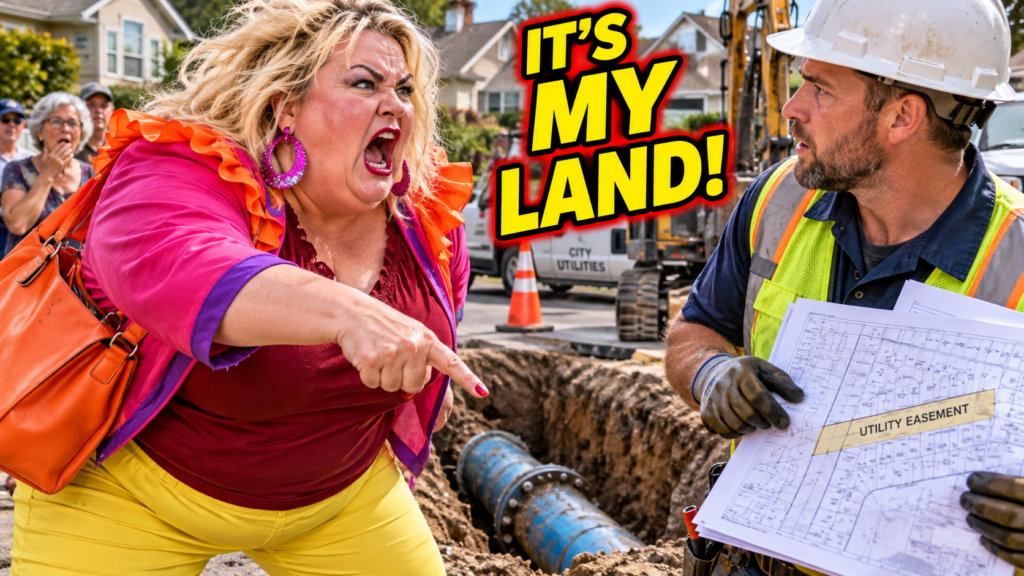
Chapter 4: What Was Buried Under the Backyard
The county returned the next morning with the historical engineering plans.
This time, Karen was waiting.
She stood behind her locked gate, arms crossed, already prepared for another confrontation.
Mark kept his distance.
“We’ve confirmed the second line is part of the original shared water system.”
Karen shook her head.
“No.”
“It serves the rear lots.”
“No.”
“It was installed before your house was built.”
“No.”
“You bought the property with the easement already recorded.”
Karen stepped closer to the gate.
“I bought a home. I didn’t buy a public utility corridor.”
Mark pointed toward the old plan.
“This line was installed in 1982. Your home was completed in 1987.”
Karen stared at the document.
For a moment, her certainty faltered.
Then she recovered.
“Then the county should have disclosed it.”
“That’s a question for the property records.”
“I never agreed to this.”
“You didn’t need to personally agree to an easement that existed before you purchased the property.”
That sentence landed harder than anything else.
Karen looked toward the neighbors.
She saw Evelyn standing beside her porch.
She saw the empty water containers.
She saw a mother carrying bottled water into her house.
But instead of stepping aside, Karen made another decision.
She called her attorney.
By afternoon, a formal notice had been delivered to the county.
Karen was challenging the repair work until the ownership and easement boundaries were independently reviewed.
The effect was immediate.
The utility crew could repair the exposed section of the main, but they could not safely proceed with the secondary connection until the legal boundary was clarified.
The neighborhood’s water service remained unstable.
That evening, Evelyn sat on her porch with two gallons of water beside her.
Mark stopped by.
“You’ve been very patient.”
Evelyn gave him a tired smile.
“I’ve lived here long enough to know that some problems aren’t solved by shouting.”
Mark smiled.
“I wish everyone knew that.”
Evelyn looked toward Karen’s darkened house.
“She isn’t just protecting her property.”
Mark waited.
“She thinks admitting she’s wrong means losing.”
He nodded.
That was when Evelyn remembered something else.
Years earlier, when the subdivision had been renovated, an old utility marker had been moved during landscaping.
She remembered seeing workers place a metal cap near the rear fence.
“If that marker is still there,” she said, “it could identify exactly where the corridor runs.”
Mark’s expression changed.
“Do you know where?”
Evelyn pointed.
“Behind Karen’s garage.”
The next morning, the survey crew located the marker.
It was buried beneath several inches of soil.
When they uncovered it, the stamped lettering was still visible.
PUBLIC WATER EASEMENT — MAINTAIN ACCESS.
Karen watched from her window.
She had lost the argument about the main.
But the discovery created another problem.
The marker was not near the boundary line she had believed belonged to her.
It was farther inside her yard.
And the map showed why.
The easement passed directly beneath a section of landscaping Karen had installed only months earlier.








