Chapter 6: The Connection Nobody Had Seen
The county brought in an older engineer who had worked on municipal systems for decades.
His name was Robert Hayes.
He studied the historical plans, the exposed fitting, and the modern map.
Then he explained what had happened.
The old community garden had once supplied water to residents during summer months.
When the garden was removed, the pump house was demolished.
But the underground line had never been completely abandoned.
Instead, it had been incorporated into the neighborhood’s later water network.
Over the decades, new homes had been connected around it.
The system had evolved.
The paperwork had not.
That explained why the records seemed confusing.
It also explained why the second line ran beneath Karen’s backyard.
It wasn’t an accidental pipe.
It was part of the neighborhood’s history.
And more importantly, it had become part of the modern public system.
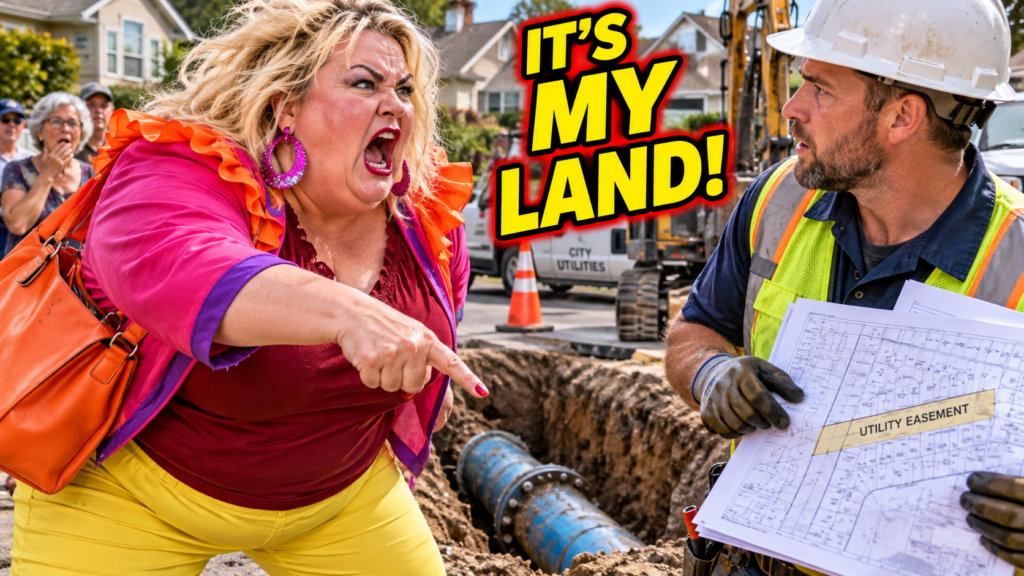
Karen stood silently beside the excavation.
Robert pointed toward the fitting.
“If this connection fails completely, the pressure problem could spread.”
Karen looked at Mark.
“So you’re saying everyone needs this?”
“Yes.”
She looked at Evelyn.
Evelyn nodded.
Karen swallowed.
For the first time, there was no argument left that could make the facts disappear.
Still, she had one final concern.
“What happens to my backyard?”
Mark answered honestly.
“The county will repair what we disturb within the work area. But the easement remains. Future utility maintenance will always require access.”
Karen looked down at the torn-up section of landscaping.
It was not what she wanted to hear.
But it was clear.
She could either keep fighting the existence of something that had been documented long before she owned the house, or accept that owning property also meant living within the history of a community.
The repair began that afternoon.
The old pipe was reinforced.
The damaged main was restored.
Water pressure slowly returned throughout the neighborhood.
One by one, faucets began running normally.
Evelyn turned on her kitchen sink and listened to the steady stream.
It was an ordinary sound.
But after two days without dependable water, it felt like something precious.
Outside, Karen watched the crew finish.
She had not apologized.
She had not admitted defeat.
But she had stopped blocking them.
That evening, she stood alone beside the repaired section of her backyard.
The stone pavers had been reset.
The fountain still worked.
The damage was visible, but manageable.
Then Mark handed her a document.
It was the final easement survey.
Karen looked at the highlighted corridor.
It passed beneath her property exactly where the old records said it did.
She sighed.
“I still don’t like it.”
Mark nodded.
“You don’t have to.”
Karen looked toward the street.
“But I suppose that doesn’t change where it is.”
“No,” Mark said.
She folded the document.
For once, she didn’t argue.
But there was still one thing left unresolved.
The county had discovered that several properties in the neighborhood had landscaping built over the same utility corridor.
And Karen was not the only homeowner who would have to decide what that meant.