Chapter 2: The Line Everyone Forgot
By sunset, the work had stopped.
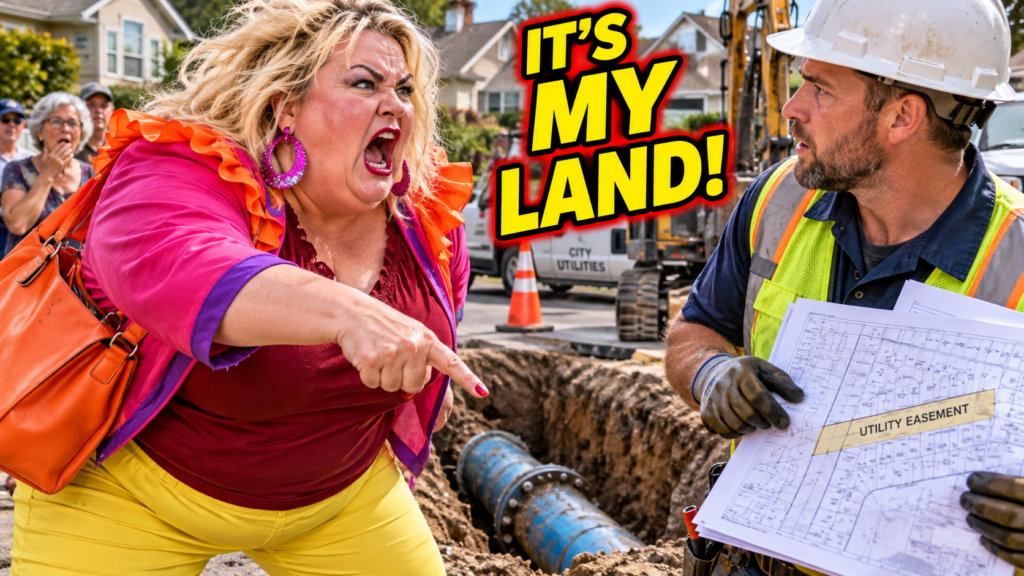
Karen had succeeded in forcing the crew to leave the excavation untouched until the county could verify the easement.
She stood in her driveway afterward, arms crossed, watching the utility truck disappear around the corner.
To Karen, it felt like a victory.
She had protected her property.
At least, that was what she told herself.
Inside her home, however, the water pressure began dropping.
At first it was barely noticeable.
Then the kitchen faucet sputtered.
Karen turned it off and tried the bathroom sink.
A weak stream came out.
She stared at it.
“This better not be because of them.”
Her phone rang.
It was Mark.
Karen almost didn’t answer.
“What?”
“Your water pressure may be affected while the damaged section remains isolated.”
“I told you to fix it somewhere else.”
“We’re trying to.”
“Then try harder.”
There was a pause.
“Ms. Karen, the repair isn’t only about your property.”
Karen rolled her eyes.
“Of course it isn’t.”
“It serves twelve homes.”
She hung up.
The next morning, the neighborhood had a bigger problem.
Several residents had little or no water.
Evelyn was among them.
At seventy-one, Evelyn had lived in the subdivision for nearly thirty years. She had watched children grow up there, watched older neighbors pass away, and watched new families arrive.
She had also kept boxes of old neighborhood documents in her basement.
When Mark came back that morning with the county surveyor, Evelyn walked outside carrying one of those boxes.
“I think I have something you need.”
Karen was standing nearby.
“What is that?”
Evelyn ignored her and handed Mark a faded subdivision plat.
The paper was old enough that its edges had turned brown.
Mark unfolded it carefully.
There it was.
The same utility corridor.
But the document revealed something else.
A handwritten note from the original developer described the water line as a shared service corridor serving the entire eastern section of the neighborhood.
Mark looked at Karen.
“This is why the county records show the easement.”
Karen snatched the paper from his hands.
“That’s forty years old.”
“It’s still relevant.”
“This house is mine.”
“Yes,” Mark said. “But ownership of the house doesn’t erase an existing utility easement.”
Karen looked around at the neighbors.
Several were holding empty water bottles.
Evelyn’s expression was tired, not angry.
“We just want our water back,” she said.
Karen stiffened.
“That’s not my responsibility.”
Evelyn looked directly at her.
“Maybe not. But stopping the repair has made it everyone’s problem.”
Karen returned the document.
Then she noticed something handwritten in the lower corner.
A second notation.
Secondary service connection — rear residential lots.
Mark saw it too.
He looked toward Karen’s backyard.
“We need to inspect that second line.”
Karen’s face tightened.
This time, she didn’t argue immediately.
She simply said:
“No one goes into my backyard.”
And locked her gate.