
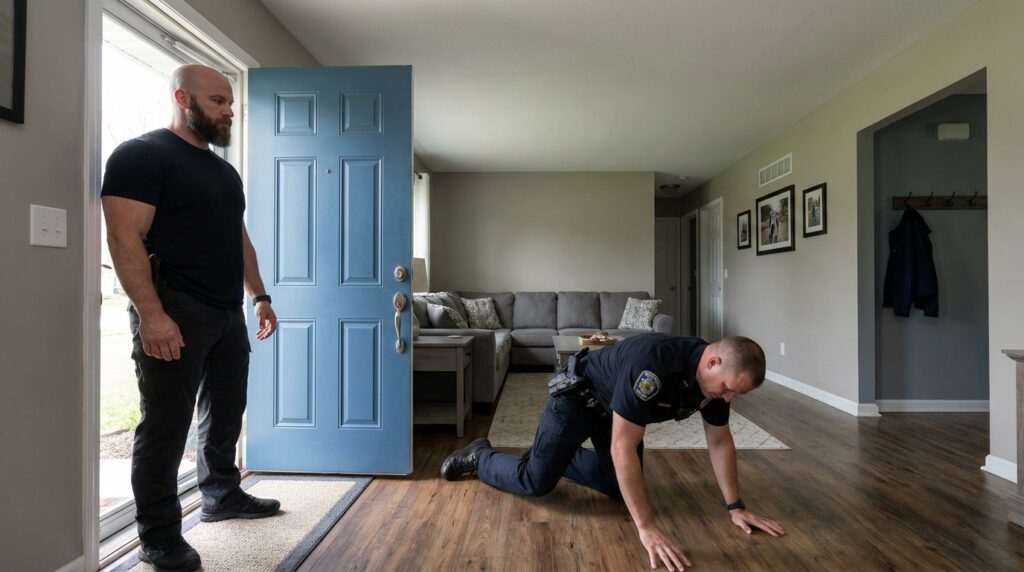
CHAPTER 8: THE SHADOW ON THE SILL
“Stand down, Deputy!” The voice didn’t come from the sergeant on the step. It cut through the flashing purple fog of the front yard from a black, low-profile utility vehicle that had pulled silently into the grass behind the cruisers, its massive tires tearing deep into the wild onions of the drainage ditch. The door slammed with a heavy, dead click that signaled armored plate.
The rookie didn’t answer. His boots stayed pinned to the rubber mark he had dragged across the oak planks, his chest heaving under his split uniform shirt as he watched a third man clear the boxwood hedge. The newcomer was lean, clad in a desaturated slate-gray service coat that bore no municipal insignias—only a small, black-anodized bar across the right lapel. Behind him came the municipal Police Chief, his face tight and gray under his formal visor, his uniform buttons catching the cold, mechanical blink of the emergency bars.
The state official didn’t stop at the porch steps. He ignored the dry pine risers, his heavy oxfords coming down on the wood with a rapid, rhythmic precision that signaled thirty years of concrete hallways. When his shadow fell across the open blue door, his eyes didn’t look at the sergeant, nor did they record the split shoulder of the rookie. They locked onto Vance’s right hand, specifically tracking the dull, pitted face of the silver signet ring resting against the black T-shirt.
“Vance,” the director said. The name was a short, lead weight dropped into the center of the foyer. He didn’t offer a hand across the three-inch oak threshold. He simply stood there, his slate-gray coat smelling faintly of dry-cleaning chemicals and high-grade diesel exhaust. “The regional repeater flagged an unverified code override from this sector four minutes ago. Dispatch logged it as a property line intrusion.”
“The deputy wanted to see the stamps, Director,” Vance said. His voice remained a flat, low-frequency rattle that didn’t rise to meet the authority on the porch. He didn’t drop his arms. His massive shoulders stayed perfectly square with the frame, blocking out the last rectangle of the fading afternoon light. “He thinks the sills are loose.”
The Police Chief stepped inside the gold perimeter of the strobe light, his hand reaching out to grab Deputy Miller by the nylon shoulder strap of his vest. He didn’t pull him gently; he yanked the younger officer back until the rookie’s boots struck the brass strike plate with a loud, metallic clang.
“Get out of the house, Tyler,” the Chief said, his teeth clamped together so hard the muscles along his jawline looked like knots of old hemp rope. His voice was a low, dangerous hiss that stayed inside the frame of the doorway. “Take your belt off and get in the back of the sergeant’s unit. Do it right now before I have the state police take your statement at the barrack.”
The rookie’s mouth opened, his tongue dry as he looked from the Chief’s silver star back to the state official’s blank lapel bar. “Chief, he’s got an unmapped basement vault—”
“I told you to shut your mouth, Deputy,” the sergeant barked from the porch landing, his voice shaking with the rattle of old grease and fear. “Move your heels.”
The young officer’s hand finally dropped completely away from his belt. The uncoordinated twitch in his fingers left a tiny streak of dark sweat against the polymer casing of his holster as he backed out through the screen door, his head tucked low against the blinding blue glare of the cruisers. The screen door gave a sharp, ungreased slap against the cedar casing—a dry, wooden crack that sounded like a small caliber round going off in the quiet neighborhood.
The state official didn’t watch him leave. He kept his eyes on Vance’s bald head, tracking the thin, pale scar that ran down behind his earlobe. “The grid is holding twenty thousand gallons a minute through the lower bypass, Commander,” the director said softly, his voice dropping below the mechanical rumble of the idling patrol cars. “We had an indicator drift on the three-inch line near the reservoir yesterday. The engineering detail thought it was a packing leak.”
“It’s not a leak,” Vance said, his left thumb shifting an eighth of an inch along the canvas of his belt. “The alignment is off because the county road crew dropped the concrete tile too close to the retaining wall three winters ago. The ground shifted four inches under the apron. If you don’t grease the pintles on the lower bypass valve before the frost hits, the thrust will crack the casing.”
The Chief looked down at the galvanized steel anchor sleeve embedded in the floorboards between his boots, his face darkening as the implications of the file numbers began to settle into the old oak planks. He didn’t speak. He simply stood there like a decorative iron post, his uniform cap casting a long, desaturated shadow across the linseed oil finish of the foyer.
“We’ve got a joint task force briefing at the capital tomorrow at zero six,” the director said, his fingers reaching inside his slate coat to pull out a small, triple-sealed inspection log with a heavy brass clasp. He didn’t step across the sill to hand it over; he laid it down on the small telephone table beside the door numbers, right next to the wooden bowl. “The secretary wanted to know if the sector anchor was verified. I told him the blue door was still on its hinges.”
“The door is fine,” Vance said, and his right hand slowly drifted into his pocket, the silver signet ring vanishing into the black fabric as the low-frequency hum of the water gates below the floorboards began its rhythmic, late-afternoon cycle. “Tell the secretary to keep his trucks off my gravel.”








