
CHAPTER 4: THE VACUUM AT THE SILL
The rotted pine of the top riser didn’t simply groan under Miller’s weight; it yielded three-quarters of an inch, the rusty framing nails squeaking inside the water-logged stringer. Miller’s left shoulder tilted slightly forward as he cleared the threshold, his hand extended—not flat, but hooked into a rigid claw meant to snag the loose cotton of Vance’s collar. He was counting on the raw physics of his forward lean, two hundred pounds of bone and wet wool accelerated by an aggressive stride, to force the older man back into the darkness of the hall.
The vacuum occurred in the space of a single pulse.
Vance didn’t back up. He didn’t drop his hands into a defensive block or throw his weight against the wood. Instead, his right heel drifted backward exactly two inches along the dry grain of the floorboards, a minimal rotation that aligned his hips with the outer frame of the door. As Miller’s fingers brushed the black fabric of the T-shirt, Vance’s left hand came up—not a strike, but a small, heavy scoop that caught the underside of Miller’s extended wrist.
The trajectory of the entire encounter inverted instantly.
Miller’s own forward velocity became a trap. Without the resistance of Vance’s chest to stop his momentum, the young deputy lunged into empty air, his center of gravity traveling past his knees before his brain could register the lack of friction. The silver signet ring on Vance’s right hand didn’t strike stone; it merely pressed against the heavy nylon weave of Miller’s utility belt, a precise, guiding point of contact that redirected the falling mass toward the interior oak planks.
The contact was dry, brief, and entirely mechanical. Miller’s boots skidded across the polished sill, his scuffed heels kicked upward by his own frantic attempt to recover his footing. The heavy duty belt, loaded down with twenty pounds of steel tools and high-grade plastics, swung sideways like a loose pendulum. The snap on his pepper-spray pouch sheared off against the iron striker of the door latch, sending a tiny cloud of dry leather dust and zinc shavings spinning through the bright rectangle of afternoon sun.
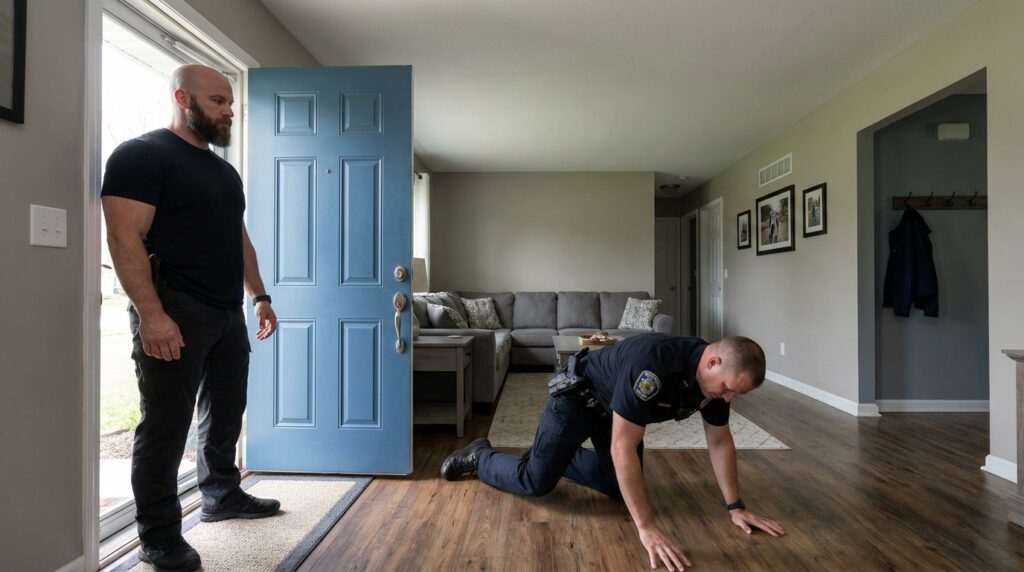
The house didn’t shake when Miller hit the floor, but the low-frequency thud of his Kevlar vest striking the oak planks carried the dead, dead weight of a dropped sack of grain. He slid four inches on his shins before his palms slammed into the wood to arrest the drift. The impact drove the air from his lungs in a sharp, wet grunt that rattled the small glass panes in the side-lights of the entryway.
The silence that followed was dense, suffocating, and absolute.
Miller stayed there, braced on his hands and knees in the center of the foyer floor. The wood beneath his knuckles was clean, polished with linseed oil that smelled faintly of old turpentine and dry earth, but his nose was an inch from a deep, ragged groove in the timber—a mark where something incredibly heavy and metallic had been dragged across the floor years before. His breath came in ragged, shallow wheezes, his vision tunneled down to the intricate pattern of the wood grain and the gray dust motes settling onto his dark blue trousers.
He couldn’t hear the rod knock of his cruiser anymore. The only sound in the small space was the rapid, frantic ticking of his own pulse against his eardrums and the slow, heavy drip of condensation from the small air-conditioning unit mounted high in the hallway ceiling. He didn’t look up immediately. The sheer humiliation of the drop kept his neck locked, his shoulders hunched as he waited for the second strike, the kick to the ribs or the heavy weight of a knee between his shoulder blades that standard defensive tactics said should follow a takedown.
The pursuit never came.
Vance remained planted exactly where he had stood before the lunge, his boots aligned with the edge of the blue sill, his frame filling the opening until the bright glare of the street was reduced to a thin, gold halo around his wide shoulders. His hands were down at his sides, the fingers loose, the thumb of his right hand resting just above the pocket line. He wasn’t breathing hard. The heavy muscles of his chest rose and fell with a slow, mechanical regularity that matched the ticking of the car engine outside.
“The threshold is clear, Deputy,” Vance said. The voice didn’t carry the heat of a victor; it was the cold, dry assessment of a mechanic who had just tested an old hydraulic line and found it wanting. “You’re inside the house now. Your camera is recording the ceiling. Your backup is two minutes out by the sound of the transmission line. Get your feet under you.”
Miller’s fingers twitched against the oak, his fingernails digging into the thin lacquer coating until the wood groaned. His right hip felt numb where the heavy steel cuffs had pinned themselves between his pelvic bone and the floor. He could see the shadow of Vance’s boot—unmoved, unmarred, a solid block of oiled leather that hadn’t even shifted into the dust kicked up by the fall.
“You’re done,” Miller whispered into the floor, his voice breaking on the second word as he tried to find enough leverage in his wrists to lift his chest off the planks. “You touched a deputy. That’s ten years in the brick house, Vance. Ten years.”
Vance didn’t look down at him. His flat, dark eyes remained fixed on the long ribbon of gray asphalt visible through the open doorway, tracking the first low vibration of a distant siren that was just beginning to stir the dry pine needles at the edge of the woods. “Nobody touched you, son. You tripped on the sill because you forgot to check your lead foot. Now clean yourself up before the Chief has to look at you on your knees.”








