
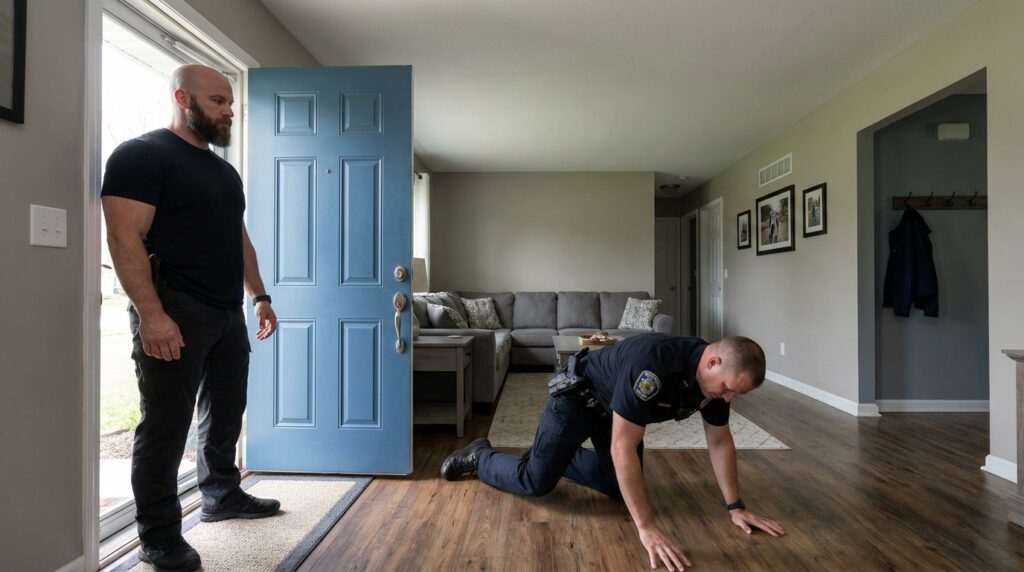
CHAPTER 5: THE WEIGHT OF OAK AND ANCHORS
The heavy impact of standard-issue Kevlar and knee leather striking the polished oak floor echoed through the dead silence of the foyer. The vibration ran sideways through the joists, stopping abruptly where the thick sills were bolted directly into the subterranean concrete bed. Miller’s jaw clamped shut so hard his molars grated on the alkaline dust he had inhaled from the threshold mat. His knuckles, splayed flat across the oak planks to maintain his vertical stance, were turning a dark, bloodless white against the desaturated grain of the wood.
“Stand up, Miller,” Vance said. The command wasn’t delivered with the sharp, rising bark of a drill instructor. It had the mechanical weight of a hydraulic cylinder dropping into place—slow, low-frequency, and completely indifferent to the resistance beneath it.
Miller didn’t move his legs. His left knee felt as though it had been jammed into a cold iron rail, the nylon of his uniform trousers twisted and binding tight around the joint. He kept his head down, his vision locked onto a circular discoloration in the floor wax three inches from his left thumb. It was a flush-mounted galvanized steel sleeve, three inches wide, drilled straight through the hardwood into the structural heart of the foundation. The edges were raw, dark with the crust of oxidized zinc, and inside the hole, the massive threads of a heavy-duty leveling bolt were visible. A house in a standard development didn’t have tie-down anchor sleeves embedded in the foyer floorboards.
“Don’t tell me what to do on an active scene,” Miller choked out. He shifted his weight to the right, trying to slide his boot heel under his thigh to establish a clean base of upward leverage, but his gun belt caught on the brass strike plate of the door frame. The metallic clink of his spare magazines sounded thin, brittle, and entirely decorative in the narrow hall. “You resisted a lawful investigative entry. You used physical leverage on an officer of the county.”
“Nobody used leverage but the earth, son,” Vance said, his boots remaining perfectly stationary at the edge of the blue sill. He hadn’t reached down to help the younger man up, nor had he shifted into an offensive guard. His massive forearms remained crossed over his chest, the fitted black fabric of his shirt showing the heavy, corded ridges of his traps. On his right hand, the silver signet ring remained locked against his ribcage, the rectangular notch in the silver casting a tiny, sharp shadow across the fabric. “You crossed a dry threshold with your center of gravity six inches out of alignment. If I had used leverage, your collarbones would be sitting in the baseboards. Now clear your gear off my floor.”
The sound of the neighborhood was changing outside. The distant, high-frequency scream of a municipal siren had dropped an octave, shifting into the heavy, broken wail of a vehicle navigating the narrow grid lines of the residential development. Two blocks north, a transmission line rattled as a secondary unit took the corner over the drainage ditch too fast, its loose leaf springs clanging like scrap metal against the frame.
Miller managed to force his right heel flat against the oak, his thighs trembling as he pushed his torso upright. His uniform shirt was ruined—the center seam was split out at the left shoulder where he had overextended his lunge, and a long, pale smear of old floor wax ran from his sternum down to the heavy leather pouch of his radio. His face was a dark, mottled purple, the sweat from his neck dripping onto the polished brass house numbers that sat in a small wooden bowl on the telephone table beside the door.
“You think you’re insulated here because you know the code book,” Miller whispered, his voice rising as he finally cleared his holster from the snag of the door frame. He didn’t draw the weapon, but his palm stayed clamped over the grip, his thumb hooked over the safety strap with a frantic, uncoordinated twitch. “You think because you’ve got some old military metal on your finger, the sheriff is going to walk away from a threshold assault? I’ve got three logged calls on this parcel. I’ve got probable cause of structural modification without an inspection rider. Look at this floor. Look at these bolts. You’re running a fortified asset inside a residential zone.”
Vance’s expression didn’t change by a single millimeter. His cold, dark eyes shifted from Miller’s hand on the weapon down to the steel sleeve in the floorboards, then back up to the young deputy’s face. The level of observation was surgical, devoid of the emotional static that usually filled a standard domestic standoff. He looked like a man evaluating a damaged winch line before deciding whether to cut it or splice it.
“The fortification was paid for by the state emergency management budget in ninety-eight, Deputy,” Vance said. His voice dropped lower, beneath the rising pitch of the sirens now turning into the head of the driveway. “The file isn’t under the residential parcel number. It’s under the regional infrastructure registry. If you had spent ten minutes reading the grid layout instead of cruising the fence lines to see who didn’t salute your light bar, you’d know this house sits on the primary control junction for the entire western valley valley drainage system. The floor doesn’t move because it can’t move.”
Miller froze, his thumb remaining locked on the holster strap. The floor beneath his feet seemed to give a sudden, low-frequency hum—not from the house itself, but from the immense mechanical volume of the water mains running through the easement sixty feet below the cellar floor. He looked at Vance’s bald head, at the immaculate gray of his beard, and for the first time, he noticed the small, flat scar running from the veteran’s left earlobe straight down into the collar of his black shirt—a pale, smooth track left by a fragment of hot casing that had torn through skin but missed the artery by the thickness of a thumbnail.
“That doesn’t give you the threshold,” Miller said, but the cadence had left his voice. The words were just dry paper sliding across a desk.
“The threshold belongs to whoever keeps the anchors greased, son,” Vance said, and his head turned slightly toward the open door as the high-intensity strobe lights of the first backup cruiser cut through the dust of the driveway, turning the blue paint of the entryway into a flashing, violent purple.








