CHAPTER 6: THE TRUE METRIC
“The survey stakes don’t lie, Brenda,” Mark said. His tone lacked heat. It was just a cold calculation delivered across a strip of scorched earth that had ceased to belong to either of them.
The blue-plated state sedan remained parked behind Mark’s truck, its exhaust pipe emitting a faint, colorless heat ripple that blurred the gravel in the gutter. Officer Davis had returned, his cruiser tucked against the opposite curb with its low-frequency engine drone vibrating through the dry sod. He stood by the front fender of the state vehicle, his thumbs hooked loosely inside his utility belt, watching the state official deploy a high-precision optical transit tripod directly over the notched iron pin.
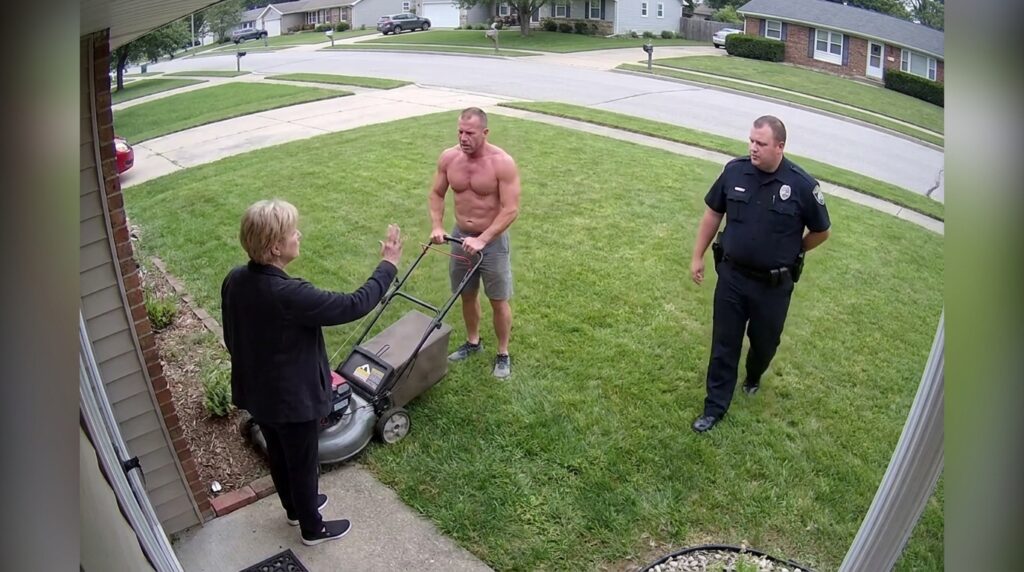
Brenda stood four feet back on her elevated aggregate pad. Her arms were wrapped tightly across her torso, the dark fabric of her windbreaker jacket absorbing the harsh glare of the late afternoon sun. The pale skin around her eyes looked translucent, paper-thin, tracking every mechanical adjustment of the transit’s brass dials.
The examiner adjusted a small thumb-screw on the scope, his shirt sleeve pulling back to reveal a silver watch face pitted with corrosion. “The nineteen eighty-eight plats were baseline drawings for the private developers,” he said, his voice carrying clearly down the asphalt. “They built the retaining walls and the driveways on a secondary grid. But the civil defense easement from sixty-one overrides the sub-division line by twelve vertical inches from the culvert center.”
He leaned back from the lens, his boot heel grinding against a dry clod of dirt. “This entire six-foot corridor—from the foundation wall of her porch to the third course of his lawn—is designated public utility access. No residential deed on this side of the lane extends to the grass line.”
Mark looked down at his boots. The fine grass clippings from his midday mow had dried into a stiff, yellowish crust across his leather laces. The territory he had spent months defending, the ground Brenda had used as a platform for her petty micro-management, was gone. It had been swallowed by an old federal map drawn before the concrete on either porch had even cured.
“The leak under the pad,” Mark said, his eyes shifting to Officer Davis. “The overflow running into my crawlspace.”
“The city crew will be out with a backhoe at seven tomorrow morning, partner,” Davis said, his uniform cap casting a deep diagonal shadow over his nose. He took three slow steps into the mediation zone, his heavy boots crushing the unmanaged fescue. “They have an emergency mandate to clear the connection gate. That concrete apron her husband poured is coming out. All of it.”
Brenda’s fingers dug into the fabric of her pockets. Her shoulders slouched inward, her body losing the rigid, gate-like posture that had defined her presence on the street for thirty years. “The structure will list,” she whispered. Her voice was cracked, dry as sun-baked brick. “The foundation won’t hold if you dig out the drainage trench.”
The state examiner didn’t look up from his ledger. He stamped the linen page with a heavy, mechanical ink pad, the loud thwack of the rubber seal sounding like a small hammer striking a timber. “Then your insurance firm will have to settle with the municipal risk pool, ma’am. You can’t seal a federal infrastructure artery to keep your basement dry.”
Mark watched a small stream of rusty condensation drip from the underside of his parked lawn mower, spot-welding the dry earth beneath the blades. The vindication wasn’t clean; it had the metallic, bitter taste of old well water. He had won the line, but the line itself had disintegrated beneath his feet, leaving nothing but an open trench of municipal clay and fifty years of hidden administrative rot.
Officer Davis walked over to Brenda, his hand reaching out to touch the handrail of her porch step—right where the fresh mortar had been chipped away to expose the iron gate. “Let’s go inside and review the excavation notice, Brenda. The street needs to stay clear for the utility trucks.”
Brenda didn’t move for three long seconds. She looked across the yellow fescue at Mark, her pale eyes wide, searching his face for some sign of the old neighborly friction she had used to fuel her days. Mark kept his expression flat, his arms crossed over his chest, his posture as unyielding as the iron survey rod driven into the subsoil.
She turned slowly, her heavy rubber soles scraping against the aggregate as she followed Davis up the steps. The screen door gave a light, tinny rattle as it closed behind them, followed by the heavy thud of the deadbolt sliding into place.
Mark grabbed the handle of his push-mower, the rubber grip hot against his palms. He pulled the machine backward, its wheels leaving two dark parallel tracks in the dust where the true boundary line had once been. The street was quiet again, the amber light of the setting sun catching the red tag on the spigot, but the block would never look the same. The lines had been redrawn, not by anger or paperwork, but by the rusted weight of old steel buried deep within the ground.