CHAPTER 2: DEEDS IN THE DUST
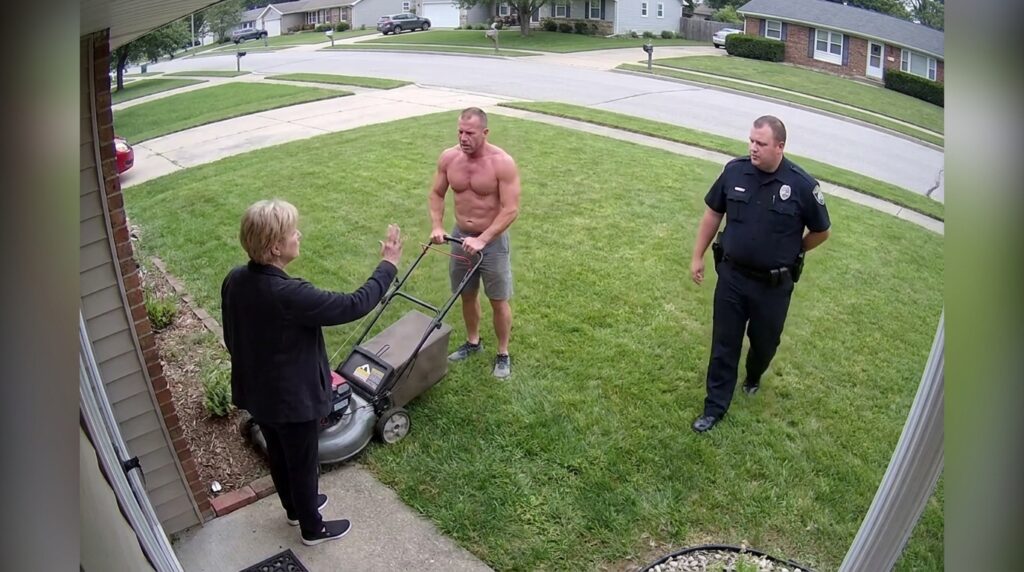
“He’s not giving you a citation, Brenda,” Officer Davis said, his voice dropping into the lower register of a man who had spent fifteen years writing reports on people who hated their own fences. His boots made a dry, scraping sound as he turned away from the red push-mower, his uniform trousers heavy with dust. “But nobody touches the sod until the city clerk looks at the grid maps tomorrow morning. We’re freezing the line. Right here.”
Brenda’s mouth didn’t twist; it hardened into a thin, bloodless seam. She didn’t look at Mark. She looked past his shoulder, her eyes tracking the slow, rhythmic sweep of the high-mounted doorbell camera under the porch gable. The red LED on the casing pulsed like a low-voltage coal in the noon shadow. Without a word, she spun on her heel, the heavy rubber soles of her walking shoes tearing a small patch of fescue from the root as she retreated across the sun-baked dirt toward her own porch.
Mark didn’t watch her go. He waited for the heavy mechanical click of Brenda’s front door to travel across the space between the foundations before he turned his back on the street.
Inside his kitchen, the air was different—stagnant, smelling of cold coffee grounds and the metallic tang of the old copper pipes beneath the sink. The refrigerator compressor kicked on with a low, vibrating hum that rattled the loose silver spoons in the drying rack. Mark pulled a chair out from the formica table, the aluminum legs screeching against the linoleum tile like grease-starved brakes. He didn’t turn on the overhead light. The yellow afternoon glare filtered through the dust on the windowpane, cutting a diagonal block of amber across the legal-sized folders laid out before him.
He ran a thumb over the edge of the oldest document—the 1988 county plot registry map. The paper was thick, yellowed at the margins, smelling of old basement filing cabinets and dry rot. According to the purple ink stamp from the Registrar of Deeds, his property ran exactly twenty-eight feet from the center line of the shared asphalt driveway. That put the six-inch strip of turf firmly within his domain. It gave him the right to clear it, to mow it, to dig it if he pleased.
But his eyes kept drifting back to the high-definition doorbell footage playing on the screen of his phone, propped against a salt shaker.
He slid the timeline bar back with his index finger, watching the micro-seconds before the confrontation. The wide-angle lens distorted the edges of the frame, bending the perspective of the two houses until they looked like they were leaning toward each other in the heat. In the corner of the image, where the foundation of Brenda’s concrete porch step cut into the grass line, there was a small, white blemish. It was the jagged patch of fresh mortar he had noticed while Officer Davis stood between them.
Mark zoomed in. The resolution pixelated, turning the stone into a gray checkerboard, but the shape remained clear. It wasn’t a standard repair. The mortar was slapped on thick, unweathered, still showing the diagonal scoring marks of a cheap hand-trowel. It sat directly above the old iron drainage culvert that ran between their walls—a subterranean pipe that was supposed to carry rainwater down to the municipal storm drain at the curb.
He leaned forward, his knuckles pressing hard into the table until the skin turned white.
From the floor below, deep within the crawlspace beneath the kitchen, came a faint, rhythmic sound. Drip. Drip. It was the low-frequency code of a plumbing leak, but it wasn’t coming from his own lines. The sound carried through the foundation blocks, vibrating through the cast-iron waste stack that shared an underground trench with Brenda’s utilities.
Mark stood up, his chair scraping the linoleum again. His shirtless skin felt cold now, the sweat from the lawn drying into a tight, salty film across his ribs. He walked over to the side window that faced Brenda’s driveway.
Through the dirty glass, he could see the gray line of her concrete pad. It was poured five inches higher than his own, a thick slab of aggregate that had always forced the summer runoff toward his foundation. But looking down from the kitchen’s elevation, he noticed the slope wasn’t natural. The entire concrete apron had been raised near the porch step, supported by an extra layer of cinder blocks that were half-buried in the dirt.
A memory, dry and rusted as an old nail, stirred in his chest. Ten years ago, before Brenda’s husband had passed away in that back bedroom, the old man had spent three weeks out by the boundary line with a rented concrete mixer and a shovel. He’d claimed he was just reinforcing the porch against the winter frost. Mark had been working twelve-hour shifts at the rail yard back then; he’d watched the old man through the headlights of his truck when he came home at midnight, his silhouette hunched over the forms in the dark, pouring bucket after bucket of wet stone into the gap between the foundations.
Mark reached into his pocket and pulled out his keys, his fingers selecting the small, brass-headed key to the basement bulkhead.
He didn’t need the city clerk’s maps. He didn’t need to wait for a neutral surveyor to tell him where his ground ended. The answer wasn’t on the yellowed paper on his table; it was down in the dark, where the roots of his fescue met the concrete Brenda’s husband had poured while the rest of the street was asleep.
He crossed the kitchen, his boots heavy on the wood, and threw open the basement door. The smell of cold earth and damp lime came up to meet him, accompanied by that steady, unchanging sound from the dark below.
Brenda hadn’t called the police to protect her grass. She had called them to keep him from looking down.