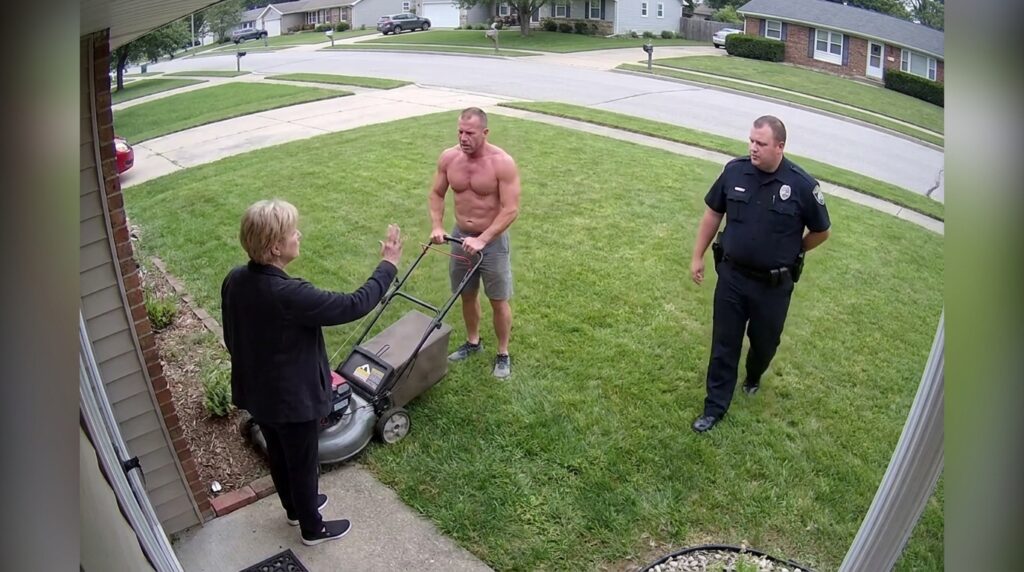
CHAPTER 4: UNBLINDING THE AXIS
The steel spade edge didn’t cut the sod; it struck with a clean, jarring tonk that rattled up through the fiberglass shaft and bit into the meat of Mark’s palms. He didn’t stop to clear his breath. The municipal pickup had left an hour ago, its orange beacon leaving a fading trail of smoke in the heavy afternoon air, but the red tag dangling from Brenda’s spigot remained—a stiff piece of plastic knocking against the brickwork in the hot breeze.
Mark drove his boot heel down onto the step-tread of the shovel again, forcing the tempered edge through the dry fescue roots until he hit the unyielding spine of whatever lay buried beneath the grade.
“You’re tearing up the foundation line, Mark,” a voice rasped from the shadows of the neighboring eaves. Brenda wasn’t holding the clipboard now. Her fingers were empty, hooked into the pockets of her dark windbreaker jacket, her shoulders hunched forward as if the sun had suddenly gotten too heavy for her. Her oversized sunglasses were gone, revealing small, pale eyes surrounded by deep, dry creases that didn’t move when she spoke.
Mark didn’t look up from his ditch. He knelt down in the coarse, desaturated dirt, his fingers clawing away the damp thatch from the iron column he had scraped. “The city tag says the drainage corridor has to be clear of obstruction, Brenda. I’m clearing it.”
“My husband laid that stone thirty years ago,” she said. Her voice had lost its aggressive, performance-ready edge, sinking into a flat, defensive monotone that seemed to mimic the dry rustle of the leaves overhead. “The city didn’t care about the runoff then. They won’t pay for the retaining wall if the slope slides.”
Mark’s fingers hit cold metal. It wasn’t the curved belly of the storm pipe. It was a square iron rod, one inch thick, driven straight down into the subsoil behind the concrete pad. The iron was heavily pitted, flaking off in reddish-brown scales that turned to powder under his fingernails. This was the original layout corner—the primary survey pin that defined the western coordinate of the entire block.
He pulled a wire brush from his back pocket, the stiff bristles scraping across the iron head with a high, screeched whine.
As the crusted clay crumbled away from the flank of the pin, Mark stopped. A notch had been filed into the side of the iron—a clean, mechanical V-cut that had been executed with a hand file long after the metal had been driven into the earth. The notch sat exactly four inches to the left of the true center mark. If a surveyor aligned their transit scope with that file mark instead of the core axis, the entire boundary line would pivot, throwing six inches of Mark’s yard into Brenda’s lot and burying the municipal gate under her concrete apron.
A dull ache settled behind Mark’s temples. The old man hadn’t just poured concrete to fix a settling step in the dark. He had systematically repositioned the baseline of the neighborhood to mask the fact that his foundation was slowly listing into the utility path.
“He knew,” Mark muttered, his voice barely louder than the scrape of his brush against the iron.
“He did what he had to do to keep the house dry,” Brenda said from the property edge. She didn’t move any closer, her shoes glued to the high lip of her raised aggregate pad. “The water has to go somewhere, Mark. It’s been going down there since before you bought that place.”
Mark stood up, his height giving him a clear view over the top of the fence line. His chest was covered in gray clay dust, his bare skin showing the red friction marks of the heavy work. He looked from the notched pin to the red tag on the spigot, then past Brenda to the quiet residential street. The neighbor across the way had their front door open three inches, a pale face catching the light behind the screen. The block was watching, silently registering the slow collapse of the block’s most rigid boundary.
He reached down and grabbed the iron pin, his knuckles locking around the rusted head to check its stability. It didn’t budge. It was anchored deep, set into a plug of old gray cement that extended far beneath Brenda’s raised driveway.
Then his phone vibrated against his hip—a single, long pulse from the security application.
He pulled the screen out with a dirty hand. The wide-angle camera on his porch was registering movement, but it wasn’t at the front curb. The digital frame showed a second vehicle pulling up behind his pickup truck—a dark blue sedan with state government plates and a long, whip-like radio antenna mounting the trunk. A man in a pressed white shirt and a dark tie stepped out onto the asphalt, a leather-bound logbook tucked under his arm.
Mark looked from the screen back to Brenda. Her pale eyes were fixed on the sedan, her mouth dropping open slightly as the man in the white shirt began walking toward the property markers with a heavy, deliberate stride that had nothing to do with residential code enforcement.
The file mark on the iron pin wasn’t just a trick to steal six inches of fescue. It was a marker for an entirely different kind of line—one that neither Brenda’s clipboard nor Mark’s yellowed deeds had accounted for in the thirty years they had shared the dirt.