CHAPTER 3: THE CODE IN THE STONE
The basement stairs didn’t give under Mark’s weight; they groaned, a dry, wood-on-wood rasp that died against the rough limestone foundation walls. Down here, the smell of the lawn was entirely erased, replaced by the heavy, alkaline scent of damp lime and fifty years of weeping mortar. He reached the bottom step, his bare feet pressing into the cold, gritty concrete slab. The light from the open door above cut a sharp orange rectangle across the floor, illuminating floating dust motes and a dead, curled-up millipede near the drain.
Drip. Drip.
The sound was louder here, hollowed out by the masonry. He followed the noise toward the western corner, where the foundation blocks formed the underground spine between his cellar and Brenda’s crawlspace. The mortar between the third and fourth courses of cinder block was soft. When he pressed his thumb against it, it flaked away like wet chalk, leaving a dark, damp streak on his skin.
He reached out, his fingers tracing a corroded, ancient cast-iron pipe that passed directly through his wall and disappeared into the earth toward Brenda’s lot. This was the drainage line. It wasn’t standard PVC; it was heavy, pitted iron, its belly coated in a thick, white crust of calcified scale. The water wasn’t leaking from his side. It was weeping backward along the exterior of the pipe, pushed by a head of pressure from a source higher up on Brenda’s raised grade.
A sudden, sharp mechanical whine from the street cut through the cellar’s silence, vibrating through the small glass awning window above his head. A strobe of amber light flashed across the joists.
Mark turned, leaving the damp wall behind, and hauled himself up the cellar steps three at a time.
Out on the curb, parked directly on the disputed boundary strip where the fescue met the bluegrass, sat a white municipal pickup truck with a high-visibility chevron pattern on the tailgate. An orange beacon rotated on its cab, casting long, rhythmic shadows across Brenda’s pristine driveway. A man in a fluorescent yellow vest stood near the edge of Brenda’s concrete apron, a long, rusted steel T-bar T-handled key clamped over an underground valve box.
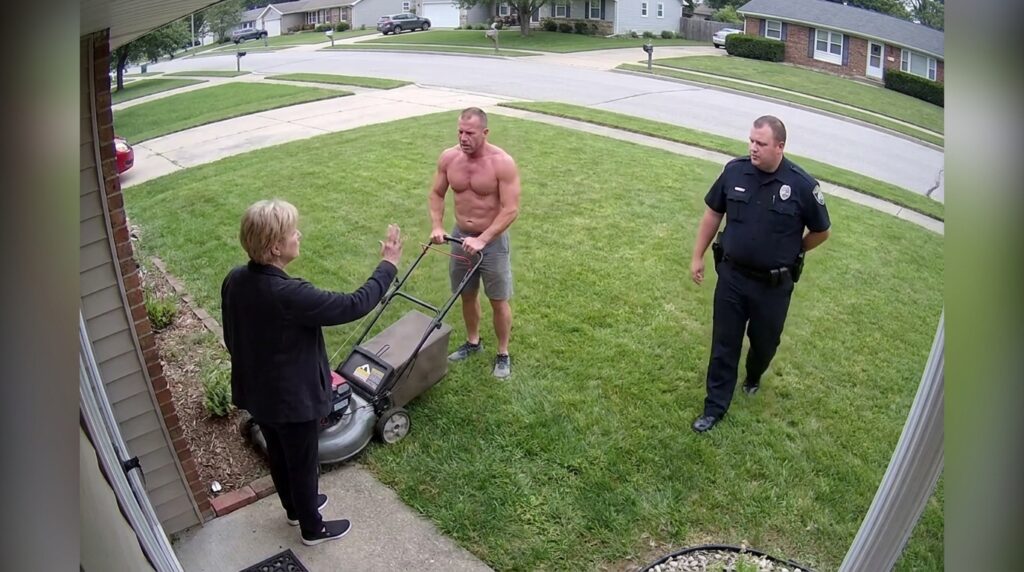
Mark stepped onto the porch, the heat hit his chest like a wet sheet. Brenda was already down there, her dark windbreaker zipped tight despite the rising temperature, her fingers gripping a clipboard like a shield.
“The work order was cleared by the district office, ma’am,” the inspector said. His voice was tired, flat, carrying the unhurried authority of a man paid by the hour. He didn’t look up as Mark approached the property line, his boots crunching on the dried grass clippings. “We have a pressure drop logged on the neighborhood collector line. I need to clear the access gate on the culvert.”
“The culvert is entirely within my residential parcel,” Brenda said. Her hand came up, her index finger pointing rigidly at the fresh, white mortar patch on her porch step that Mark had examined on his phone just an hour earlier. “The maintenance agreement from nineteen eighty-eight clearly states that any sub-surface inspection requires forty-eight hours written notification to the deed holder.”
Mark stopped three feet short of the truck’s rear bumper, his eyes tracking the line where Brenda’s raised concrete met the old asphalt gutter. “She patched over the cleanout hook, inspector,” Mark said, his voice level, cutting through the low thrum of the pickup truck’s idling engine.
The inspector paused, his hands resting on the iron T-bar. He turned his head slowly, looking from Mark’s sweat-streaked bare shoulders to the fresh white mortar on Brenda’s foundation.
Brenda’s chin rose, her oversized sunglasses reflecting the rotating orange beacon. “This has nothing to do with him. He’s a neighbor who can’t keep his mower on his own dirt.”
“Actually, it has everything to do with the grade,” the inspector muttered. He hauled the steel key out of the ground with a wet, sucking sound and walked over to the patched stone step. He knelt down, his heavy leather tool belt clinking against his thigh, and ran a calloused finger over the jagged edge of the new mortar. He tapped it with the butt of a metal flashlight. It gave off a dull, hollow thud.
“This cleanout isn’t just a residential lateral,” the inspector said, looking up at Brenda, his eyes narrowing under the brim of his faded city cap. “This is a cross-connection valve for the storm main. Why did you seal the gate?”
Mark watched Brenda’s shoulder blades stiffen under the dark nylon of her jacket. She didn’t answer immediately; her fingers tightened against the wood of her clipboard until the cheap plastic clip groaned. When she spoke, her voice had lost its flat gravelly edge, replaced by a sharp, defensive snap. “My husband repaired that masonry before he passed. The stone was settling. It was a structural safety issue.”
The inspector didn’t buy it. He reached into his vest pocket and pulled out a heavy iron scraping tool, driving the flat edge into the fresh mortar with a single, practiced strike. The white paste crumbled away in dry chunks, revealing a circular iron plate buried beneath the surface. Stamped into the metal, pitted with rust but entirely legible, was a municipal code emblem and a serial number beginning with US-1961.
Mark stepped closer, the smell of the dry earth rising around his boots. The iron plate wasn’t centered on Brenda’s property at all. Now that the mortar was cleared away, the physical cast-iron rim of the gate sat directly on the old, weathered concrete curb marker—the very marker Brenda’s husband had covered with aggregate ten years ago. The line hadn’t been shifted by thirty feet of paperwork; it had been buried under four inches of illegal cement.
The inspector stood up, dusting the white powder from his palms onto his vest. He didn’t look at Brenda. He looked at Mark, then down at the red push-mower still sitting idle in the fescue.
“We’re going to need the heavy equipment from the yard to clear this out,” the inspector said, pulling a ruggedized digital tablet from his belt. “This pipe is collapsed three feet down under her pad, and the overflow is draining directly into your crawlspace, partner. I’m red-tagging the entire easement.”
Brenda took a step back, her shoe catching on the lip of her raised driveway. Her face remained rigid, but the clipboard in her hand trembled against her thigh, her performative authority entirely shattered by the iron seal of a city main that had been waiting fifty years to see the sun.