
CHAPTER 4: THE GRIT IN THE MACHINE
The starter motor groaned twice, a low, zinc-on-iron scrape that vibrated upward through the floorboards and into the heels of Arthur’s boots. On the third revolution, the straight-six caught, its idle uneven, spitting blue oil smoke into the red dust that was already beginning to pile against the fence posts of the gravel lot.
Arthur shifted the lever into reverse, the mechanical linkage under the floor clicking with the heavy, dry precision of a locking bolt. The truck rolled back, its tires grinding over the packed river stone, before he swung the front bumper toward the county line road. The wind was coming hard now, a steady forty-mile gale from the lake beds that hit the driver’s side door with a sound like dry corn thrown against a barn wall.
The green canvas map case slid six inches across the vinyl bench seat, its brass buckle clinking against the exposed metal seat frame. He didn’t touch it. His hands stayed at ten and two on the cracked plastic wheel, his thumbs hooked loosely inside the rim. His knuckles were gray from the dust that seeped through the rotted rubber seals of the firewall, but they didn’t shake.
Two miles north, where the old rail grade rose to meet the limestone bluff, a dark shape sat skewed across the shoulder. It was the red pickup. The hood was propped open, held against the gale by an old piece of two-by-four, and the boy was leaning deep into the engine bay, his quilted jacket ballooning around his shoulder blades as he worked a wrench against something frozen.
Arthur didn’t slow down until his front bumper was six feet from the boy’s tailgate. He pulled the handbrake, the ratcheting teeth clicking nine times before holding the vehicle against the incline.
When Arthur stepped out, the wind took his cap, forcing him to bring his left arm up to pin the wool against his temple. The air was a thick, orange wall that tasted of sulfur and dry silt. He walked to the edge of the open hood, his boots sinking two inches into the soft sand piling on the asphalt.
“The nut’s sheared,” the boy yelled over the rattle of his loose valve train. He didn’t look up, his fingers slick with black grease as he tried to force a pair of slip-joint pliers onto the rounded shoulder of the fuel line fitting. “The whole line’s dry. They did something to the pump up at the tank. Don’t tell me to leave it, old man. I know what they’re doing.”
“You’re using the wrong jaw for a brass sleeve,” Arthur said. He reached down, his thick fingers bypassing the boy’s hand to touch the copper line. It was cold, vibrating with the pulse of an empty fuel pump that was sucking air from a tank that had been tapped from the bottom. “You didn’t check the filter element. The silt from the storm got past your separator three miles back. The car’s done.”
The boy swung the pliers, the metal missing Arthur’s sleeve by three inches as the wind caught his arm. His eyes were bloodshot, the rims packed with red clay, his face streaked with sweat that had dried into a crust along his jaw.
“The diner owner’s son said you were the one who drew the line,” the boy shouted, his chest heaving under the quilted nylon. He stepped back until his spine hit the rusted radiator support. “He said the county didn’t even have a map for Area 4 until you brought that green case into the office back in eighty-four. He said my mother’s house is sitting on forty feet of state easement because of you.”
Arthur stood perfectly still between the two trucks. The wind was lifting the corners of the green case on his passenger seat through the open cab window, the canvas flapping like a crow’s wing. The boy was breathing through his mouth now, his teeth grey from the grit, his hand holding the pliers like a weapon he didn’t know how to drop.
“The son doesn’t know how to read a legal description,” Arthur said. His voice didn’t rise; it stayed beneath the roar of the wind in the scrub oak, flat and heavy. “He thinks every line on an old blue-print is a fence. He’s pushing you because he wants the concrete slab under your shop for his storage units. If you go to the county clerk with that notice, you’re giving them the right to lock the gate.”
“Then who has the deed?” the boy stepped forward, his boot heel slamming into the oil pan he’d laid on the ground, spilling a dark, viscous circle onto the sand. “Who signed the transfer that took the water line out? My mother’s been there forty years, Arthur. Forty years without a late tax receipt.”
Arthur reached into his inside pocket and pulled out the folded, water-stained document he’d taken from beneath the napkin holder. He didn’t hand it over. He held it down against his thigh, the paper snapping in the wind like a small pistol shot.
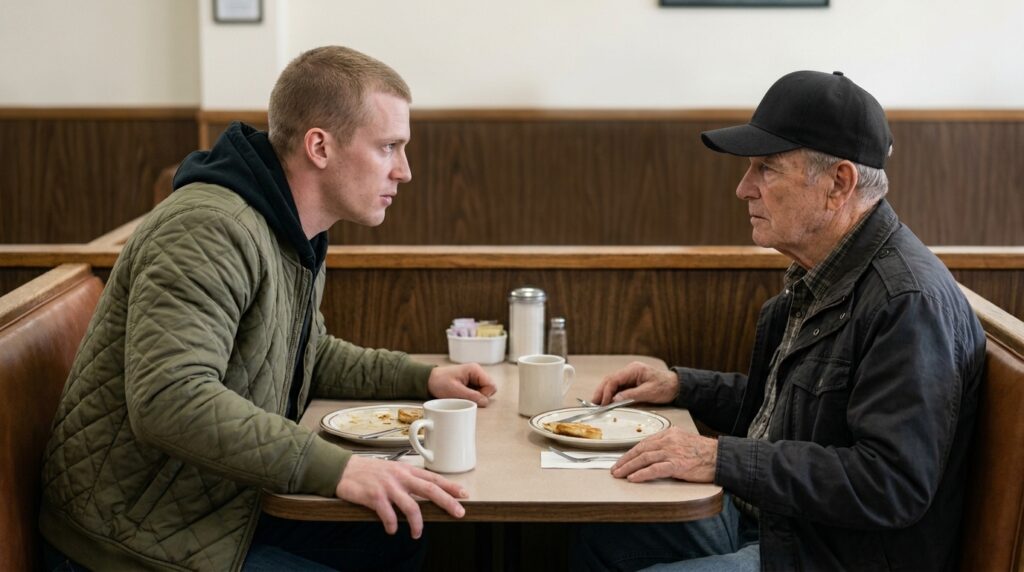
“This isn’t an eviction,” Arthur said, his eyes locking onto the boy’s face with the same unyielding mass that had stopped him at the booth. “It’s an appraisal. The son bought the debt from the bank in Henderson three months ago, but he doesn’t have the clear title to the easement. He’s waiting for you to abandon the pump so he can claim failure of use.”
The boy looked from the paper to the green canvas case visible through the window of Arthur’s truck. The physical connection between the old man and the maps that defined the valley was too clear, too heavy to ignore. The boy’s hand lowered, the pliers slipping from his greasy fingers to fall into the red dirt between his boots.
“Then why are you out here?” the boy asked, his voice cracking as the first large drops of a mud-rain began to spot his jacket. “If you didn’t draw the line, why do you have the tag?”
Arthur turned back toward his cab, his left hip dragging slightly as he broke his stance. He didn’t answer. He climbed behind the wheel, his hand going down to his pocket where the brass tag with the numbers 104 sat against his leg. Through the glass, he saw the boy slide down against his own fender, his head buried in his grease-stained hands as the orange dust turned to streaks of red clay across his shoulders.
Arthur engaged the clutch, the truck pulling away from the stranded vehicle with a low, heavy whine from the differential. He looked down at the canvas case beside him. The leather strap was held by a single brass rivet that had gone green with oxidation, but the lock was still bright—a small, square tumbler that required a three-digit key he hadn’t turned since the county office burned down in ninety-two.
The road ahead was disappearing into the grey wall of the ridge, the silt turning the world the color of old iron as the truck climbed higher into the white clay cuts.








