
CHAPTER 3: THE GRAIN OF THE PAPER
The paper didn’t want to come out. It had sat beneath the heavy, chrome-plated base of the napkin dispenser long enough for the salt-laden humidity of the valley to soften its grain, molding it against the rusted steel rivets below.
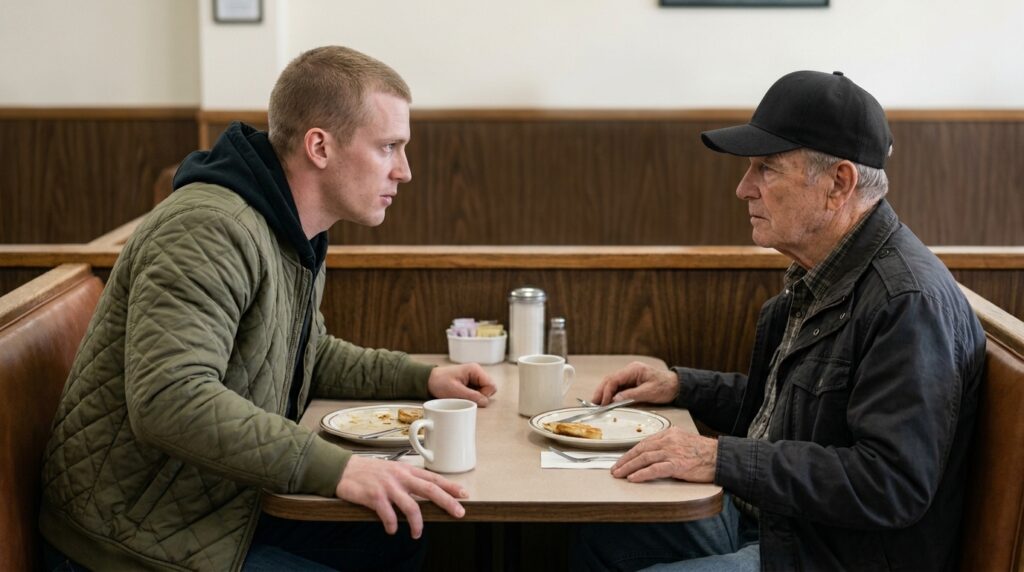
Calm Seated Veteran applied a slow, linear pressure with his right hand. The skin of his knuckles, cross-hatched with old scars and small blue veins that traveled beneath the surface like buried copper wires, didn’t twitch. He felt the resistance first—the dry, microscopic tear of wood pulp catching on oxidized metal—before the folded sheet slid free into the grey light of the table.
It was legal stock, three times the thickness of a diner receipt, stained a deep amber around the bottom margin where old coffee spills had crept into the grain. The printed text at the top was bold and blocky, typed out on a ribbon that had been failing even then, leaving the letters faint, broken at the edges like ancient fencing.
NOTICE OF INTENT TO RECLAIM ACQUISITION AREA 4.
The veteran did not unfold the paper fully. His thumb rested over the small seal at the corner—a circular embossed mark that had flattened out into a ghost of silver foil over the decades. He didn’t need to look at the description of the parcels. He knew the numbers by heart. He knew the surveyor’s lines that cut through the creek beds, the stone markers that had been buried three feet deep in the hard clay under what was now the boy’s unpainted machine shop.
Across the room, Clara let the glass pot settle into its heating element with a small rattle. Her shoes made a wet, sucking sound against the linoleum as she approached the booth, her hand carrying a yellow plastic check pad.
“He shouldn’t have been in here saying those things to you, Arthur,” she said. Her voice was thin, the texture of cheesecloth that had been scrubbed too many times in the back sink. “His mother’s stayed up at the property three days without her well-pump running. He’s out of his mind with it.”
Arthur—the name felt small and detached in his own ears, a label used by people who only knew him by his mail—did not look up from the document. He turned it over, his thumb dragging across the crease until the paper gave a sharp, dry snap.
“The pump isn’t broken,” Arthur said. His voice was lower than the idle of the logging trucks that parked on the shoulder outside. “The line’s capped at the main junction by the county road. They put the lock on it Tuesday.”
Clara stopped two feet away, her apron strings hanging loose down the side of her hip. Her eyes shifted from the tarnished gold on his cap down to the water-damaged document. She didn’t reach for it. No one in this basin reached for paper unless it had a check attached to it or a sheriff’s signature at the bottom.
“The boy thinks it’s the diner owner’s son doing it,” she whispered, her gaze tracking a fly as it buzzed against the dirty glass of the front transom. “He says the family’s clearing out everything north of the old rail spur to build the new dry storage lockers. He was out there at dawn with an iron bar, trying to clear the valve himself.”
Arthur looked out through the window. The sky had lost its blue completely, turning the color of wet zinc as the south wind began to lift the fine silt from the dry lake bed six miles down the valley. A plastic oil drum was rolling across the gravel lot, its hollow thud-thud-thud counting out the seconds against the fence line.
“An iron bar won’t turn a brass cylinder that’s been frozen in lime since seventy-six,” Arthur said. He folded the notice once more, the thick paper resisting his hand until it settled into a stiff square that fit exactly into his inside coat pocket. “He’ll just shear the nut off the stem. Then nobody gets water until the state brings a crew down.”
He reached down to the table, his index finger hooking the small brass key tag with the faded numbers 104. The metal was cool, pitted with small grey spots where the nickel plating had worn away to expose the dull, orange alloy underneath. It didn’t belong to a room; it belonged to a locker that had been cut out of a concrete wall in the basement of the old county clerk’s annex before they tore the brickwork down to make room for the bypass.
“He’s going to the county office next,” Clara said, her pencil tapping twice against the plastic pad. “He was talking about it at the counter before you came in. Saying he’d find out who filed the original easement definition. The old maps from before the state took the corridor.”
Arthur stood up. His knees made a dull, dry sound inside his denim trousers, his weight settling into his boots with a slow, heavy deliberation. He didn’t use the table to brace himself. His back remained straight, his shoulders square beneath the dark wool of his jacket, though his left hip dragged slightly as he cleared the edge of the booth.
He laid a five-dollar bill on the damp Formica, the paper crisp and clean against the grease ring left by his mug.
“If the boy comes back,” Arthur said, his hand settling on the door handle before the bell could ring, “tell him the records aren’t in the town office. They haven’t been there since the fire in ninety-two.”
He didn’t wait for her to answer. He pushed the door open, the heavy glass resisting the rising pressure of the outside air as the first grit of the sandstorm rattled against the aluminum frame like buckshot.
The air in the lot was thick with the smell of dry clay and ozone. Across the gravel, the boy’s old red pickup was gone, leaving only two dark spots of oil where the oil pan had been weeping onto the stones. Arthur walked toward his own truck—an old inline-six with rusted wheel wells and an iron pipe bumper that had seen three separate deer and one stone wall without shifting its alignment.
He pulled the heavy door open, the hinge groaning as the wind caught the metal. On the passenger seat sat a flat, green canvas map case, its leather straps stiff and cracked from forty years of grease and floorboard dust.
He didn’t open it yet. He sat behind the wheel, his eyes on the road that led toward the ridge where the old rail beds used to run, his hand tightly closed around the brass tag in his pocket until the numbers pressed deep into the meat of his palm.








