
CHAPTER 2: THE BREAKING WEIGHT OF MOMENTUM
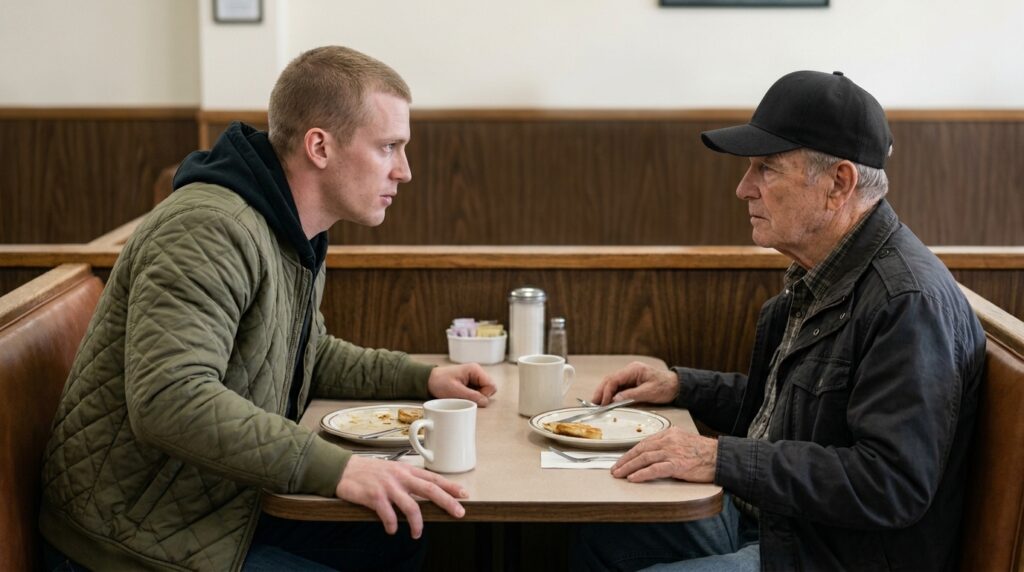
“You don’t know a damn thing about what’s mine,” the boy said, but his voice lacked the sharp edge it had carried thirty seconds ago. It dragged now, full of the grit that blew off the dry-farmed topsoil outside.
Calm Seated Veteran didn’t shift his weight on the cracked vinyl seat. The foam beneath the blue-and-white patch repair didn’t even creak. He watched the boy’s fingers twitch away from the Formica, leaving a faint, oily smudge near the base of the white ceramic mug. The boy’s skin was too pale for June, the color of someone who spent his daylight hours under the tin roof of an uninsulated shop, chasing gremlins in old diesel pumps.
“I know the sound of a dry gear,” the veteran said. His tone remained perfectly flat, an unpainted fence post in a wilderness of noise. “And I know when a man’s looking for an exit he hasn’t earned.”
Behind the counter, the short-order cook let the spatula slide down the grease trap with a dull, metallic clink. The sound was too loud in the dead air of the diner. The waitress, her name-tag Clara pinned slightly crooked on her faded blue apron, took a slow step backward until her spine met the stainless steel of the pie case. She didn’t look at the boy; she looked at the tarnished gold lettering on the old man’s cap, as if measuring the distance between what the town used to be and what it was turning into.
The boy took a long, shallow breath through his nose. His teeth ground together, a tiny knot of muscle jumping at the corner of his jawline. He wanted to hit something—the veteran could see the calculation moving behind the boy’s clouded eyes, the kinetic urge to disrupt the absolute stillness of the booth. But there was nothing to anchor the violence. The veteran wasn’t matching his posture; he wasn’t offering friction. He was simply existing there, an immovable mass of salt-and-pepper hair and heavy flannel that had survived colder winters than this boy had seen years.
“My old man said guys like you think you own the county just because you got a piece of tin in a drawer somewhere,” the boy muttered, his hand dropping down to the pocket of his quilted jacket. The nylon rasped against his coarse denim jeans, a dry, grating hiss that scraped against the quiet room.
“Your old man spent his disability checks at the track in Henderson,” the veteran said, his thumb finally moving. He didn’t raise his hand; he just shifted his thumb across the chipped rim of his mug, tracking the small, grey line where the glaze had flaked away down to the porous clay beneath. “And he never learned how to seat a ring properly on a four-stroke. Don’t carry his bad habits into a crowded room.”
The boy’s face flushed a dark, bruised red beneath the grease smudges. He took half a step back, his boot heel catching the metal strip that held the linoleum tiles to the floor. The friction was audible—a sharp squeak of rubber against wax. He looked around the room then, his eyes wild and seeking some kind of leverage, some witness to validate the heat burning in his chest. But the mechanic in the corner booth had turned his back completely, focusing on a grease-spotted napkin, and the couple near the door were already reaching for their coats, their movements silent and hurried.
The lack of an audience was a physical blow. The boy’s shoulder hit the corner of the wooden divider separating the booths, the impact muffled by his padded jacket. He looked back at the old man, his lips parting as if to let out another string of inherited grievances, but the veteran merely raised his cup. The movement was slow, deliberate, the dark surface of the coffee remaining perfectly level as it rose toward his mouth.
“The wind’s coming up from the south,” the veteran murmured before taking a sip. “If you’ve got iron sitting out in the yard, you’d better cover it before the dust takes the oil off.”
The boy stood there for three more seconds, his fingers buried deep in his pockets, his lean frame shaking with the residual vibration of an adrenaline rush that had nowhere to go. He wasn’t a dangerous man anymore; he was just an inconvenience that had run its course. With a jerky, uncoordinated turn, he swung toward the double doors, his boots thudding heavily against the floorboards until the glass shook within its rusted aluminum frame.
The screen door slammed once, twice, the pneumatic cylinder whistling as it gave up its air.
The veteran didn’t watch him through the window. He set his cup back down in the center of the saucer, exactly where it had been before the boy entered the space. The small brass key tag sat beside it, its three faded numbers catching the grey light that filtered through the grease-filmed glass of the front window.
He reached for the napkin holder to clear his side of the table, his rough fingers catching on something stiff and white that had been shoved beneath the weighted metal base. It wasn’t a stray receipt. It was a thick piece of legal stock, folded into thirds, the edges soft and grey from moisture.
The veteran pulled it free with a slow, calloused drag of his hand.








