CHAPTER 7: THE CRACKED SHELL
The steady drip-drop of greasy condensation from the excavator’s underside hit the pool at the bottom of the trench with a dull, oil-slicked slap. Carl had already turned away from the panel, his heavy-set frame slumping as he reached for a tin lunchbox behind his seat. The machine was dead iron now, a cold monument of rust and yellow primer squatting on Miller’s bluestem grass.
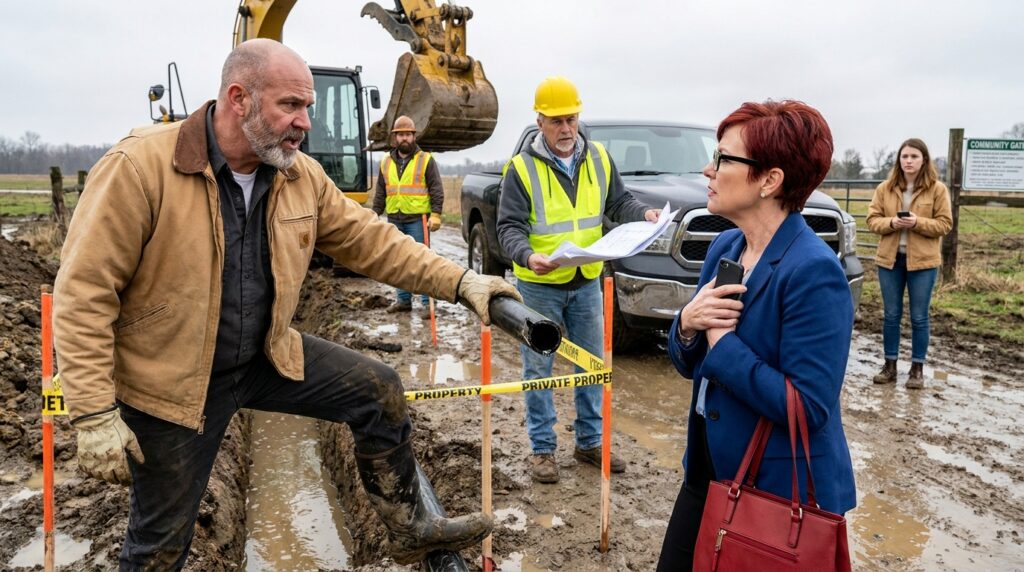
Miller didn’t leave the truck fender. He watched Evelyn Vance’s fingers—cold, red-tipped, and trembling slightly—as she unclasped the brass frame of her red handbag. She pulled out a fresh pack of cigarettes, her thumb tearing the foil with a frantic, rhythmic scratch that sounded like a mouse behind drywall. She couldn’t get the lighter to spark against the raw wind coming down the draw.
“Frank,” she said, her voice dropping all its legislative weight, turning into a thin, sand-scoured rasp. “The low-pressure junction is already paid for. The association took out a secondary infrastructure levy from the phase-two homeowners in January. The cash is in the escrow account. This isn’t a funding failure. It’s a timing knot.”
Miller leaned forward, his mud-soaked sleeves grinding against the cold iron of the truck’s quarter panel. He didn’t look at the blueprints. He looked straight at the little printed code on the subcontractor’s manifest sheet that the neighbor girl had displayed on her phone.
“The levy didn’t go into escrow, Vance,” Miller said. His tone was level, devoid of heat, carrying only the hard, unyielding weight of a man who spent his winters counting hay bales against an unyielding frost. “If the underlying tract registry is listed as incomplete on the county audit, that means your phase-three land isn’t even legally subdivided yet. You didn’t pay for an easement because the bank wouldn’t clear the funds for a title that’s got three active mechanics’ liens on the greenbelt sector.”
Vance’s face didn’t twitch, but the unlit cigarette between her fingers snapped with a dry, white crunch, tobacco flakes spilling down onto her blue lapel. She looked at Miller, her large black-framed glasses catching the gray, desaturated glare of the sky. For the first time since she had stepped into the pasture silt, her jaw didn’t hold its structured line. It went slack, the skin under her chin looking thin and gray in the midday drizzle.
“You don’t understand how the development mechanics operate, Mr. Miller,” she said, her whisper barely carrying over the slap of the vinyl fence slats behind them. “The phase-two infrastructure has a cross-collateralization clause with the county utility district. If the tie-in isn’t logged by the state inspector before the fiscal board closes the ledger on Friday, the district triggers an automatic forfeiture on the primary development bond. It doesn’t just freeze phase-three. It liquidates the association’s maintenance reserve for the existing homes. The entire subdivision goes bankrupt by Monday.”
Frank let out a dry, rattling cough, his hand reaching down to secure his leather logbook binder with a sharp pop of the brass snap. He didn’t look surprised. He looked tired—the old, deep fatigue of a county man who had watched five different development companies try to pave over the valley’s debt with cheap lime and fast titles.
“So that’s why Craddock’s name is on the scratch sheet,” Frank said, shaking his head until his yellow hardhat caught the edge of the pickup’s side mirror. “He didn’t just give you an old map, Evelyn. He’s the one who held the original option on the greenbelt before the 2008 crash. The HOA has been playing hide-and-seek with the state treasury for eighteen months, using Craddock’s old corporate shell to sign off on utility extensions so the bank wouldn’t smell the default.”
The neighbor girl backed away two steps from the utility truck’s tailgate, her white shoes making a heavy, squelching sound in the clay. Her smartphone screen stayed bright, tracking a fresh line of text that seemed to reflect off her wide, staring eyes. “The board meeting notification just hit the resident portal,” she muttered, her voice dropping into the cold wind. “An emergency session has been called for six tonight. They’re discussing an emergency assessment… seven thousand dollars per lot to cover the infrastructure deficit.”
Miller looked back down into the trench at the black polymer main line. The pipe looked different now—not like a corporate machine cutting into his legacy, but like a long, expensive piece of garbage left behind by a crowd of people who had run out of other people’s money. He reached into his pocket and pulled out his grandfather’s old fence-tightening tool, the cold, pitted iron fitting into his palm with a familiar, greasy weight.
“You built your whole town on a ledger trick,” Miller said, his boots grinding into the limestone gravel as he stepped toward Vance, forcing her to look down at the gray clay caked over her polished white shoes. “You thought because you had a blue coat and a smartphone, the dirt would just move out of your way. But the dirt don’t owe your bank a dime, and it don’t hold a mortgage.”
Vance didn’t answer. She dropped her red handbag onto the truck hood, the leather hitting the blueprints with a heavy, dead smack. She turned her back to the pasture, her eyes tracking the long, uniform rows of identical asphalt shingles and white vinyl trim that stretched out across the ridge—thirty-six homes waiting for water that was locked behind an old iron boundary pin.
Frank slung his tripod over his shoulder, the metal legs clicking with a cold, final resonance. “Carl,” he called out to the operator, his voice rising into a flat, administrative command. “Get your rig ready to reverse out of this slot. The district marshal’s coming down with the red tags, and if this machine is still sitting inside Miller’s fence line when the clock strikes five, you’re going to be explaining that work order to a state magistrate.”
Carl didn’t say a word. He threw his grease rag onto the dashboard and reached for the ignition key, his knuckles white as he prepared to pull the yellow steel back across the border.