
CHAPTER 2: UNDER THE SOD
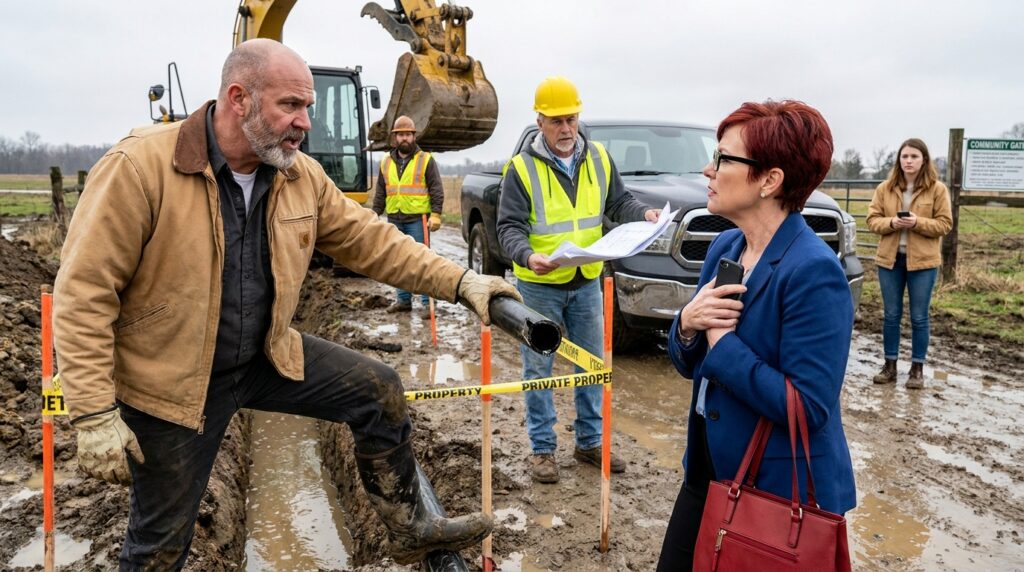
The woman’s heel sank three inches into the gray clay, the leather suctioning with a wet, heavy rasp as she tried to pull her foot back. She didn’t look down. Her attention remained fixed on Miller, her teeth clicked tight behind pale lips, her large black-framed glasses trembling slightly on the bridge of her nose.
“Mr. Miller, I presume,” she said, her voice dropping into a register that had likely flattened dozens of neighborhood committees. She shook her smartphone toward the idling excavator. “I am Evelyn Vance, Director of the Whispering Pines Homeowners Association. You are actively obstructing a county-sanctioned infrastructure corridor. This equipment operates under a municipal utility waiver. Every minute you stand on that tread costs our community thousands of dollars in contractor retention.”
Miller didn’t take his boot off the yellow tracking steel. The iron links beneath his sole were coated in a fine glaze of rust and wet grit that ground against his leather work boots with every micro-movement of the machine’s chassis. He looked at her white shoes, now stained a dark, indelible charcoal by the valley silt, then up at the red handbag clutched like a small leather shield against her ribs.
“There’s no corridor here, Mrs. Vance,” Miller said. His voice was low, dry, carrying the rasp of a man who spent his mornings clearing cedar dust from his throat. “There’s only pasture. My pasture.”
“The county records indicate an emergency extension variance for Phase Three,” she snapped, her thumb flicking across her phone screen, bringing up a PDF document with a bright digital seal. She thrust the screen toward his face. The glass was misted with fine droplets of the cold afternoon drizzle. “Look at the authorization. It was logged six months ago. The easement is automatic under the municipal growth ordinance.”
Miller didn’t look at the phone. He reached into the deep canvas pocket of his tan work jacket, his fingers brushing against the cold, notched edge of his grandfather’s old fence-tightening tool before settling on a heavy, brass-bound tape measure. He pulled it out, the metal casing cold and scratched, its springs grinding with a gritty rattle as he pulled three feet of yellow blade from the housing.
He stepped off the excavator track, his boots making a heavy thud in the uncompacted sod. He walked six feet to the left of the trench, where the earth rose into a small, untamed knoll covered in dead briars and wild mustard.
“The growth ordinance covers the section line,” Miller said, his boots crunching through the frozen stalks. “The section line is forty rods back by the blacktop. This knoll belongs to the original Miller patent. 1914.”
He knelt in the grey mud, heedless of the clay soaking through the knees of his dark trousers. With his gloved hand, he began tearing away the thick, matted layers of dead grass and wet earth. The operator in the cab cut the engine down to a low, guttural throb, the sudden drop in decibels making the wind sound louder as it whistled through the vinyl privacy slats of the development forty yards away.
Evelyn Vance followed him to the edge of the clearing, her breath coming in short, ragged plumes of white vapor. “This is obstruction of a public utility, Mr. Miller. I have the sheriff’s department on speed dial. The county crew lead is already on his way with the official filing papers. You cannot simply dig up a worksite because you’re nostalgic about acreage.”
Miller didn’t answer. His fingers hit something solid beneath the mud—something cold, pitted, and unyielding. It wasn’t limestone. It was the square, hand-forged head of an iron boundary pin, driven four feet into the bedrock by a man who had broken his back to clear this valley before the roads were even gravel. The top of the iron was deeply rusted, flakey layers of orange oxide coming away against the split-cowhide of Miller’s glove.
Beside the pin, buried under two inches of loose silt, sat an old surveyor’s plastic cap, melted and warped by some ancient brush fire. Miller cleared the dirt from its face. There were numbers stamped into the plastic, but they didn’t match the standard county ledger prefix. They were irregular, erratic, carved with a heavy hand.
He stood up, his knees cracking in the cold air. He wiped the gray muck from his palms onto the flanks of his canvas jacket, leaving dark, smeary tracks across the fabric. He looked past Evelyn Vance toward the open trench, where the black sewer main sat like a giant, half-buried water moccasin in the muddy water.
“Your contractor didn’t check the markers,” Miller said, pointing a muddy finger down at the rusted iron head in the grass. “And that stamp on your orange flags doesn’t belong to the district office. It belongs to a private outfit out of the western line.”
Vance’s face didn’t soften, but her shoulders went rigid beneath the sharp lines of her blue blazer. Her fingers tightened around the handle of her red handbag until the leather creaked. “The contractor was selected through standard association procurement, Mr. Miller. The documentation is legally binding. If there is an error in the physical alignment, it will be handled through an administrative adjustment after the infrastructure is secured. The homes cannot wait for a boundary dispute.”
“The infrastructure is sitting on private earth,” Miller said. “And nobody buries anything on my land until I see the county seal on wet ink.”
From the gravel access road behind the subdivision gate, the low, heavy rumble of a commercial engine approached. A dark utility pickup truck, its door panels bearing the faded gold emblem of the County Engineering District, rolled through the gap in the fence, its tires churning the gravel into a wet paste. The brake lights flared red, reflecting off the standing pools of water in the trench.
Miller watched the driver’s side door open. A man in a yellow hardhat and a high-visibility vest stepped out, holding a thick leather folder tucked under one arm like a ledger. The game was expanding, and the ground beneath their feet was getting softer by the second.








