CHAPTER 3: THE BORDER AND THE CLIPBOARD
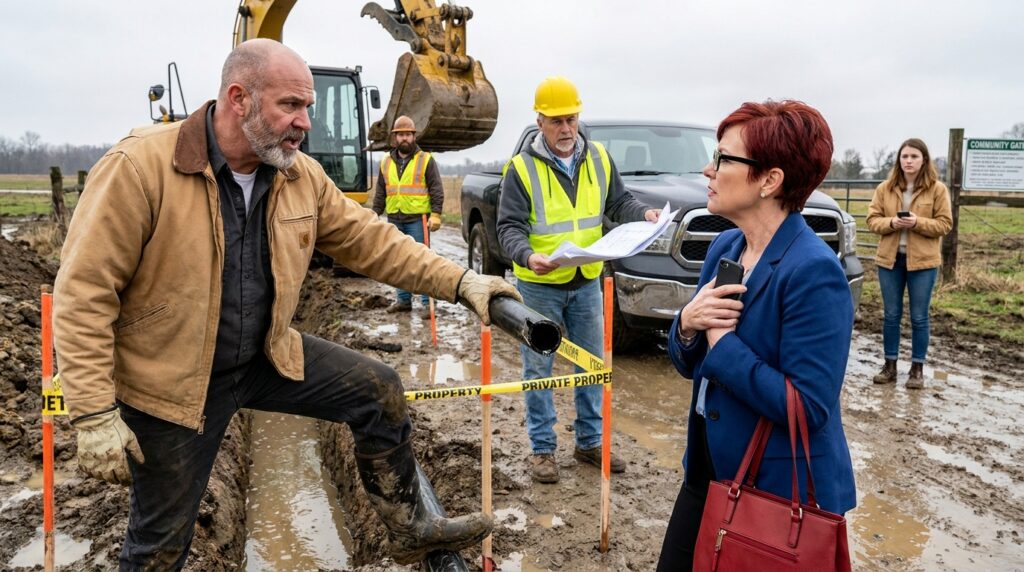
The dark utility pickup truck didn’t just stop; it settled into the pasture’s edge like an old iron wedge dropped into a fresh log. The driver’s door groaned against its hinges as the man in the yellow hardhat stepped down, his heavy leather boots finding purchase in the crushed limestone gravel at the subdivision gate before tracking straight out into the soft, uncompacted clay.
Evelyn Vance didn’t wait for him to reach the trench. She stepped out of the high weeds, her blue blazer catching a low branch of dead briar that scraped along the synthetic fabric with a dry hiss. Her white shoes were completely caked now, turning into thick, shapeless clubs of gray silt that left jagged tracks behind her.
“Frank, thank goodness,” she called out, her phone already raised like an official summons. “We have a structural hold on the trench. Mr. Miller has physically blocked the excavator tread. I need you to produce the county clearance log for Phase Three immediately so we can clear this obstruction.”
The man she called Frank didn’t speed up. He was a thick-set man with a face like wind-scoured granite, his eyes small and watery behind squinted lids as he took in the scene. He didn’t look at Vance’s phone. He looked at the yellow machine, then down at the deep, muddy canal where the black sewer pipe lay shivering under the low vibration of the machine’s secondary hydraulic line. Under his arm, the heavy leather binder showed worn corners where the cardboard insert had begun to rot out from decades of county rain.
“Afternoon, Miller,” Frank said. His voice was a flat, unhurried rumble, the sound of a man who spent forty years interpreting tax codes and concrete grades. He stopped two feet short of the trench, his gaze dropping down to where Miller’s fingers had peeled the sod back from the hand-forged iron pin.
“Frank,” Miller nodded. He didn’t stand up all the way, remaining balanced on one boot with his split-cowhide glove resting flat against the orange oxide of the boundary marker. “Your office send out a line crew this morning?”
“We got the notification for the tie-in on the main road,” Frank said, his thumb hooking into the thick webbed strap of his high-visibility vest. He looked down at the warped plastic cap Miller had uncovered. “But we didn’t slate any ditching through the lower valley segment until the winter board meets. Not on the master grid.”
Evelyn Vance’s phone screen went dark as she dropped her hand, her knuckles turning a sharp, bloodless white against the red leather strap of her handbag. “Frank, that’s an administrative detail. The emergency utility waiver signed off six months ago by the district surveyor covers the entire corridor adjacent to the Whispering Pines perimeter fence. We have thirty-six families whose residential closings are dependent on this connection being inspected by Friday. The contractor has an expedited work order.”
“The contractor’s got a lot of things, Evelyn,” Frank said, his fingers working the rusted brass snap of his leather folder. The sound was a sharp, metallic clink that seemed to focus the quiet of the pasture. He pulled out a large, three-times-folded sheet of translucent blue drafting paper. The margins were tattered, grayed by oil stains from older trucks. “But if they’re digging sixty feet west of the road allowance, they’re not in the corridor. They’re in the tax block.”
Miller stood up then, the dry clay on his knees cracking and peeling away in thin flakes that dropped into the dead mustard stalks. He stepped closer to Frank, the space between them closing with the quiet rhythm of two men who understood the physical realities of fence lines and drainage ditches.
“Look at that cap, Frank,” Miller said, pointing down with his mud-caked thumb toward the erratic numbers stamped into the melted plastic beside the old iron pin. “That’s a 740-series registration. The county hasn’t issued a 740 prefix since old man Craddock retired from the assessment office after the county bond crisis.”
Frank squinted down at the pin, his thick leather boots sliding slightly in the slick gray silt as he leaned over the edge of the knoll. His jaw tightened, the skin around his salt-and-pepper beard turning white. He didn’t answer right away. He pulled a small, brass-rimmed magnifying loupe from his vest pocket—a tool that had belonged to his father before the county paved the main line—and held it down toward the numbers.
“Vance,” Frank said softly, not looking up from the loupe. “Who brought this specific work order down to the site crew this morning? Was it the main office or the subdivision coordinator?”
“It was processed through our development counsel,” Vance said, her posture stiffening until her shoulders appeared almost squared off against the line of houses behind her. She took half a step forward, her heel catching on a buried stone, but she didn’t look down to check her balance. Her voice maintained that precise, unyielding edge that had carried her through every zoning meeting. “The signature on the waiver is from the district surveyor’s desk. It has the county seal on the header, Frank. I reviewed the physical file myself before the track was laid.”
“The signature might be on the header,” Frank said, straightening his back with a slow, deliberate crunch of his vertebrae. He folded the blueprint back into its leather housing, the paper rustling like dry corn husks in the raw afternoon wind. “But the registration on this marker isn’t in the current county book. It’s an old provisional layout. One that was killed when the highway bypass went through twenty years ago.”
Miller looked from Frank to the open ditch, his mind already calculating the cause and effect of the line. The operator in the cab had stopped smoking; he was leaning over his console now, his gloved hands resting loosely on the black knobs of the hydraulic controllers, waiting for the word that would either turn his machine back into an installation tool or a weapon of extraction.
“That means the line crew didn’t misread the map,” Miller said, his voice dropping into the low, dangerous tone he used when a steer was pinned against a wire fence. “They used an old sheet on purpose. To miss the legal easement cost.”
Vance’s hand moved toward her handbag, her fingers slipping into the outer pocket where her car keys rattled with a small, frantic silver sound. “This is an administrative dispute, Frank. It can be settled in the county courthouse on Monday. The machinery is here now. The trench is open. We cannot simply leave a primary utility conduit exposed to the elements because of a twenty-year-old clerical error.”
“It’s not a clerical error, Evelyn,” Frank said, his voice turning as hard and cold as the limestone shelf at the bottom of the ditch. He turned his back to her, his yellow hardhat catching the gray light from the clouds as he looked at the operator. “Turn off the fuel pump. Nobody moves an inch of this earth until I get the digital transit out of the truck.”
The excavator worker didn’t hesitate. He pulled the red emergency kill-switch on his dash, and the deep, throbbing roar of the diesel engine died instantly, leaving only the sound of the wind snapping the yellow caution tape against the orange stakes.
Miller didn’t take his eyes off Evelyn Vance. Her face hadn’t changed, but her smartphone was trembling in her palm, the light from the digital seal reflecting off her dark glasses like a small, fake star trapped in the mud.