CHAPTER 4: THE DEED AND THE TRANSIT
The silence left by the dead diesel engine felt heavier than the machine itself. Without the throb of the exhaust, the raw rattle of the wind against the vinyl slats forty yards back became a rhythmic slap, carrying the smell of wet asphalt from the suburban grid across Miller’s frozen clover.
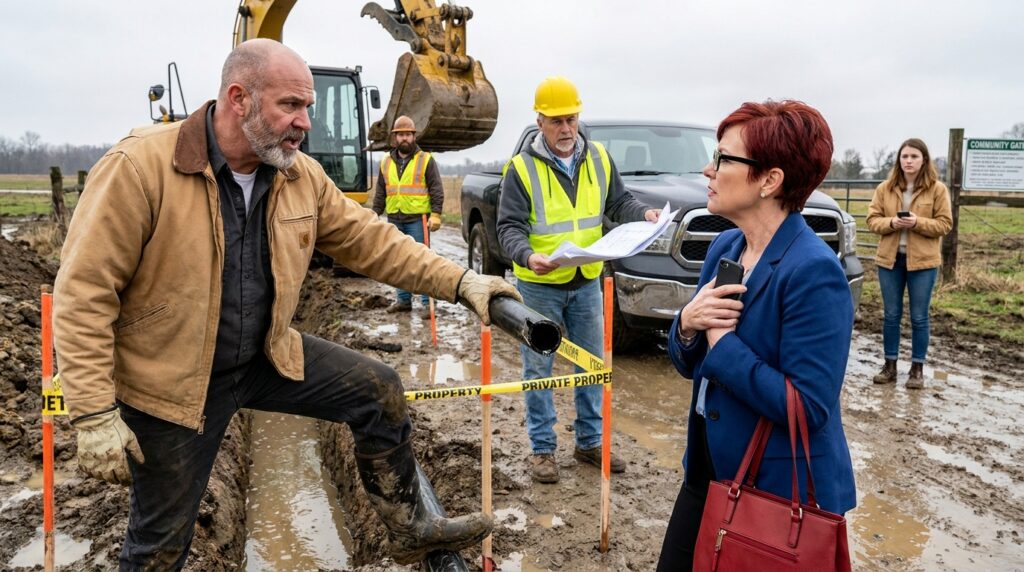
Miller didn’t stand by the open trench to watch Evelyn Vance calculate her next phrase. He turned on his heel, his heavy leather work boots tracking two-inch wedges of clay across the pasture as he walked back toward his old three-quarter-ton truck parked near the line fence. The driver’s side floorboard was littered with loose iron fence staples, spent brass casings from a varmint rifle, and the grey dust of dried limestone. Beneath the seat lay what he needed—a rectangular, scuffed green canvas case with an oil-darkened brass zipper that smelled of dry graphite and age.
He hauled the case onto the dropped tailgate. The rusted metal chain holding the gate popped and strained, grinding under the sudden shift of weight. Inside the canvas lay his father’s ledger, a leather-bound logbook from 1968, its pages thick, yellowed by tobacco smoke, and hand-ruled with waterproof iron-gall ink.
When Miller turned back to the trench, Frank had already pulled a tripod from the bed of the county pickup. The aluminum legs were nicked, covered in white spray-paint remnants from a dozen highway jobs, the iron shoes on the bottom biting into the sod with a wet crunch.
Evelyn Vance had moved closer to the dark pickup truck’s hood, her stocky frame silhouetted against the subdivision’s white entrance arches. Her fingers were still moving on her smartphone screen, but her breath came faster now, leaving thin, irregular plumes of white mist that tore apart in the wind.
“Frank, this is an administrative overreach,” she said, her voice dropping lower, trying to narrow the perimeter of the conversation so the operator in the cab couldn’t catch the rhythm of it. “The contractor has already paid the county filing fee for the development tie-in. The stamp on that sheet was cleared through the engineering clerk’s desk in May. If your office has an internal discrepancy regarding old records, that is an insurance matter for the county, not a reason to halt an active regional connection.”
Frank didn’t look up from the brass mounting screw of the digital transit he was leveling on the plate. “The filing fee went to the road commission, Evelyn. Road commission don’t clear land titles. They just clear gravel.”
Miller dropped the heavy leather logbook onto the dark hood of the county truck. The sound was a flat, dead thud that made the blueprints rustle. He flipped the cover back, the stiff binding creaking like an old saddle. He ran his mud-stained thumb down the hand-penciled margin of page forty-two until he hit the entry for the western section line.
“Look at the entry for the 1974 secondary easement request,” Miller said, his voice flat, dry, and unhurried. He pointed with a dirty fingernail at a six-digit string of numbers written in red ink. “Old man Craddock tried to run a cattle-dip line through this exact knoll fifty years ago. My father stopped him at the boundary because the county charter doesn’t allow automatic utility extensions on properties with an active homestead exemption dating before the 1920 consolidation. The 740-prefix cap you’ve got down there in the mud isn’t an authorization. It’s the rejection marker.”
Frank pulled his head back from the transit eyepiece, his squinted eyes turning toward the handwritten page. He reached down, his leather-gloved index finger tracing the red ink numbers, then shifted his gaze back to the blueprints spread across the metal hood. His jaw worked beneath his short, weathered beard, the skin around his mouth tightening into hard, dry folds.
“Where did your council get this map number, Vance?” Frank asked. His tone wasn’t loud, but it had the weight of an iron pipe dropping into sand. He tapped the blueprint’s title block with a blunt finger. “This isn’t the master grid revision from the county clerk. This is an archival plate from the old railroad appraisal office. The person who signed off on this work order didn’t get it from the district vault. They pulled it from the dead files.”
Evelyn Vance’s red handbag slipped slightly down her forearm, her wrist straining against the weight as she adjusted her grip. She didn’t look at the ledger. Her eyes stayed locked on the small, brass-rimmed loupe Frank had left on the drafting paper.
“The documentation was provided by the independent surveyor hired by the primary developer,” she said, her chest rising sharply under the blue blazer. She took a step toward the truck hood, her caked shoes sticking to the pasture turf until the leather groaned. “Mr. Craddock’s firm handled the initial layout for Whispering Pines Phase One. His signatures have been accepted by the county board for three decades. We had no reason to question the validity of an established engineering stamp.”
Miller watched her closely. He saw the subtle twitch in the corner of her jaw—not the anger of an official caught in a mistake, but the cold calculation of an investor who knew exactly how many days were left before the bank pulled the construction credit line.
“Craddock hasn’t held a county surveyor’s license since the state board revoked it for boundary cooking during the valley commercial development five years ago,” Miller said. He reached down and picked up the contractor’s orange flag he’d snapped earlier, tossing the broken plastic shaft onto her phone screen. “Your independent surveyor didn’t file this with the county because he couldn’t. He signed a private work order using a dead stamp so your crew could get the pipe in the ground before anyone looked at the deeds.”
The operator in the excavator cab leaned his elbows on the steering wheel, his head turning toward Vance as he pulled a greased rag from his pocket to wipe his fingers. He didn’t say a word, but his posture had gone loose, the posture of a hired hand who had just realized his company truck might get impounded by the state.
Frank turned back to his transit, his thumb clicking the coarse adjustment wheel through three quick notches. “I’m running the line from the road marker now, Miller. If the transit aligns with that iron head you found under the sod, this trench is thirty feet inside your line. And that means the association is sitting on a Class A civil trespass while actively operating a commercial trenching tool without a permit.”
Vance’s smartphone beeped, a sharp, electronic chime that sounded small and useless against the expanse of the gray pasture. She didn’t look down to answer it. Her mouth had thinned into a pale line that looked like a scar across her face.
“Frank,” she said, her tone dropping into a dry, whispery rasp that lacked all its earlier committee authority. “We have forty-eight hours before the utility commission pulls the system certification for the entire phase. If this main isn’t connected, the development title is frozen.”
Miller leaned his weight against the truck fender, his gloved hands tucked into his armpits against the sharpening wind. “Then you better start thinking about where you’re going to put thirty-six homes’ worth of sewage, because it isn’t crossing this grass.”