
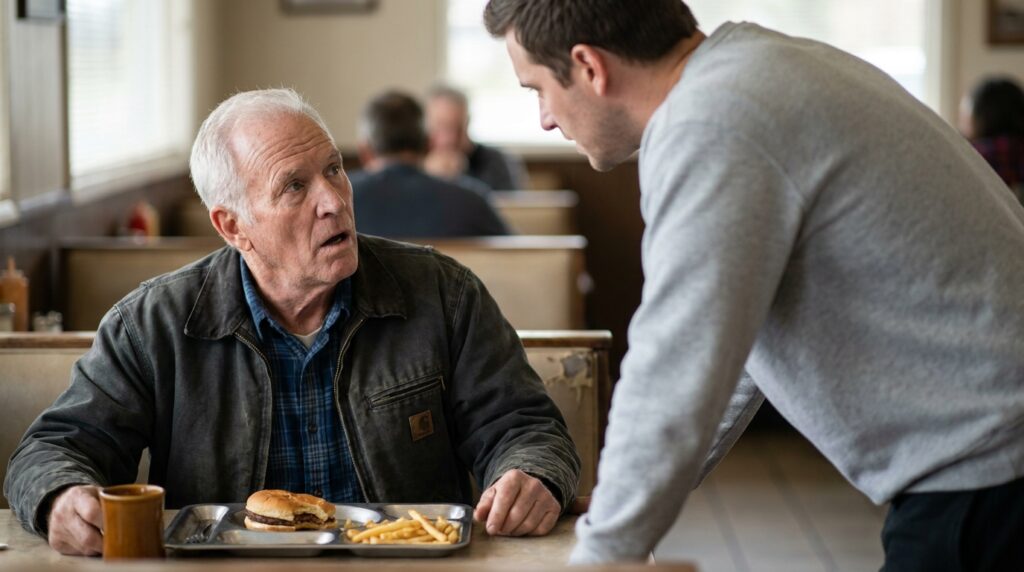
CHAPTER 6: THE STATE LINE CHECKMATE
The heavy iron bumper of the utility truck didn’t clear the limestone mile marker cleanly; it scraped the zero-point post with a long, concussive shriek that sent a spray of white calcium dust across the dual rear tires.
Marcus kept his eyes dead center on the illuminated asphalt three hundred yards ahead. The dashboard array of the flatbed was whistling now—a steady, high-frequency digital squeal from the high-frequency communications console that told him the localized tracking beacon had already crossed the outer zone line. The oil pressure needle had dropped below twenty, the block under his boots radiating a wet, iron-heavy heat that smelled of fried gasket sealer and scorched grease.
Behind him, across the long, flat stretch of the Blackwater bottoms, three distinct sets of headlamps had materialized through the ground fog. They weren’t spacing themselves for a pursuit; they were running three abreast across the two-lane bitumen, their cherry-and-blue roof bars throwing long, jerky strobes against the wet timber.
The county sheriff’s office had finally mobilized its primary motor inventory.
Marcus didn’t push the accelerator pedal into the fire wall. A machine under administrative stress didn’t respond to panic; it responded to the preservation of momentum. He kept the flatbed locked in third gear, the transmission howling like a circular saw hitting a pine knot as the grade began to level into the wide, concrete apron of the old interstate weigh station—the absolute legal boundary of the county’s authority.
The roadblock wasn’t a surprise. Two county cruisers were parked nose-to-nose across the white fog lines, their spotlight beams crossing to create an overlapping glare that completely blinded the approach lane.
Standing in the gap between the bumpers was the thick, blocky frame of Sheriff Callahan himself, his tan winter stetson pulled low against the high-beams, a standard twelve-gauge pump gun held at an aggressive forty-five-degree slant across his utility belt. Beside him, Deputy Miller stood loose near the fender, his hand resting on the open door of his vehicle, his posture devoid of the sheriff’s performance. Jimmy, the kid from the diner, was stuffed into the rear cage of the secondary cruiser, his plum-colored cheek pressed flat against the wire mesh as he waited for the execution of his lineage’s leverage.
Marcus didn’t touch the air brakes. He adjusted his grip on the cold steel spoke of the wheel, his left thumb completely steady now, the persistent twitch buried beneath thirty miles of grease and iron vibration.
He guided the seven-ton flatbed directly down the center yellow line, the massive radiator grille aimed squarely at the narrow six-inch gap between the cruisers’ front push-bars. He didn’t blink as the spotlights hit his eyes. He reached down into the open canvas duffel on the passenger seat, his fingers passing the loose brass casings to find the cold, cylindrical aluminum tube with the faded government stencil. He unscrewed the cap with his teeth, dropping the threaded metal plug onto the floorboards, and pulled out a single, narrow strip of gray laminated cardstock—the master logistics clearance manifest issued by a department that hadn’t officially existed since the Berlin wall came down.
Sheriff Callahan didn’t fire. At fifty yards, the sheer kinetic mass of the oncoming flatbed chose the outcome for him.
The sheriff lunged lateral, his boots slipping on the dew-slicked grass of the median as his pump gun clattered uselessly against the concrete curb. Deputy Miller had already pivoted, stepping back into the safety pocket of the drainage ditch before the truck’s iron bumper caught the first cruiser’s front quarter panel. The impact was a massive, low-frequency boom that sheared the steering knuckles off the patrol car, spinning the vehicle three hundred and sixty degrees across the bitumen like a thrown coin.
The flatbed didn’t stall. It shuddered, the front axle alignment groaning as Marcus drove the vehicle through the debris and across the thick, rusted brass plate embedded in the asphalt—the state line.
He brought the truck to a controlled stop forty yards past the marker, the engine dying with a heavy, wet hiss as the remaining engine oil turned to blue smoke against the manifold. The silence that followed was absolute, broken only by the rhythmic, click-click-click of the truck’s cooling exhaust pipe and the distant, tinny squeal of the radio coming from the wrecked cruiser behind him.
Marcus climbed down from the cab, his boots striking the concrete of the new jurisdiction with a clean, solid thud. He didn’t reach for a weapon. He held the gray laminated cardstock in his left hand, his work jacket open to reveal the faded stencil inside the lining.
Sheriff Callahan was already over the brass line, his face the color of raw liver, his boots kicking through the broken glass of his own vehicle’s headlight lens as he strode toward Marcus with his handcuffs drawn. “You’re done, old man. You’re going under the county courthouse if I have to carry the concrete myself. Auto theft, assault on an officer, fleeing across—”
“Callahan,” a voice called out from the dark.
It wasn’t Miller. A black sedan—an unmarked model with no chrome trim and long, government-issue registration plates—had pulled out from the shadow of the abandoned weigh station office. The driver’s door didn’t creak; it swung open on grease-silent hinges, and a man in a dark, tailored topcoat stepped onto the shoulder. He didn’t carry a sidearm, and he didn’t have a badge pinned to his lapel. He carried a small, leather-bound briefing folder with a silver secure-link seal along the zipper.
The sheriff stopped five feet from Marcus, his cuffs dangling from his index finger. “The hell is this? This is a local warrant. This bastard near killed my boy in a diner three hours ago.”
The federal agent didn’t look at Callahan. He walked directly up to Marcus, his eyes dropping to the gray laminated cardstock held between the old man’s fingers. He didn’t take the card. He simply verified the five-digit stenciled routing number stamped along the upper margin, then looked at the faded dark denim of Marcus’s jacket collar.
“The stencil is forty years out of date, sir,” the agent said quietly. His voice had the cold, pristine clarity of an underground vault. “The automated tripwire cleared the relay through Fort Meade twenty minutes after the column block was turned over. The current directive says your perimeter is to remain unrecorded.”
Marcus let his hand drop, the gray card disappearing back into the deep pocket of his plaid shirt. “The local authority has an administrative discrepancy regarding a lunch bill.”
The agent turned his head three inches toward the sheriff. “Callahan, your office is currently operating seven miles outside its funding allocation. The flatbed belongs to a commercial transport contractor under federal receivership. The override block was government property. If you write so much as a parking citation within this sector, the compliance audit on your county’s asset forfeiture fund begins at eight o’clock tomorrow morning.”
Sheriff Callahan’s mouth opened, then closed with a sharp, dry click of his teeth. He looked at the wrecked cruiser, then at his boy Jimmy, who was still staring through the wire cage of the secondary car with his mouth hanging open. He looked at Deputy Miller, but Miller was already leaning against the guardrail, lighting a cigarette with his back turned to the entire state line.
“He’s a transient,” Callahan muttered, his voice losing its small-town authority, falling into the flat, beaten cadence of a man who had just run into a concrete retaining wall. “He doesn’t even have a name on the ledger.”
“He doesn’t need one,” the agent said. He stepped aside, opening the rear door of the black sedan with a soft, magnetic click. “Your truck’s engine is ruined, sir. We have a logistics transport waiting at the airfield ten miles up.”
Marcus didn’t look back at the diner’s valley, or at the kid who had thought an old man in a faded jacket was an easy target for a Tuesday afternoon. He adjusted his cap, his fingers steady, and stepped into the rear seat of the sedan. The door closed with a solid, pressurized seal that shut out the sound of the highway entirely, leaving only the quiet, rhythmic thrum of a machine built for the long, silent spaces between the maps.








