
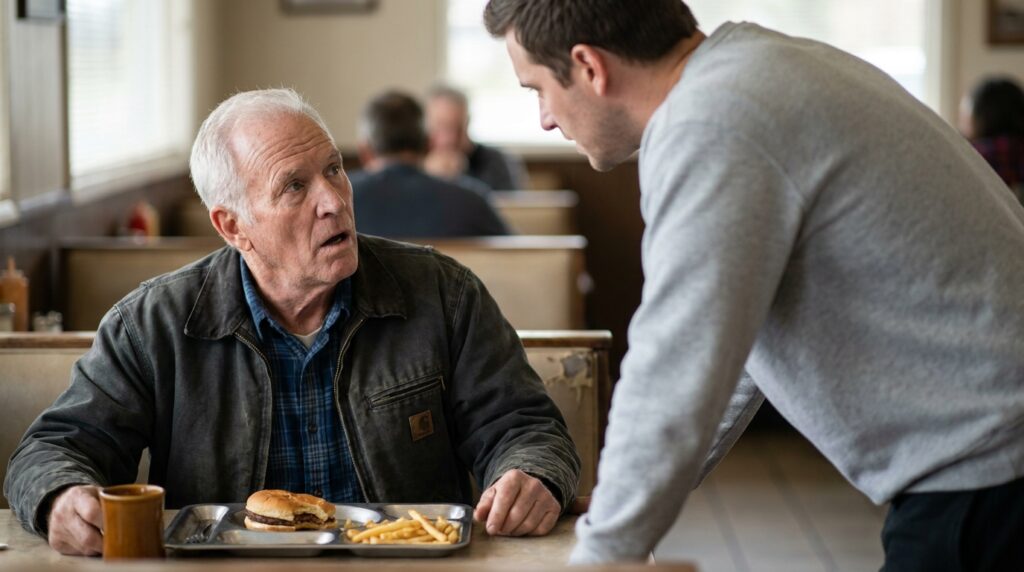
CHAPTER 2: THE CALCIUM OF THE ASHPHALT
The heavy plate-glass door didn’t slam; it settled back into its weathered aluminum frame with a soft, magnetic sigh that smelled faintly of old lard and hot ozone.
Marcus stepped out onto the gravel apron of the parking lot, the midday heat hitting his dark work jacket like a damp wool blanket. The air out here was thick with the scent of unburned diesel and the dry, metallic tang of the drainage ditch running parallel to Route 9. He didn’t rush. A rushed man drew eyes, and eyes in this corridor of the county were dangerous. He walked with his hands loose at his sides, his left thumb rhythmically tapping against the seam of his trousers—the twitch still humming from the friction of the kid’s wrist bone.
Behind him, through the grime-filmed glass of the diner window, the silhouette of the short-order cook was motionless, still holding the grease-blackened spatula like a dead bird.
Marcus reached his vehicle—a faded brown sedan with pitting chrome trim along the quarter panels and a thin coat of limestone dust standard to the valley roads. He didn’t look back at the diner aisle where the youth in the grey sweatshirt was currently discovering how hard it was to draw oxygen into a collapsed lung. Instead, Marcus opened the door, the hinges screaming with a dry, iron-on-iron rasp that set his teeth on edge. He climbed in, the vinyl seat cracking under his weight, releasing a small puff of dry horsehair and ancient tobacco smoke from the seams.
He turned the key. The starter didn’t purr; it groaned twice, a heavy, mechanical struggle against cold oil before the block caught, settling into a low, asymmetric rattle that vibrated through the floorboards and up into the soles of his boots.
Marcus shifted into reverse, his eyes scanning the three mirrors with an old, systematic efficiency. In the side mirror, the glint from the diner floor stayed with him—that tiny, silver-plated shield insignia pinned inside the kid’s sweatshirt. It wasn’t a standard department badge. It was too small, the edges stamped out of cheap nickel instead of cast brass, the kind of token a man gave his boy to keep him out of the county drunk tank. A sheriff’s deputy badge had weight; this thing had a pedigree. It meant the kid didn’t just have a cousin on the force—he had the house.
Marcus backed the sedan out onto the soft shoulder, the rear tires crunching through broken beer bottles and grey river stone before he dropped the linkage into drive.
The road ahead was a straight, desaturated ribbon of cracked bitumen, the tar strips melting under the June sun until they looked like long black scars. Marcus drove forty-five in a fifty-five, keeping the sedan exactly three inches inside the white fog line. He watched the rearview. Every half-mile, a telephone pole passed, its creosote timber bleeding dark grease in the heat, the wires overhead sagging between the crossarms like dead vines.
Two miles down, where the timber gave way to scrub pine and abandoned gravel pits, the first sign appeared. It was a plywood board nailed to a rusted iron post, the letters hand-painted in dull red: THE WILLOWS — WEEKLY RATES.
Marcus pulled the sedan into the lot. The surface here wasn’t asphalt; it was packed slag, grey and sharp enough to chew through cheap rubber. The office was a flat-roofed cinderblock cube painted the color of dried liver. Behind it sat six identical units, their screen doors patched with gray duct tape that had curled and yellowed at the corners until it looked like old skin.
He left the engine idling for three minutes, his hands loose on the wheel, listening to the cooling rhythm of the manifold. Nothing moved in the ditch. No dust tails rose on the highway behind him.
Marcus cut the ignition, grabbed his small canvas duffel from the floor mat, and stepped back into the sun. The air here smelled different—deeper, like rotting pine needles and the sour dampness of a low-lying swamp that never fully dried. He walked up to the screen door of the office, his boots kicking up small, chalky clouds of lime dust.
An old woman sat behind the laminate counter, her skin the texture of a turnip left too long in the cellar. She didn’t look up from her crossword puzzle, but her hand moved automatically toward a row of brass keys hanging from a pegboard behind her. The pegs were rusted, leaving dark red stains against the green drywall.
“Single,” Marcus said. His voice was lower out here, stripped of even the flat cadence he’d used in the diner.
“Thirty-five a night. Fifty if you want the linen changed before Friday,” she muttered, her pencil scratching a heavy lead mark across the newsprint. She didn’t ask for a name. In this county, a name was a liability on a tax ledger, and the Willows didn’t keep ledgers that went to the courthouse.
Marcus laid two tens and a fifteen on the Formica. The paper was crisp—the last of the cash he’d drawn from the terminal three counties back before he’d torn the card into four pieces and dropped them into separate trash receptacles along the interstate.
She slid Key 4 across the counter. The brass was thin, the notches worn down to smooth, rounded hills by thirty years of transients, laborers, and men who didn’t want their license plates recorded.
“Ice machine’s broke,” she said as he reached for the doorknob. “Trucks from the quarry take the water pressure down around five. Don’t try the hot tap after six unless you like brown rust in your soap.”
Marcus nodded once, his fingers hooking the key. He didn’t tell her that he hadn’t used hot water since the winter of seventy-four, or that the smell of iron in a pipe was the only thing that kept him from dreaming about the valleys. He walked down the concrete walkway, his shoulder brushing the pink cinderblock walls of the units until he reached Number Four.
The door smelled of cedar shavings and damp carpet. He stepped inside, letting the screen click shut with that same hollow, dry snap he’d heard all his life. He didn’t turn on the overhead bulb. He stood in the gray shadow of the room, his eyes adjusting to the dim light filtering through the yellowed plastic shades.
He set the canvas bag on the edge of the mattress—the springs groaning once in protest—and walked straight to the window facing the road. He didn’t pull the shade back; he used two fingers to create a half-inch gap between the plastic and the casing, his eyes dropping to the highway.
Five minutes passed. Then ten.
The sun began its long, flat descent behind the pines, casting three-mile shadows across the slag lot. And then, through the haze of the heat riser coming off the bitumen, Marcus saw it: an unmarked white utility truck, its grill coated in dried grasshoppers, pulling onto the shoulder exactly two hundred yards north of the Willows entrance. The engine cut, but the parking lights stayed on, two small amber eyes glinting through the dusty gray weeds of the ditch.
Marcus let the plastic shade click back against the frame. His left thumb started to twitch again, a small, steady throb against the seam of his dark jacket. He reached into his duffel, his hand closing over a small, cylindrical aluminum tube with a faded government stencil near the cap. It was time to clear the perimeter.








