
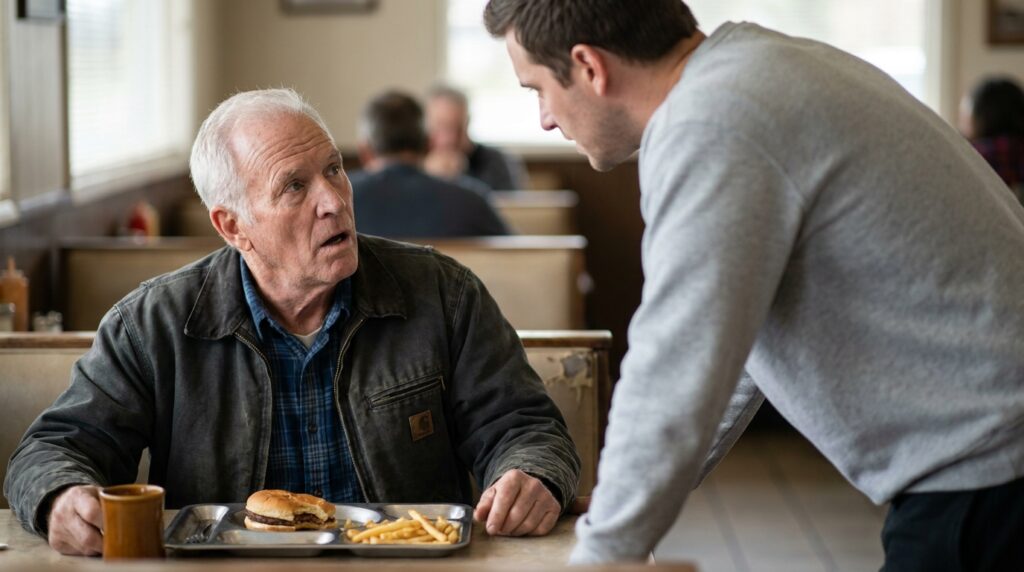
CHAPTER 3: THE WEIGHT OF A BADGE AT MIDNIGHT
The cheap hollow-core wood of the door frame didn’t shatter; it gave way with a dry, splintering crack that sounded like old winter ice snapping over a creek bed.
Marcus didn’t jump from the mattress. He had been sitting on the edge of the springs for two hours, his boots laced tight, his fingers resting light against the ribbed aluminum surface of the canister. When the lock cylinder tore out of the rotted pine frame, sending a small shower of rust-colored dust across the linoleum, Marcus simply pivoted his weight onto his heels. His center of gravity remained perfectly low, his knees bent slightly to absorb the kinetic shock of the floorboards as the door swung wide against the concrete walkway outside.
The beam of a high-intensity tactical flashlight cut through the dark of Room Four first, its glare bouncing off the yellowed window shades and catching the floating dust motes in sharp relief. Behind the light stood a silhouette wrapped in a stiff nylon patrol jacket, the metal snaps along the wind flap clicking against a heavy leather duty belt.
“Don’t reach for the bag, old man,” a voice barked from behind the lens. It wasn’t the youth from the diner. This voice had the jagged edge of bureaucratic exhaustion—thicker, colder, hardened by fifteen years of writing tickets and ignoring county line discrepancies.
Marcus didn’t move his hands toward the duffel. Instead, he dropped the aluminum tube back into the side pocket of his work jacket, his left thumb coming to rest flat against the seam of his plaid shirt. The tremor in his hand was entirely gone now, replaced by the heavy, familiar stillness that always arrived when a room became small and tight.
“The lock was already ruined,” Marcus said. His voice didn’t rise above a low, gravelly drone, matching the steady thrum of the quarry trucks passing half a mile away on Route 9. “You could have knocked.”
The light didn’t waver. It shifted downward, focusing directly on Marcus’s boots, then on the worn cuffs of his dark trousers. A second figure stepped over the broken threshold—a younger man, walking with a pronounced limp that caused his right heel to drag across the green linoleum with a heavy, rubbery rasp. He was wearing a fresh shirt, but the skin around his left cheekbone had already begun to turn the color of an old plum, swollen tight from the impact with the diner pedestal.
“That’s him, Miller,” the kid from the diner spat, his fingers hooking nervously into the belt loops of his jeans. His face was pale under the flashlight beam, his jaw set in a rigid, fragile line that didn’t hide the twitch in his throat. “That’s the bastard who broke my ribs.”
The older deputy—the one named Miller—didn’t draw his sidearm. He left his right palm resting on the molded plastic grip of his holster, his thumb unhooking the leather retention strap with a soft, metallic click that echoed clearly against the cinderblock walls. He used his left hand to lower the flashlight beam, allowing the ambient glow to illuminate his own face. His eyes were small, rimmed with gray grease from the highway air, his jaw thick and weathered like a piece of untanned cowhide.
“You’ve got a habit of making a mess out of a simple lunch, old man,” Miller said, his boots crunching on the loose wood chips near the door. He didn’t look at the kid beside him; his attention remained locked on Marcus’s shoulders, measuring the distance between the booth-honed frame and the narrow escape lane of the window. “The boy says you used a weapon.”
“I used his weight,” Marcus replied. He didn’t shift his gaze from the deputy’s badge—a real one this time, five-pointed and stamped from heavy chrome, pinned slightly crooked over the left pocket of the utility jacket. “He didn’t know how to carry it.”
The kid stepped forward, his boots clicking hard against the linoleum, his hand rising to point an index finger within six inches of Marcus’s nose. “You’re done talking, old man. My old man runs this entire valley from the river to the state line. You think you can just dump me on the floor of a diner and walk away into a thirty-dollar motel room?”
Marcus didn’t flinch from the finger. He noticed the small, silver-plated token from the diner floor was missing from the kid’s sweatshirt now, likely tucked back into a glove box or an office drawer at the courthouse. He also noticed that Deputy Miller’s expression hadn’t changed at the mention of the sheriff. If anything, the older man’s shoulders dropped half an inch—not with pride, but with the heavy, unglamorous burden of a man who spent his nights clearing up the structural failures of his superior’s bloodline.
“Get the bag, Jimmy,” Miller said quietly, his voice cutting off the youth’s tirade without a glance. “Go sit in the truck.”
“The hell I am,” the kid muttered, his fingers tightening. “I want to see him in the back of the cruiser.”
“I said get the bag,” Miller repeated. The cadence of the words was flat, empty of anger but entirely solid, the tone an experienced officer used when the administrative tolerance for an amateur had reached its absolute perimeter.
The kid hesitated, his boots grinding into the lime dust on the floorboards, before he snatched the canvas duffel off the mattress springs. He didn’t look inside. He carried it by the strap, dragging his right foot through the broken doorway and out into the gravel lot, his shadow stretching long and distorted against the pink cinderblock facade of the Willows.
Marcus remained seated, his back straight against the wall. Through the gap in the broken door, he could see the unmarked white utility truck idling on the highway shoulder, its amber parking lights casting two dull, rusted reflections across the stagnant water of the drainage ditch.
Miller waited until the wet crunch of the kid’s boots died out against the slag lot. Then, he reached back with his heel and pushed the splintered door until it clicked against the remaining iron latch, sealing the two of them into the gray, cedar-scented shadow of the room.
“He’s an idiot,” Miller said, his flashlight finally cutting out, leaving the room to the dim orange wash of the highway lights outside. “But he’s the sheriff’s idiot. And that means you’re an administrative problem for me until the morning shift comes on.”
Marcus let his fingers drift back to the seam of his dark jacket, his thumb tracing the faint, rectangular ridge of the government stencil hidden inside the lining. “An administrative problem usually has a price, Deputy. I left twenty on the table for a burger I didn’t finish.”
“The burger’s paid for,” Miller said, his boots shifting slightly on the linoleum. “But the sheriff’s boy has an eye for things that don’t belong in this valley. He found something else in your car before we walked up here.”
Miller reached into his jacket pocket and pulled out a small, heavy object, dropping it onto the Formica nightstand beside the bed. It landed with a dull, iron-on-wood clatter that made the lamp shade rattle.
Marcus didn’t need the light to know what it was: the spare ignition override block from his sedan’s steering column, its casing stamped with the same high-level military distribution codes as the canister in his pocket. The decoy secret was out—they thought they had caught a high-value thief or a disgraced black-market runner with government clearance. They didn’t know that the block wasn’t stolen; they didn’t know that touching it had just opened a digital tripwire that was already clearing its path through the federal relays three states away.
“You’ve got until the gravel trucks start rolling at five,” Miller said, his hand dropping back to his duty belt. “After that, the paperwork goes to the county seat, and I stop being the only one looking for you.”








