CHAPTER 8: THE TERMINAL HOLD
The blue spark vanished, leaving the scent of charred copper and vaporized vinyl hanging thick in the rain.
The circuit was dead. The scavenger pump had stopped.
Without the mechanical hum fighting the subterranean hydraulic lift, the silence that fell over the yard was heavy and rotten. Rain beat down in steady, vertical sheets, plastering Arthur’s gray hair to his skull. Under the arches of his bare feet, the earth didn’t just vibrate—it liquefied. Water table sludge, black with forty years of industrial tailings, welled up between his toes like grease.
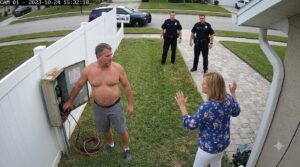
“Arthur, move!” Reyes shouted, lunging forward through the muck. Her hand locked onto the waistband of his cargo shorts, hauling him back from the rim with all the weight of her boots and duty gear.
A sickening shuck tore through the sod.
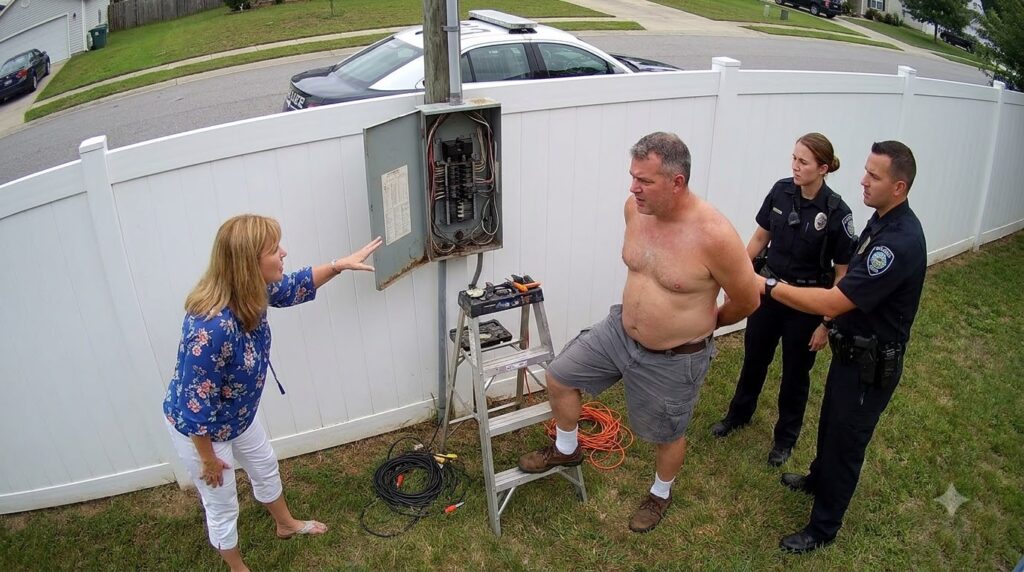
The white fence post—the one anchored into the concrete collar right above the creosote timber—dropped straight down. Four inches. Then eight. It didn’t tip; it sank vertically into the mud, swallowed like a wooden stake pushed into grease. The heavy gray electrical enclosure went down with it, the unlatched door flapping violently in the gusts, the open brass padlock clattering against the shattered PVC bracket.
“My retaining wall!” Brenda screamed from the edge of the driveway. She had both hands pressed against her cheeks, her knuckles white with horror.
The five-foot stone terrace collapsed. It did not spill into the yard; the earth behind it simply caved inward. A hundred fieldstones, laid thirty years ago to frame her prize hydrangeas, tumbled into the open mouth of the void with a series of muffled, wet thuds. The rose bushes went next, their roots whipping through the mud before disappearing into the black throat of the drift.
“Get behind the patrol car, both of you!” Briggs bellowed from the street. He was waving his arms wildly, his boots planted on the crowned centerline of the asphalt where the pavement hadn’t yet begun to bow. “The main is buckling! The whole curb is going!”
Arthur didn’t run toward the car. He wrenched himself out of Reyes’s grip, spinning back toward the aluminum stepladder.
“Arthur, leave it!” Reyes yelled, water streaming down her face, cutting pale tracks through the clay splatters on her cheeks. “There’s nothing you can patch! That header’s gone!”
“The key!” Arthur rasped, his voice raw, stripped down to bare gristle. He pointed a trembling, grease-blackened finger at the stepladder.
The aluminum frame was tipping, its rear legs sinking deep into the slurry trench. Suspended from the top tool tray by its loop of wet twine, the rusted brass key—the key stamped BORO PUB WKS 1974—was sliding across the grooved metal, inches from the precipice.
Arthur didn’t lunge for the ladder. He stopped, his bare feet sliding in the mud, his chest heaving as the cold rain lashed against his bare ribs.
He looked at the key. He looked at the white privacy fence he had built, measured, and defended for three decades.
The fence wasn’t a boundary line. It had never been a boundary line. It was an iron curtain, a cosmetic shield erected by county clerks and shell contractors to ensure two working people spent thirty years paying property taxes on a poison ditch. He had spent six years of nights kneeling in the dirt, breathing sewer gas, running hot wires and salvage clamps just to keep two split-level houses from cracking in half—all so the bank wouldn’t find out, so the town wouldn’t put up yellow tape, so his life’s labor wouldn’t be declared zero dollars on a foreclosure auction block.
Beside him, Reyes caught up, her chest heaving, her service weapon pinned securely against her hip as she took hold of his forearm with both hands.
“Arthur,” she said, her voice dropping below the roar of the downpour. She wasn’t pulling him anymore. She was just holding him steady against the trembling earth. “Look at the houses.”
Arthur looked up.
On his side of the boundary, the two-car garage had developed a crooked, diagonal fracture running from the lintel to the footer, wide enough to slip a hand through. On Brenda’s side, the glass patio door he had heard about shattered into a thousand spider-web fractures under the torsional twist of the shifting frame.
The ladder went down.
It tipped slowly, gracefully, sliding into the black slurry and vanishing into the subterranean haulage tunnel beneath the cedar footers. The brass key went with it, swallowed by the forty-year-old dark.
Brenda stumbled toward them through the rain, her clothes plastered to her frame, her face completely emptied of rage. She stood shivering beside Arthur, her hand instinctively reaching out and clutching the wet, cold fabric of his bare shoulder.
“Arthur,” she whispered, her teeth chattering so violently the words could barely form. “It’s gone. Everything… it’s all hollow.”
Arthur let his hands fall to his sides. The tension that had held his neck rigid for twenty years, the endless calculation of breaker loads and ground sensors, uncoiled from his spine like a snapped spring. The C-clamp slipped from his numb fingers and sank silently into the churned red clay.
“Yeah, Brenda,” Arthur said, the rain washing the grease and sweat from his tired face into the lawn they had fought over an hour ago. “It’s hollow. It was hollow before we ever broke ground.”
Down at the corner of the cul-de-sac, the wail of sirens cut through the thunder. Red and amber beacons from county emergency trucks strobed through the trees, casting long, fractured shadows across the drowning street.
Officer Reyes didn’t reach for her cuffs. She kept one hand on Arthur’s elbow and the other on Brenda’s trembling shoulder, turning both of them away from the open trench and guiding them through the ruined fescue toward the pavement.
Behind them, the white privacy fence gave one final, dry groan, snapped at the center post, and vanished into the earth.