
CHAPTER 1: THE COMMON POST
“You can’t just work on that fence without asking me first, this is my property too!”
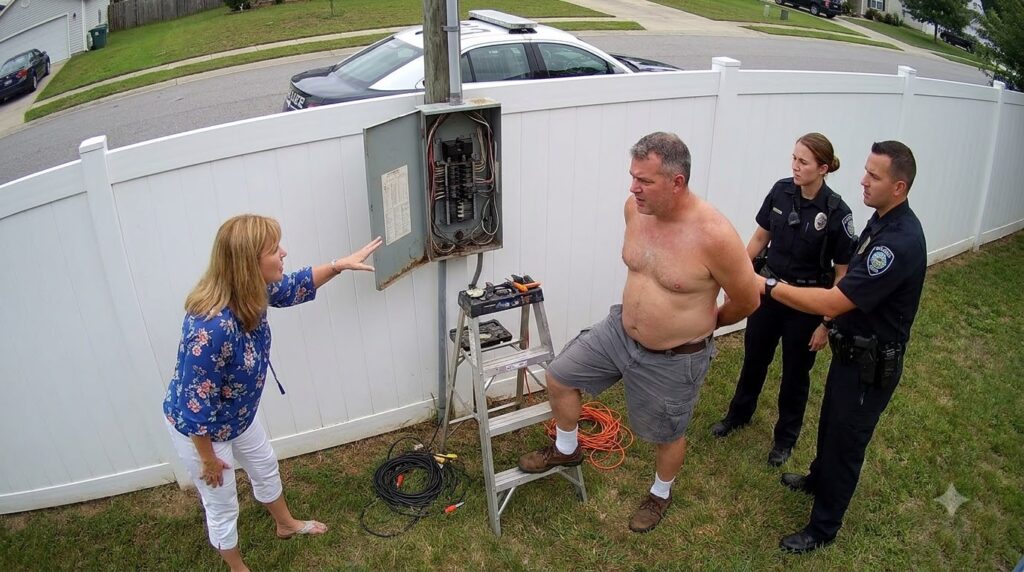
Arthur’s work boot found the bottom rung of the aluminum stepladder, then the dry, sun-baked crabgrass. The metal groaned behind him. Sweat cut pale rivulets through the fine film of zinc oxide and red-clay dust coating his bare shoulders. In his right hand, the insulated pliers felt slick, heavy with twenty years of grease ground into their knurled handles. He did not drop them. Dropping a tool was an admission that someone else owned the tempo.
“It’s mounted on the post,” Arthur said, his voice flat, raspy with the dry heat of mid-afternoon. “The post sits three inches on my side of the survey pin.”
“The easement runs right through the center-line, Arthur! I told you last Tuesday when the sparks came through the rose bed!” Brenda stepped into the open lane of the turf, her white capris catching the harsh glare of the midday sun. Her index finger remained rigidly locked on the dull gray enclosure bolted to the white PVC fence. The box hung open like a split jaw, its innards a tangle of black, red, and split-sheath Romex exposed to the stagnant air. “You didn’t pull a permit. You never pull a permit.”
Behind her floral blouse, a white-and-blue patrol car sat idling against the curb, its tires pressed hard against the cracked asphalt edge. The engine hummed with the thin, uneven rattle of an overburdened alternator.
Two doors slammed almost in unison—hollow thuds that flattened the suburban silence.
Arthur shifted his weight, turning his hip slightly to shield the bottom corner of the open box with his shoulder. His ribs ached with the memory of the four-inch lag bolts he’d driven into the fence upright an hour before sunrise.
“Sir, don’t reach back toward that enclosure,” the female officer said, her boots cutting through the fringe of lawn with practiced economy. Her dark duty belt creaked—leather stiffened by sweat and salt. Her brown hair was pinned hard beneath her cap, eyes cataloging Arthur’s bare chest, the copper filings on his forearm, and the open face of the panel. “Step away from the fence, sir, and let us handle this from here.”
Her partner moved in along the arc of the coiled orange extension cord, his hand resting light and flat against the butt of his sidearm without unholstering. He was younger, his uniform shirt dark around the armpits, his expression locked into the blank, procedural neutrality that preceded a citation or an escort.
“He’s been out here since six in the morning,” Brenda snapped, her voice tightening as she backed half a step behind the male officer’s shoulder. “He’s running juice off the mains before the transformer. Check the meter—he bypassed the seal.”
“Step back, ma’am,” the younger officer said without turning his head. “We’ve got it.”
Arthur took half a pace backward, his left heel grazing the base of the stepladder. The brass padlock he’d popped off the enclosure box dangled by its shackle from the lower hinge, swinging like a lead weight in the muggy air. He kept his hands open, palms down at waist level. The metal jaws of the pliers dangled toward the sod.
Then the female officer stepped into the clearance between Arthur and the white pickets. Her boot toe stopped two inches from the fresh earth where Arthur had dug out the foundation run. She paused, her flashlight beam flicking on despite the sun, cutting straight into the dark interior of the opened junction box.
Past the spliced copper and the cracked porcelain caps, a length of heavy lead-jacketed wire—uninsulated, stamped with a tarnished brass seal from a county water board that hadn’t existed since 1974—was wedged directly into the concrete base of Brenda’s retaining wall.








